
Merchants imported and exported a variety of commodities, building eastern port cities into thriving commercial centers and encouraging the development of domestic trade networks in outlying areas. To counteract the risk involved in overseas trade, merchants developed safeguards, such as marine insurance companies, which spread out financial risk and offered investment opportunities. Overseas trade, however, linked merchants' commercial interests to international politics. Embargoes and the vagaries of foreign wars often hindered merchants' ability to gain access to markets.
Theodore M. Apple, Guager & Cooper. Chromolithograph. Philadelphia: Herline & Hensel, [1858].
The wharves of major port cities were lively places. But trade was not possible without barrels, crates, and other containers to transport commodities. Theodore M. Apple's company, a particularly successful nineteenth-century operation, filled orders for both ordinary and custom-made barrels of all sizes.
A Merchants Counting House. [Alexander] Lawson. Engraving. Philadelphia: T[homas] Dobson, ca. 1795-1805.
The upper portion of this image portrays the expansive nature of commerce in the early republic. Ships, by transporting valuable cargo from port to port, brought goods to cities and wealth to merchants. Here, such vessels populate the water and are observed by two well-dressed gentlemen (who also espy a mermaid) as workers nail barrels nearby.
Below is the interior of, most likely, Stephen Girard's counting-house. A large Palladian window, wall-mounted pigeon-hole cabinets, and an open hearth make this the model of civility and order. The clerks, who sit in a central work area diligently keeping accounts in ledger books, oversee the payments of debts by city retailers and merchants with whom Girard did business.
Rendered by Thomas Dobson, a Scottish stationer and publisher working in Philadelphia, this engraving would have covered a blank book, its new owner inscribing his name inside the open cartouche.
Grigg Block, North Fourth Street, Philadelphia. William H. Rease. Chromolithograph. Philadelphia: F. Kuhl, [1848].
Urban commercial districts were very active places where diverse people bought, sold, and distributed merchandise. Cartmen guided laden wagons through city streets, taking goods from ship to shop. Proprietors arranged these latest offerings - announced in newspaper and broadside advertisements - to appeal to the shopper.
This Philadelphia example shows an active block named after Grigg, Elliot & Co., the largest and most prosperous publishing firm in the city. Founded by John Grigg in 1823 and purchased by J. B. Lippincott in 1849, the business anchored a series of stores selling everything from hardware to hats.
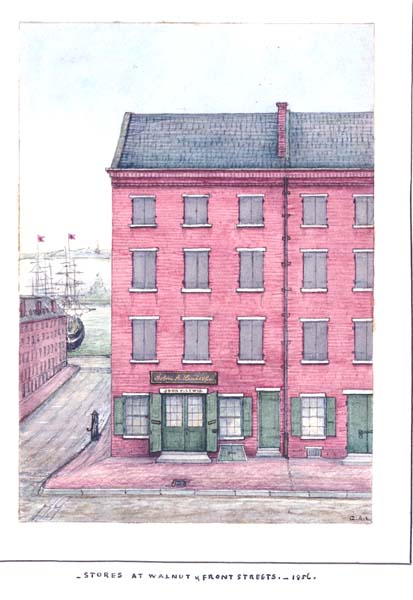
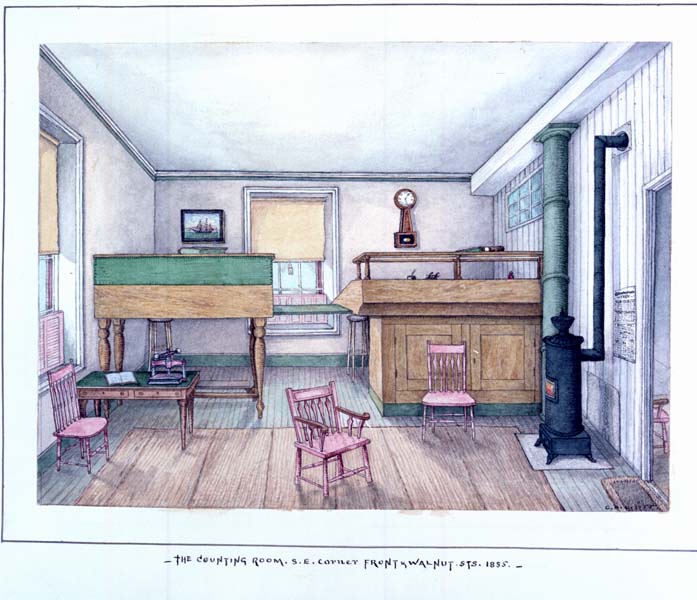
Watercolor illustrations by George Albert Lewis from the album titled, "The Old Houses and Stores with Memorabilia." Philadelphia, 1900.
"A Corner of the Old Store, Front & Walnut Streets."
"The Counting Room. S. E. Corner Front & Walnut Sts. 1855."
John F. Lewis (1791-1858) was a prosperous Philadelphia merchant involved in the China trade. The Lewis business, which dispatched supercargoes to the Far East to collect teas, silks, and porcelain for the domestic market, flourished in the early nineteenth century. His son George (1829-1915) painstakingly recorded the Lewis family history in a series of albums which he filled with text and original watercolor illustrations, shown here and in reproductions on the wall to the right. The Lewis counting house sat at the corner of Walnut and Front Streets, in close proximity to the many ships offloading cargo.
![Theodore M. Apple, Guager & Cooper. Chromolithograph. Philadelphia: Herline & Hensel, [1858].](images/apple.jpg)
![A Merchants Counting House. [Alexander] Lawson. Engraving. Philadelphia: T[homas] Dobson, ca. 1795-1805.](images/girards_counting_house.jpg)
Website Site Design by Nicole H. Scalessa, IT Manager & Reference Librarian. Send Questions or Comments to [email protected]. All Rights Reserved.