Library Company share #2 was first issued to Thomas Hopkinson (1709-1751) on November 10, 1731.
Hopkinson was a merchant and a lawyer, but he was also known for his interest in science. Hopkinson served as judge of the vice-admiralty for the province of Pennsylvania. As a merchant, he worked in partnership with William Coleman (1704-1769) to import and sell a wide variety of goods.[i]
By 1731, Hopkinson was obviously acquainted with Benjamin Franklin and his fellow Junto members. That group drew up “Articles of Agreement” on July 1, 1731 to found a library, and Hopkinson signed the agreement and was among the first group of shares issued four months later. These subscribers each invested forty shillings and “promised to pay ten shillings a year thereafter to buy books and maintain a shareholder’s library.”[ii]
Hopkinson was also named in the Library Company’s founding document as one of its first directors, and he was responsible for placing the Library Company’s first order of books during his trip to England in the spring of 1732.[iii]
Hopkinson served for a total of fourteen years as a Library Company director. He was also an active Mason, and when the American Philosophical Society was founded in 1743, Hopkinson served as its first president.[iv]
Hopkinson passed away in 1751, but his Library Company share apparently remained with his estate for the next eleven years. Hopkinson’s widow Mary Hopkinson finally transferred the share to their son, Francis Hopkinson (1737-1791), on January 29, 1762.
In an interesting quirk, son Francis had already been serving as the Secretary of the Library Company for three years by the time he became the named shareholder. He recorded his mother’s transaction in his official capacity as Library Company Secretary.
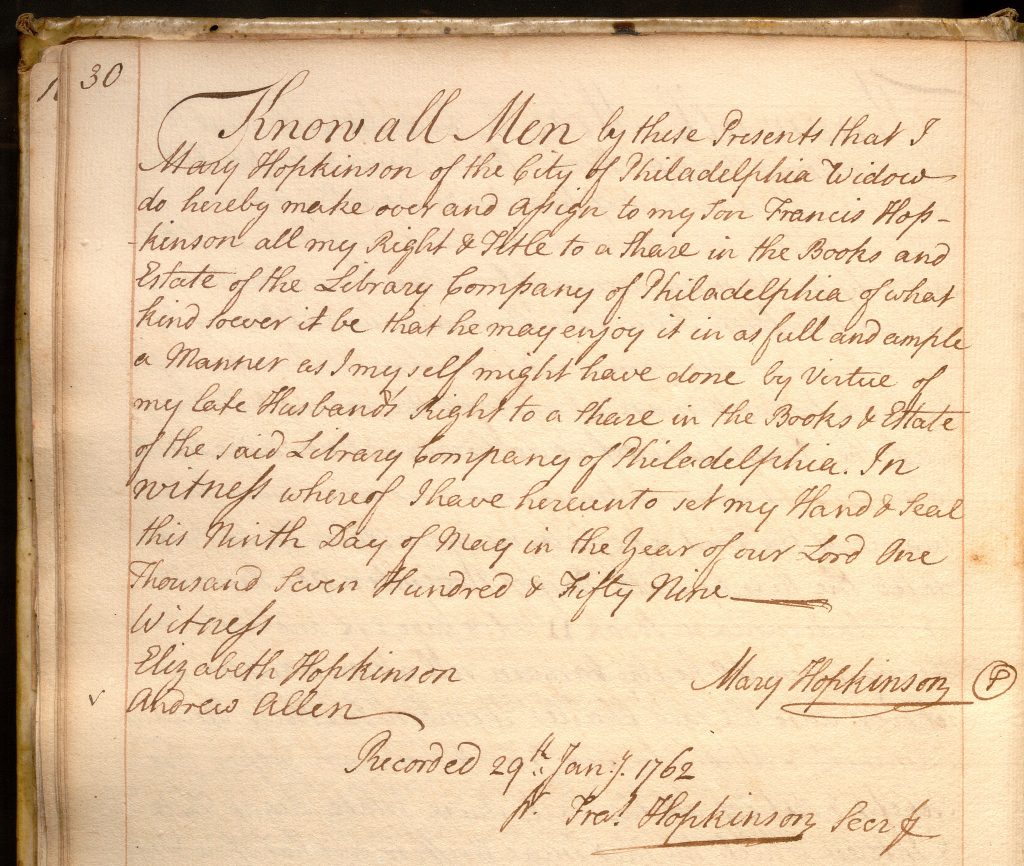
Image: Francis Hopkinson is listed as the new owner of share #2 in this transaction record, which Francis also signed in his capacity as Library Company Secretary. Detail from Share Record Book A, volume 171, Library Company of Philadelphia records (MSS00270).
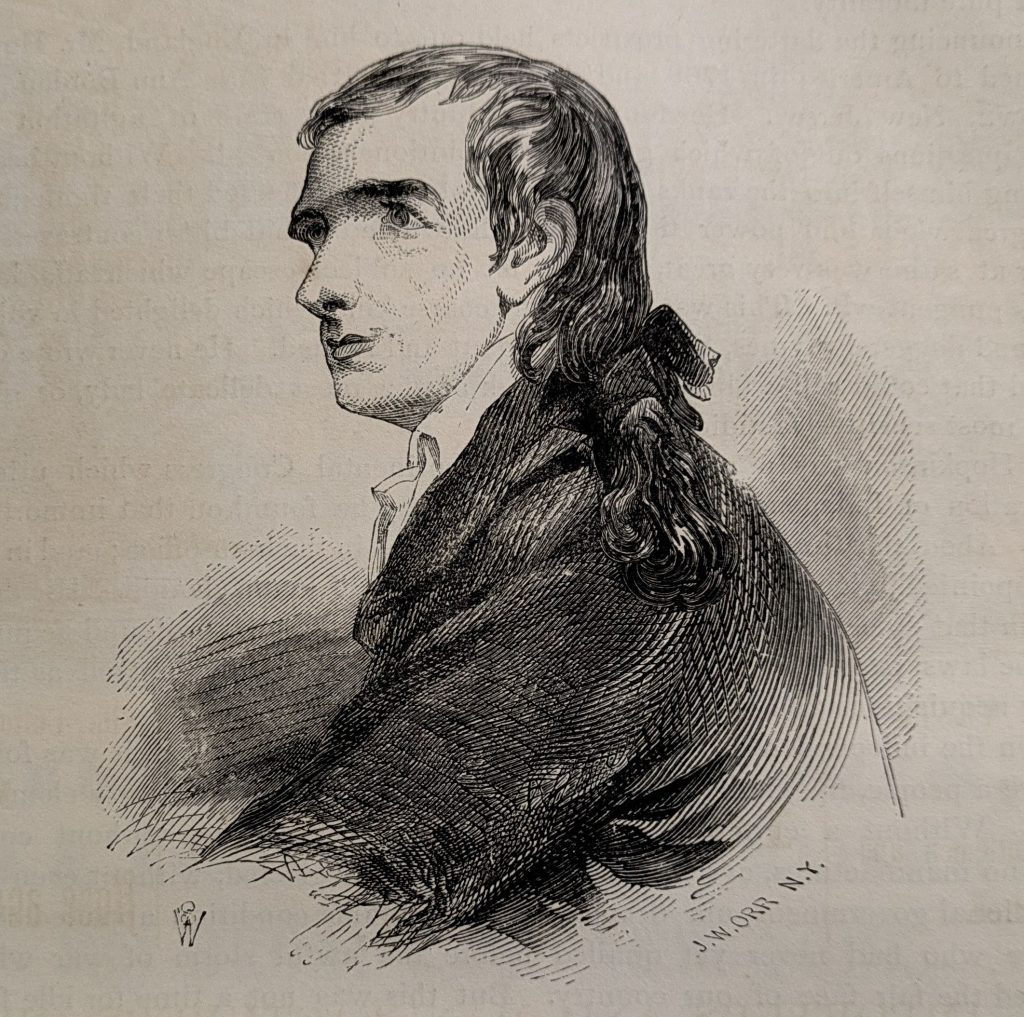
Image: Portrait of Francis Hopkinson from A. D. Jones, The Illustrated American Biography (Philadelphia, 1854).
Francis was a member of the first class from the College of Philadelphia (now University of Pennsylvania) in 1757. He served as Secretary of the Library Company from 1759 to 1768, and also served as Librarian from February 1764 to May 1765. Meanwhile, he studied law and served in several provincial roles until he resigned in 1776 in support of the American Revolution.[v]
By then, Francis and his family were living in his wife’s large family home in Bordentown, New Jersey. Francis is credited as being a signer of the Declaration of Independence for New Jersey, and he was elected as a New Jersey delegate to the Continental Congress in 1778. Later, he served as a member of the Constitutional Convention of 1787. He is also credited as one of the designers of the first flag of the United States and the Great Seal of the United States.[vi]
Francis was also an author, satirist, and composer. His 1757 composition, “My Days Have Been So Wondrous Free,” is often credited as being the first secular musical composition by an American composer.[vii]
After Francis’s death, his son and executor Joseph Hopkinson (1770-1842) purchased the share for himself on October 4, 1813.
Joseph too was a lawyer, and he had served on several high-profile cases in Philadelphia by the time he became a Library Company shareholder.
The year after he acquired share #2, Joseph was elected as a U.S. Representative for Pennsylvania, and served two terms from 1815 to 1819. Later he served as a New Jersey Assemblyman, and as a District Court judge for the Eastern District of Pennsylvania.[viii]
Joseph also served as chairman of Pennsylvania’s constitutional convention of 1837. Among other changes, the new Constitution ended Black voting rights in the Commonwealth.[ix]
After Joseph’s death, his son and estate administrator Francis Hopkinson (1796-1870) acquired the share for himself on June 7, 1844.
The younger Francis maintained Library Company share #2 for the rest of his life, but Library Company records provide no further information about him. His son and executor Thomas Biddle Hopkinson eventually sold the share to the “rector, wardens, and vestrymen” of Christ Church on January 6, 1882.
Christ Church had served a central role in Philadelphia life since its founding in 1695, and first owner of share #2 Francis Hopkinson had been among its early members.
Share History:
- Thomas Hopkinson (1709-1751), acquired share #2 on November 10, 1731
- Francis Hopkinson (1737-1791), acquired on January 29, 1762
- Joseph Hopkinson (1770-1842), acquired on October 4, 1813
- Francis Hopkinson (1796-1870), acquired on June 7, 1844
- Christ Church, acquired on January 6, 1882
Shareholders who acquired this share after 1950 are not displayed for privacy reasons.
Learn more about Library Company shareholding today.
[i] “Thomas Hopkinson 1709-1751,” University Archives and Records Center, Penn Libraries, https://archives.upenn.edu/exhibits/penn-people/biography/thomas-hopkinson/ (accessed 8/9/2024).
[ii] “At the Instance of Benjamin Franklin”: A Brief History of the Library Company of Philadelphia (Philadelphia, 2015), 5.
[iii] March 31, 1732 minutes, Directors Minutes Volume 1, volume 163, Library Company of Philadelphia records (MSS00270).
[iv] “Thomas Hopkinson 1709-1751,” University Archives and Records Center, Penn Libraries, https://archives.upenn.edu/exhibits/penn-people/biography/thomas-hopkinson/ (accessed 8/9/2024).
[v] “Francis Hopkinson 1737-1791,” University Archives and Records Center, Penn Libraries, https://archives.upenn.edu/exhibits/penn-people/biography/francis-hopkinson/ (accessed 8/9/2024).
[vi] “Francis Hopkinson, 1737-1791,” Library of Congress, https://loc.gov/item/ihas.200035713 (accessed 8/9/2024). Finding aid for Hopkinson family papers (collection 1978), The Historical Society of Pennsylvania. “Francis Hopkinson House, Bordentown City,” Delaware River Heritage Trail, https://delawareriverheritagetrail.org/2021/09/13/francis-hopkinson-house-bordentown-city/ (accessed 8/9/2024).
[vii] Finding aid for Hopkinson family papers (collection 1978).
[viii] “Hopkinson, Joseph 1770-1842,” Biographical Director of the United States Congress, https://bioguide.congress.gov/search/bio/H000784 (accessed 8/9/2024).
[ix] For more on the new Pennsylvania Constitution, see Christopher Malone, “Rethinking the End of Black Voting Rights in Antebellum Pennsylvania: Racial Ascriptivism, Partisanship and Political Development in the Keystone State,” Pennsylvania History: A Journal of Mid-Atlantic Studies, vol. 72, no. 4 (Autumn 2005), 466-504.