Library Company share #3 was first issued to Benjamin Franklin (1706-1790) on November 10, 1731.
Franklin was a printer, author, inventor, scientist, politician, and diplomat, among other things. In 1727, he had joined with eleven others in Philadelphia to form the Junto, a discussion and networking club. A few years later, he and his fellow Junto members drew up “Articles of Agreement” on July 1, 1731 to found the Library Company of Philadelphia.
Franklin was among the first group of shares issued four months later, but he did not claim share #1. That honor went to Robert Grace (d. 1766). Each of the Library Company’s subscribers invested forty shillings and “promised to pay ten shillings a year thereafter to buy books and maintain a shareholder’s library.”[i]
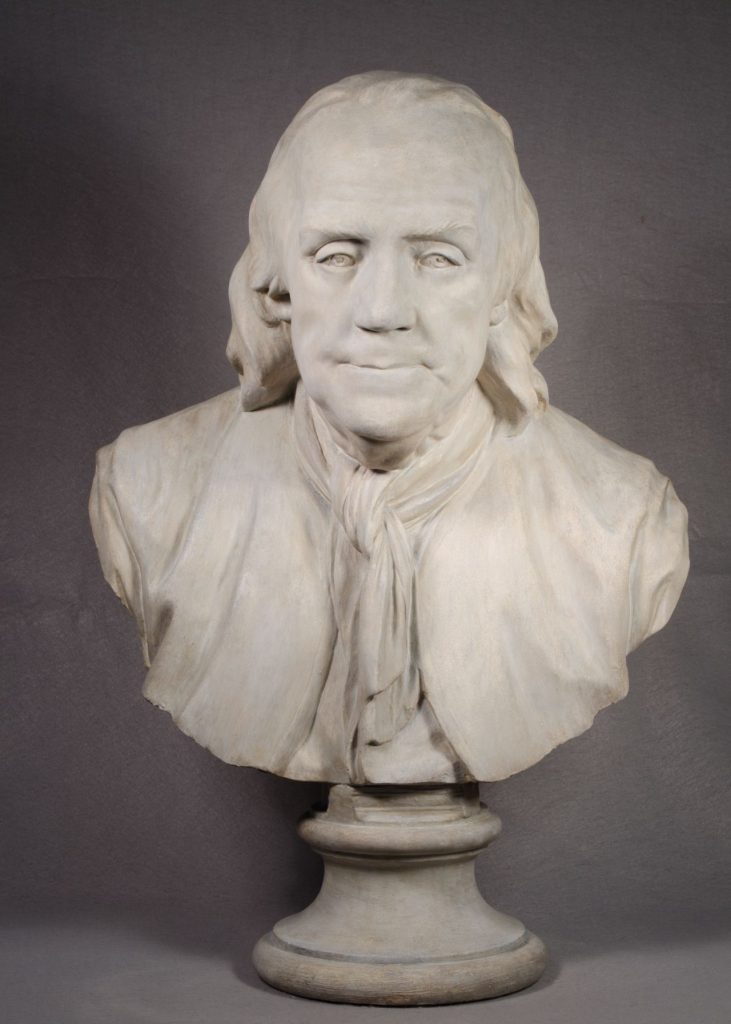
Image: Jean-Jacques Caffieri, Benjamin Franklin. Plaster. Gift of Walter Franklin, 1805. Photograph courtesy of Linda Lennon Objects Conservation.
Franklin was also named in the Library Company’s founding document as one of its first directors, and he served in that role for a total of twenty-eight years between 1731 and 1763.
He stepped in to serve as Librarian from December 10, 1733 to March 11, 1734, and he served as Secretary for more than ten years from 1746 through 1756. Unfortunately, many of the minutes Franklin recorded as Secretary had been lost by 1759, when Secretary Francis Hopkinson (1737-1791) took over the record-keeping.
Franklin also helped found many other institutions in Philadelphia, including the Union Fire Company, the American Philosophical Society, the Philadelphia Contributionship insurance company, and Pennsylvania Hospital.
By 1750, Franklin was a slave owner, and had certainly profited by printing slavery-related advertisements in his newspaper. When he moved to London in 1757 to serve as a colonial agent for the Pennsylvania Assembly, he is known to have brought two enslaved manservants with him.
Franklin remained in London for much of the next sixteen years. While there, he sometimes acted as book agent for the Library Company and sent shipments of books back to Philadelphia.[ii]
He returned to Philadelphia in 1775, served as a delegate in the Second Continental Congress, served on the committee to draft the Declaration of Independence, and then signed the Declaration. He moved to France from 1776 to 1785, first working to gain French support for the American Revolution and then serving as the new nation’s first ambassador.
Franklin returned to Philadelphia as an elder statesman. He was elected to be President of the Supreme Executive Council of Pennsylvania, and also served as a delegate to the Constitutional Convention. At the end of his life, he spoke out publicly against slavery.
In his final years, he was honored in two prominent public ways in the Library Company’s first building at 5th and Library Streets.
The building’s 1789 cornerstone, installed the year before Franklin’s death, reads in part, “Be it remembered, In Honor of the PHILADELPHIA Youth . . . They cheerfully, At the Instance of BENJAMIN FRANKLIN, One of their Number, INSTITUTED the PHILADELPHIA LIBRARY…” In 1792, Library Company shareholder and Director William Bingham (1752-1804) commissioned a larger-than-life sculpture of Franklin for a niche about the library’s front door.
In his will, Franklin gifted share #3 to his grandson, Benjamin Franklin Bache (1769-1798). The Library Company recorded this transfer on May 8, 1790.
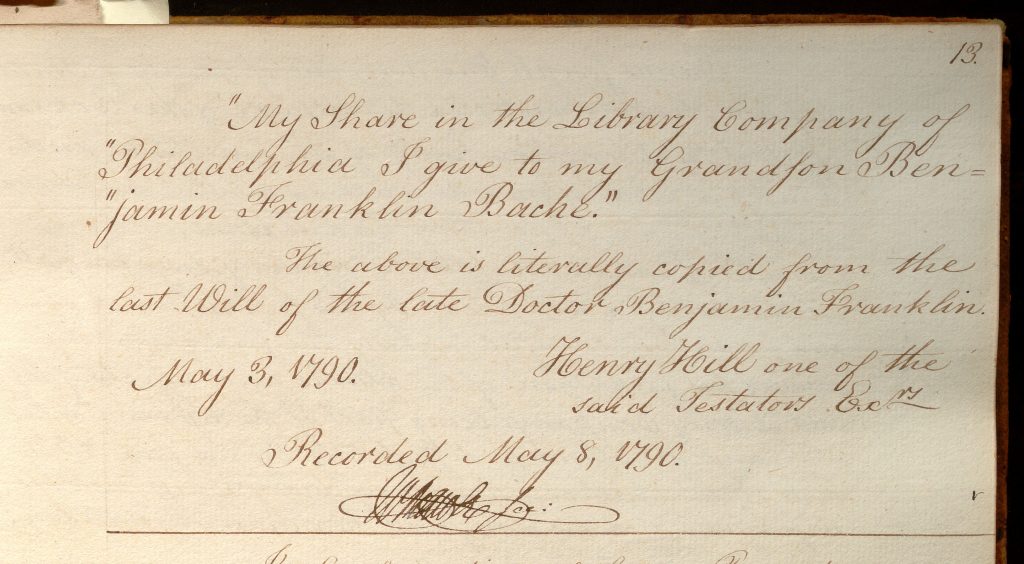
Image: Detail from Share Record Book B, volume 172, Library Company of Philadelphia records (MSS00270).
At the age of seven, Bache had accompanied his grandfather on his diplomatic mission to France. He eventually followed Franklin into the printing business, and his Aurora newspaper became an influential anti-Federalist voice during the 1790s.[iii]
The Library Company certainly purchased copies of Bache’s newspapers for the collection, as noted in directors’ minutes. In addition to being a shareholder, Bache gifted several items to the Library Company, including in 1792 the “Machine, which Doctor Franklin first used to make Experiments in Electricity.”[iv]
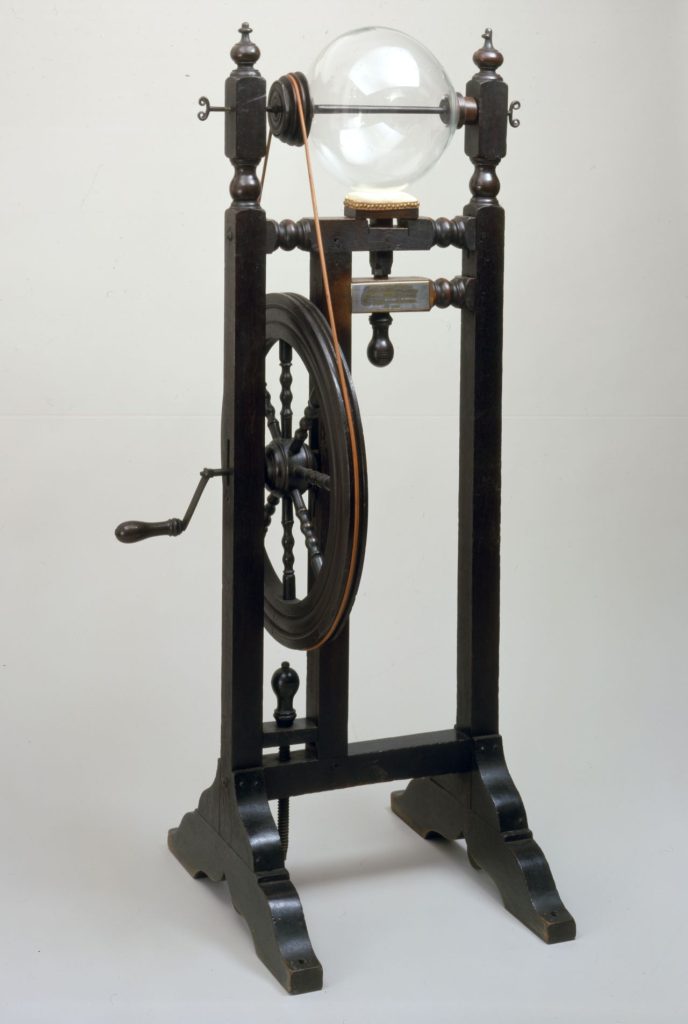
Image: After his grandfather’s death, shareholder Benjamin Franklin Bache gifted this static energy generator to the Library Company. Franklin had used the machine in experiments and demonstrations. Electrostatic Machine. Gift of Benjamin Franklin Bache, 1792.
In 1798, Bache died during a Yellow Fever epidemic in Philadelphia. His widow Margaret Hartman Markoe Bache (1770-1836) continued the newspaper and printing business, eventually marrying his handpicked successor, William Duane (1760-1835).
Margaret and her new husband William apparently maintained the share for the next thirty-four years. However, it appears that her new husband, at least, was not allowed to borrow books. According to attorney Edward D. Ingraham’s 1832 correspondence in support of Duane, “Col. Duane has paid for many years the annual payments upon this share; but the Librarian declines to furnish him with books upon it.” The directors’ minutes from that year do not mention the topic.[v]
Two months after Ingraham’s correspondence, Duane sold the share on May 11, 1832 to his grandson William Duane, Jr. (1808-1882).
The younger Duane had already been a Library Company shareholder for ten years by then. While still a minor, the younger Duane had purchased share #819 from George W. Bartram on June 13, 1821. He then sold that share to “William Duane, Senior” on February 11, 1831. The Library Company’s records provide no further clarification, but since the Library Company typically limited each person to only one share, the buyer of that share was most likely the younger Duane’s father, William John Duane (1780-1865). The next year, in 1832, the younger Duane acquired share #3.
The younger Duane was an attorney and author, and he maintained the share for the next forty years. He sold the share on November 7, 1872 to George A. Wood and Dr. Thomas Hewson Bache (1826-1912), administrators of the estate of Dr. Franklin Bache (1792-1864). (Dr. Franklin Bache was the son of the second shareholder, Benjamin Franklin Bache, and had been dead for eight years at the time of this transfer.) On the same day, the estate resold the share to Dr. Thomas Hewson Bache alone.
Dr. T. Hewson Bache was the son of the preceding shareholder, Dr. Franklin Bache; the grandson of the second shareholder, Benjamin Franklin Bache; and the great-great-grandson of the first shareholder, Benjamin Franklin. He was a doctor, and a co-founder of the Children’s Hospital of Philadelphia.
He apparently maintained Library Company share #3 for the rest of his life. He bequeathed the share to his nephew Franklin Bache (1869-1946) in his will. His nephew was also given all of his “books, excepting those specially bequeathed to others, and including the family Bible of Francis Markoe, all my manuscripts; my share of the Library Company of Philadelphia, known as the Franklin share,” the portrait of Franklin painted by Benjamin West (1738-1820), and many other family treasures “on condition that he pays into my estate the sum of five thousand five hundred dollars.”[vi]
His nephew must have accepted his uncle’s condition, because the Library Company recorded the transfer of the share to nephew Franklin Bache on April 5, 1913.
Franklin Bache was a mining engineer. He had participated in the U.S. Coast and Geodetic Survey of 1890, and later served as manager and/or engineer for several mining companies in Virginia, Pennsylvania, and eventually Oklahoma Territory. He was also an “authority on Franklin lore,” according to his obituary.[vii]
The Library Company’s records show that the share was forfeited in April 1950.
Share History:
- Benjamin Franklin (1706-1790), acquired share #3 on November 10, 1731
- Benjamin Franklin Bache (1769-1798), acquired on May 8, 1790
- William Duane, Jr. (1808-1882), acquired on May 11, 1832
- Estate of Dr. Franklin Bache (1792-1864),acquired on November 7, 1872
- Dr. Thomas Hewson Bache (1826-1912), acquired on November 7, 1872
- Franklin Bache (1869-1946), acquired on April 5, 1913
Shareholders who acquired this share after 1950 are not displayed for privacy reasons.
Learn more about Library Company shareholding today.
[i] “At the Instance of Benjamin Franklin”: A Brief History of the Library Company of Philadelphia (Philadelphia, 2015), 5.
[ii] For just one example, see the April 29, 1774 minutes, Directors Minutes Volume 2, volume 164, Library Company of Philadelphia records (MSS00270).
[iii] Independence National Historical Park, “Benjamin Bache,” National Park Service, https://www.nps.gov/inde/learn/historyculture/stories-aurora-bache.htm (accessed 8/14/2024).
[iv] For example, payments to Benjamin Franklin Bache for newspapers are noted in the minutes from November 3, 1791, Directors Minutes Volume 3, volume 165, Library Company of Philadelphia records (MSS00270). Bache’s 1792 gift is noted in the minutes from June 12, 1792, Directors Minutes Volume 3, volume 165, Library Company of Philadelphia records (MSS00270).
[v] Correspondence from Edward Ingraham regarding William Duane’s use of share of Benjamin Franklin Bache (share #3) (7446.F.42), Box 15, Folder 84, Library Company of Philadelphia records (MSS00270).
[vi] Thomas Hewson Bache will in Pennsylvania Probate Record, Wills, No 1598-1626, 1912. Courtesy of AncestryLibrary.com.
[vii] “Franklin Bache Dies at Age of 77,” The Philadelphia Inquirer, September 18, 1946.