Library Company share #4 was first issued to John Jones, Jr. (d. 1762), on November 10, 1731.
Jones was a “cordwainer,” or shoemaker.[i]
In 1727, he joined with Benjamin Franklin (1706-1790) and ten others in Philadelphia to form the Junto, a discussion and networking club. He also joined Franklin in membership with St. John’s Lodge of the Freemans and the Philadelphia Contributionship insurance company.[ii]
Jones joined Franklin and his fellow Junto members on July 1, 1731 to draw up “Articles of Agreement” to found the Library Company of Philadelphia. Jones was among the first group of shares issued four months later. These subscribers each invested forty shillings and “promised to pay ten shillings a year thereafter to buy books and maintain a shareholder’s library.”[iii]
Jones was named in the Library Company’s founding document as one of its first directors, and he served in that role for four years. Another “John Jones” served as a director for four years in the 1740s, but it is unclear from Library Company records whether this was the same person.
Jones apparently enslaved at least six people, but in his will, he detailed that he had already manumitted two, intended to manumit the remaining four at his death, and left annuities for each for the rest of their lives.[iv]
Jones also listed specific books in his will that he wanted to gift to specific relatives, with “the Remainder of all my Books pamphlets and all my Maps” to John Jones and Nathaniel Evans.[v]
He bequeathed his Library Company share to merchant John Learson. The gift was recorded in Library Company records onJanuary 29, 1762.
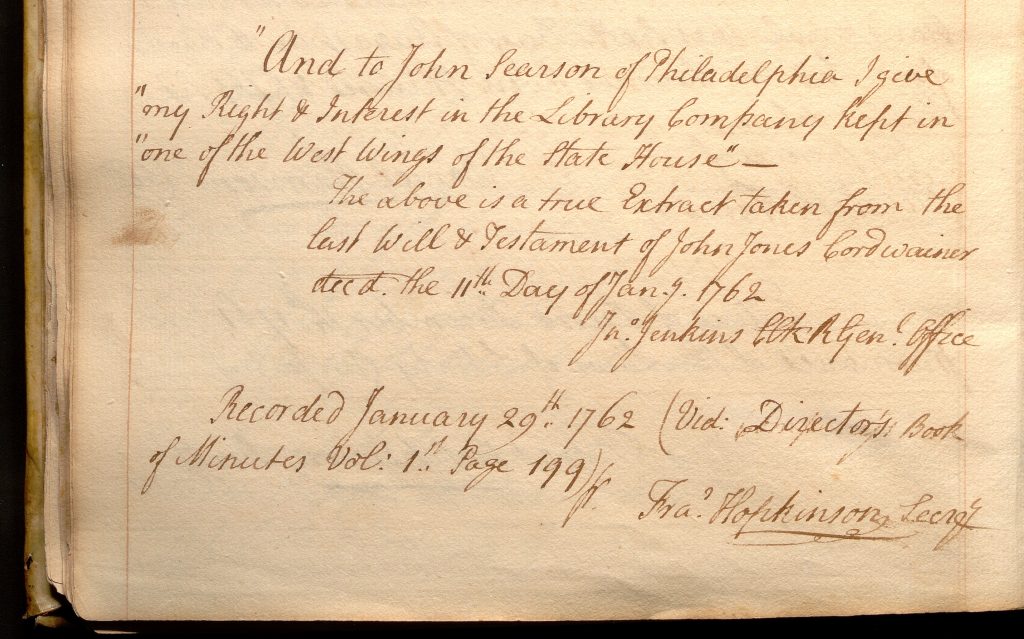
Image: John Learson inherited share #2 in 1762 as a bequest from shareholder John Jones, Jr. Detail from Share Record Book A, volume 171, Library Company of Philadelphia records (MSS00270).
Learson maintained the share for only a year. According to Library Company records, Learson had moved to New York by the time he sold the share to Jeremiah Warder (1711- 1783) on October 13, 1763.
Warder was a wealthy Quaker merchant. He was part owner of at least four ships between 1750 and 1771, and eventually took his sons into partnership with him.[vi]
After his death, noted in Library Company records as the death of “Jeremiah Warder the elder,” one of his executors James Vaux sold the share to George Vaux on June 21, 1813. Executor James Vaux is most likely Jeremiah Warder’s son-in-law, James Vaux (1748-1842), and George a relative of James, but Library Company records provide no further clarity.
The 1813 Philadelphia directory lists George Vaux as an “attorney at law” based on South 4th Street. Given the date the share passed to its next owner, it’s possible the share owner was George Vaux (1779-1836), whose father was James Vaux and therefore the grandson of Jeremiah Warder.
After George’s death, his executors William Smith and William S. Vaux sold the share to William Smith on February 12, 1836.
The 1835-1836 Philadelphia directory lists twenty-five men named William Smith, so it is unclear which one owned Library Company share #4. It’s possible that it was the William Smith who was listed as an attorney at law; a “William Smith” is listed in at least one court decision along with previous shareholder and attorney George Vaux.
Smith eventually sold the share to George Vaux’s son and second executor, William Sansom Vaux (1811-1882), on February 8, 1850.
William Sansom Vaux maintained the share for more than thirty years. William was wealthy enough that he did not have an occupation besides managing the family estates, but he was very interested in science and antiquarianism. He helped found the Academy of Natural Sciences of Philadelphia, as well as the Numismatic and Antiquarian Society of Philadelphia, and remained deeply involved with both organizations. He was elected a member of the American Philosophical Society in 1859.[vii]
William listed extensive bequests in his will, including giving his “mineral and archaeological collection” to the Academy of Natural Sciences; gifting books and science periodicals to the Institute for Colored Youth; $1,000 each to twenty-four different hospitals, asylums, and relief and benevolent societies; and much more.[viii]
After his death, William’s brother and executor George Vaux sold the share to William’s nephew, George V. Cresson (1836-1908), on March 1, 1883.
Cresson was already a Library Company shareholder, having acquired share #365 the year before. But he clearly preferred this family-connected share. He sold share #365 to Caleb Cresson on the same day he acquired share #4.
George V. Cresson was a machinist, and eventually started a business that became one of the largest machine and tool works in the country. He also served as president of the Manufacturers’ Club and was active in the Engineers’ Club, among other activities.
After his death, Cresson’s executors sold the share to his nephew Francis M. Cresson (1867-1945) on June 3, 1909.
The Library Company’s records provide no further information about Francis’ involvement, but his share was listed as “forfeited” by March 1951.
Share History:
- John Jones, Jr. (d. 1762), acquired share #4 on November 10, 1731
- John Learson, acquired on January 29, 1762
- Jeremiah Warder (1711- 1783), acquired on October 13, 1763
- George Vaux, acquired on June 21, 1813
- William Smith, acquired on February 12, 1836
- William Sansom Vaux (1811-1882), acquired on February 8, 1850
- George V. Cresson (1836-1908), acquired on March 1, 1883
- Francis M. Cresson (1867-1945), acquired on June 3, 1909
Shareholders who acquired this share after 1950 are not displayed for privacy reasons.
Learn more about Library Company shareholding today.
[i] George W. Boudreau, “Solving the Mystery of the Junto’s Missing Member: John Jones, Shoemaker,” Pennsylvania Magazine of History and Biography, vol. 131, no. 3 (July 2007), 307-317.
[ii] Boudreau, 311.
[iii] “At the Instance of Benjamin Franklin”: A Brief History of the Library Company of Philadelphia (Philadelphia, 2015), 5.
[iv] Boudreau, 312.
[v] Boudreau, 312.
[vi] Genealogies of Pennsylvania Families from the Pennsylvania Genealogical Magazine, Volume II: Hinman-Sotcher (Baltimore, 1982).
[vii] Philip H. Law, “Obituary Notice of William S. Vaux,” Proceedings of the American Philosophical Society vol. 22, no. 120, Part IV (October 1885), 404-405.
[viii] Chester County, “Exemplification will of William S. Vaux who died May 5th 1882,” Records of Wills, 1850-1924, Book C2-D2, Vol 28-29, 1887-1893. Courtesy of AncestryLibrary.com.