Library Company share #9 was first issued to Philip Syng, Jr. (1703-1789) on November 10, 1731.
Syng was a silversmith in Philadelphia. By 1731, he was obviously acquainted with Benjamin Franklin (1706-1790) and his fellow Junto members. That group drew up “Articles of Agreement” on July 1, 1731 to found a library, and Syng’s was among the first group of shares issued four months later. These subscribers each invested forty shillings and “promised to pay ten shillings a year thereafter to buy books and maintain a shareholder’s library.”[i]
Syng also helped form the first Masonic lodge in Philadelphia, as well as the Union Fire Insurance Company, among others.[ii]
He served as a Director of the Library Company for a total of thirty years, serving on the first board of Directors in 1731 and again from 1734 to 1761. He also made the Library Company’s seal, which had been designed by Franklin.
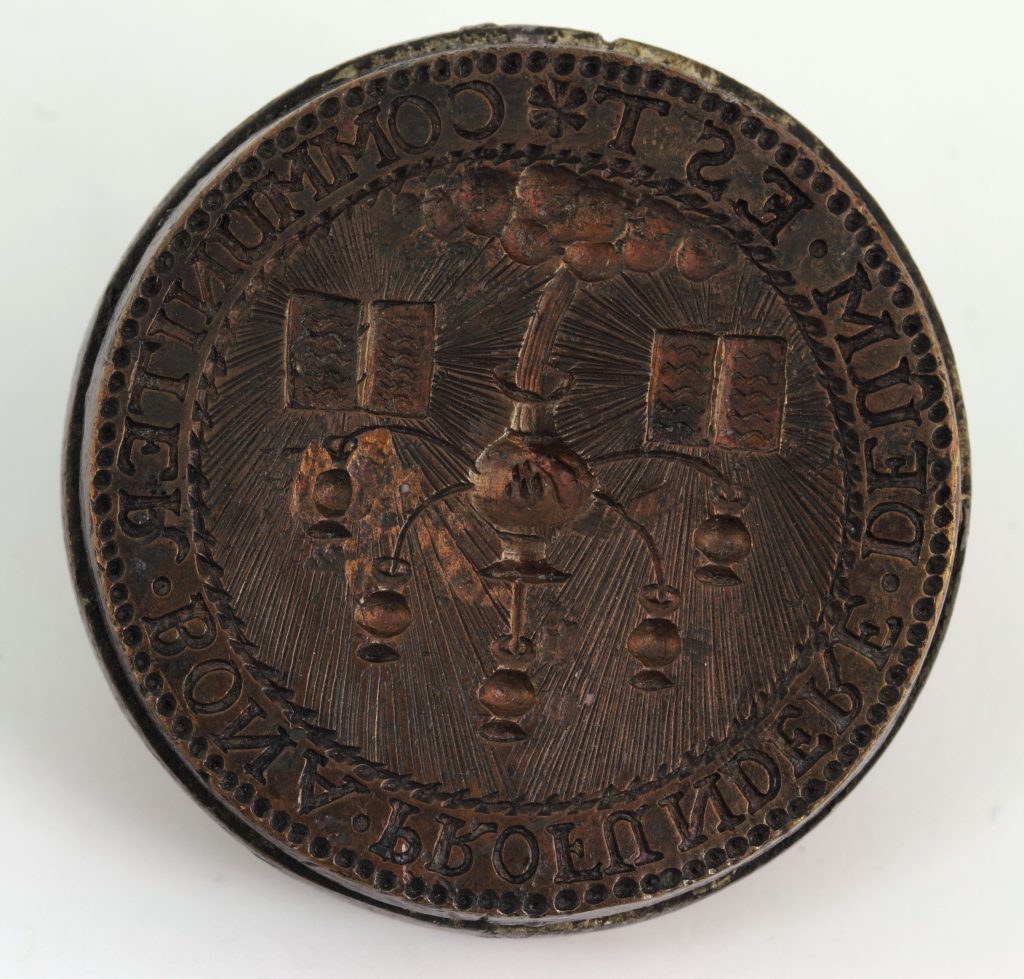
Image: Philip Syng, Seal of the Library Company of Philadelphia (circa 1731-1733). Brass.
Syng apparently shared Franklin’s interest in science and electricity. In 1747, he built a “simple labor-saving portable machine for producing electricity by friction.” He also made the silver inkstand believed to have been used by those who signed the Declaration of Independence and the U.S. Constitution.[iii]
Syng is known to have been an enslaver. He published an advertisement in the Pennsylvania Gazette newspaper in 1748 seeking the return of “a Negroe man, named Cato.” According to the advertisement, Cato “had irons on his legs, and about his neck, but probably has cut them off, as he has done several times before on the like occasion; he generally skulks about this City.” It is unclear what became of Cato, but twenty years later, Syng paid taxes on “2 Negroes.”[iv]
In total, Syng maintained his Library Company share for forty-two years, but finally sold share #9 to his son-in-law Edmund Physick (circa 1726-1804) on May 7, 1773.
Edmund was a colonial agent for the Penn family, and was involved in real estate sales and the collections of “quit rents.” He was also the Keeper of the Great Seal of the province of Pennsylvania.[v]
Edmund maintained his Library Company share for nine years. When he sold the share in 1782, he identified himself as “Edmund Physick of the Township of Blockley.”
He sold the share to his son Henry White Physick (1758-1821) on October 16, 1782.
Henry maintained the share for the rest of his life, and his estate maintained the share for another nine years. Eventually, Edmund Physick and Adriana Physick, Administrators of Henry’s estate, sold the share to Henry’s son-in law, Dr. William D. Brincklé (1798-1862),on June 5, 1830.
The 1830 Philadelphia directory lists a “W. D. and T. R. Brinckle” at 5 Palmyra Square, which is likely now Vine Street. After the cholera epidemic of 1832, Dr. Brinckléwas presented a “massive and beautiful silver vase” from the Board of Commissioners of the Spring Garden District for his “disinterested and efficient services, as Physician in Chief of the Buttonwood Street Hospital.”[vi]
Dr. Brincklé sold the share on August 14, 1835 to Dr. Thomas R. Brinckle (1804-1853), who may have been his brother.
Thomas maintained his Library Company for a decade, but Library Company records provide no other information about him.
Thomas sold the share to Charles H. Rogers on December 5, 1845.
The 1845 Philadelphia director lists a “C. H. Rogers” who was a broker. By 1854, the Philadelphia directory lists C. H. Rogers as president of Trades’ Bank.
Rogers maintained the share for about thirteen years and then sold the share to P. S. P. Conner, administrator of D. Conner, on January 6, 1859. This is no doubt Philip Syng Physick Conner (1837-1910), the great-grandson of the second shareholder, Edmund Physick.
P. S. P. Conner was the son of Commodore David Conner (1792-1856) and Susan Dillwyn Physick Conner (1803-1856).
He apparently inherited his parents’ substantial estate when they died a few months apart in 1856. He spent much of his life engaged in research and writing. He published several pamphlets on the history of the Mexican War and a biography of Sir William Penn (father of Pennsylvania founder William Penn). He also served on the board for the Historical Society of Pennsylvania, was a founder and board member of the Genealogical Society of Pennsylvania, and was an officer with the American Catholic Historical Society.[vii]
Conner lived in Philadelphia, but took over the family’s Maryland summer home known as Octorara Farm, which his mother had inherited from her father, Dr. Philip Syng Physick (1768-1837).
The estate owned share #9 for twenty-five years, and then Conner transferred the share from the D. Conner estate to himself on November 6, 1884.
After his death, his widow and executrix Mary Darch Lewis Conner (1838-1919) sold the share to herself on February 2, 1911. Library Company records provide no further information about Mary. Her brother was the noted artist and art collector Edmund Darch Lewis (1835-1910).
Mary maintained the share for five years and then sold the share to her daughter, Camilla Conner Hale, on June 1, 1916. Library Company records indicate that the share was forfeited just three years later in April 1919.
The Library Company’s Directors reissued it as share #1305 on January 8, 1931, and it was acquired by Jane Bremner Ryan. Library Company records indicate that Ryan forfeited the share in February 1938.
The share was reissued again as share #1532 on March 2, 1939. It was issued to Lawrence E. Jones.
The share was reissued as share #9 by 1997.
Share History:
- Philip Syng, Jr. (1703-1789), acquired share #9on November 10, 1731
- Edmund Physick (circa 1726-1804), acquired on May 7, 1773
- Henry White Physick (1758-1821), acquired on October 16, 1782
- Dr. William D. Brincklé (1798-1862), acquired on June 5, 1830
- Dr. Thomas R. Brinckle (1804-1853), acquired on August 14, 1835
- Charles H. Rogers, acquired on December 5, 1845
- P. S. P. Conner, administrator of D. Conner, acquired on January 6, 1859
- Philip Syng Physick Conner, acquired on November 6, 1884
- Mary Darch Lewis Conner (1838-1919), acquired on February 2, 1911
- Camilla Conner Hale, acquired on June 1, 1916
- Reissued as share #1305, Jane Bremner Ryan, acquired on January 8, 1931
- Reissued as share #1532, Lawrence E. Jones, acquired on March 2, 1939
Shareholders who acquired this share after 1950 are not displayed for privacy reasons.
Learn more about Library Company shareholding today.
[i] “At the Instance of Benjamin Franklin”: A Brief History of the Library Company of Philadelphia (Philadelphia, 2015), 5.
[ii] Dorothy Fea Grimm, “A History of the Library Company of Philadelphia, 1731-1835,” (PhD dissertation, University of Pennsylvania, 1955), 33-36.
[iii] Independence National Historical Park, “Syng Inkstand,” National Park Service, https://www.nps.gov/media/photo/view.htm%3Fid%3DD9B1C27C-155D-451F-67226D0CE7E500F5 (accessed October 9, 2024). Grimm, 30.
[iv] Advertisement, The Pennsylvania Gazette, May 5, 1748. For more on slavery and Syng, see “Pennsylvania: Cato, 1748,” National Park Service, https://www.nps.gov/articles/000/cato-pennsylvania-1748.htm (accessed October 9, 2024).
[v] “Edmund Physick,” Dr. Physick Soda’s Pop, http://drphysick.com/edmundphysick.html (accessed October 9, 2024).
[vi] E. B. Gardette, “Biographical Memoir of William Draper Brinckle, M.D., as Read, on Invitation, Before the Pennsylvania Horticultural Society, March 24th, 1863,” C. Sherman, Son & Co. (Philadelphia: 1863), 28.
[vii] “Philip Syng Physick Conner,” Publications of the Genealogical Society of Pennsylvania vol. IV, no. 3 (March 1911), 383-384.