Library Company share #11 was first issued to Thomas Cadwalader (1707-1779) on November 10, 1731.
Dr. Cadwalader was a prominent physician, politician and civic leader. Born in Philadelphia, Cadwalader received his medical education in Europe before returning to Philadelphia around 1730. One biographer placed him among the handful of physicians in the city inoculating against smallpox at that time.[i]
By 1731, he was obviously acquainted with Benjamin Franklin (1706-1790) and his fellow Junto members. That group drew up “Articles of Agreement” on July 1, 1731 to found a library, and Cadwalader was among the first group of shares issued four months later. These subscribers each invested forty shillings and “promised to pay ten shillings a year thereafter to buy books and maintain a shareholder’s library.”[ii]
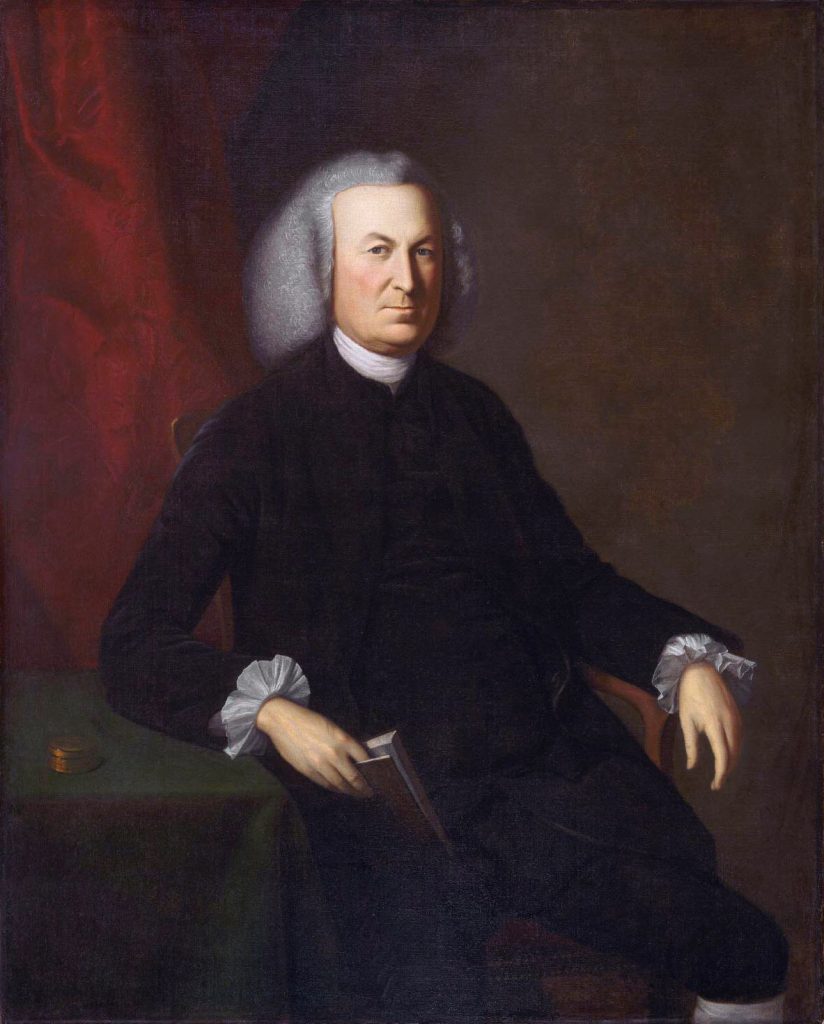
Image: Charles Willson Peale, Dr. Thomas Cadwalader (1770). Oil on canvas. Courtesy of Philadelphia Museum of Art.
Cadwalader also served as a director of the Library Company in 1731, 1733 to 1738, 1752 to 1768, and 1773. [iii]
His father had left behind a substantial estate at his death in 1734, and Cadwalader married Hannah Lambert of New Jersey in 1738. Soon after, he gave up his practice in Philadelphia and moved to Trenton. In 1739, he was appointed a “Commission of Pleas and Peace” for Hunterdon County, New Jersey, but he was also known to serve as physician to N. J. Governor Jonathan Belcher (1681-1757) and probably others. Records show that he also taught other physicians, and he published an important medical essay in 1745 on a condition known as “dry-gripes.”[iv]
Cadwalader is known to have enslaved at least one man named Sam, who escaped in October 1745. One advertisement seeking his return noted that Sam had been “enticed away by one Isaac Randall,” who was an “apprentice” of another. The pair had taken a horse as well, and were believed to be planning to seek work with a privateer in either New York City or Philadelphia.[v]
It is unclear what became of Sam, but Cadwalader paid tax on two enslaved people in 1769.[vi]
Dr. Cadwalader began preparing for a permanent return to Philadelphia in 1749. He stepped down as Burgess in Trenton, and donated 500 pounds to help establish a free library there. By 1754, he had put his substantial NJ properties up for sale.[vii]
Back in Philadelphia, he helped found Pennsylvania Hospital in 1751, and served as one of its physicians until his death in 1779. When the Medical School of the College of Philadelphia was founded in 1765, Cadwalader was elected a trustee. (That college merged with another in 1791 to become today’s University of Pennsylvania.)[viii]
Cadwalader also served as a member of the Common Council of Philadelphia from 1751 to 1774, and served on Pennsylvania’s Provincial Council from 1755 until the Revolution. He was both a strong supporter of military defense during the French and Indian War and a supporter of the American Revolution.
After his death, his estate forfeited his share in May 1782 according to the Library Company’s records, and it then remained dormant until the twentieth century.
Share History:
- Thomas Cadwalader (1707-1779), acquired share #11 on November 10, 1731
Shareholders who acquired this share after 1950 are not displayed for privacy reasons.
Learn more about Library Company shareholding today.
[i] Dulles, Charles Winslow. “Sketch of the Life of Dr. Thomas Cadwalade,” The Pennsylvania Magazine of History and Biography 27, no. 3 (1903): 262-278.
[ii] “At the Instance of Benjamin Franklin”: A Brief History of the Library Company of Philadelphia (Philadelphia, 2015), 5.
[iii] Chronological Share and Directors Register, volume 193, Library Company of Philadelphia Records (MSS00270).
[iv] Finding Aid for Collection 1454 Cadwalader Family Papers, Historical Society of Pennsylvania https://hsp.org/sites/default/files/legacy_files/migrated/findingaid1454cadwaladerpart1.pdf (accessed February 7, 2022).
[v] Advertisement, Pennsylvania Gazette, October 31, 1745.
[vi] Brooke Krancer, “Penn Slavery Project Report,” https://archives.upenn.edu/wp-content/uploads/2018/12/BKrancer_Penn-Slavery-Project-Report.pdf (accessed February 7, 2022).
[vii] Dulles, 272.
[viii] “Thomas Cadwalader 1707-1779,” Penn University Archives & Records Center https://archives.upenn.edu/exhibits/penn-people/biography/thomas-cadwalader (accessed February 7, 2022).