Library Company share #12 was first issued to Joseph Wharton (1707-1776) on November 22, 1731.
Wharton was a merchant. By 1731, he was obviously acquainted with Benjamin Franklin (1706-1790) and his fellow Junto members. That group drew up “Articles of Agreement” on July 1, 1731 to found a library, and Wharton was among the first group of shares issued four months later. These subscribers each invested forty shillings and “promised to pay ten shillings a year thereafter to buy books and maintain a shareholder’s library.”[i]
However, just two years after Wharton acquired his Library Company share, he sold it to John Read on August 16, 1733. This transaction is not recorded in Library Company share records, but it is mentioned in the minutes of the Directors meeting that month.
It is possible that this is John Read, the brother of Franklin’s wife Deborah Read Franklin (circa 1708-1774).
The Library Company’s records provide no further details about Read, other than he remained on the list of shareholders for almost twenty years.
Read’s “assignee” Daniel Benezet sold the share to Jonathan Evans (1714-1795) on August 25, 1752. This transaction was witnessed by Benjamin Franklin, who was serving as Library Company Secretary at the time.
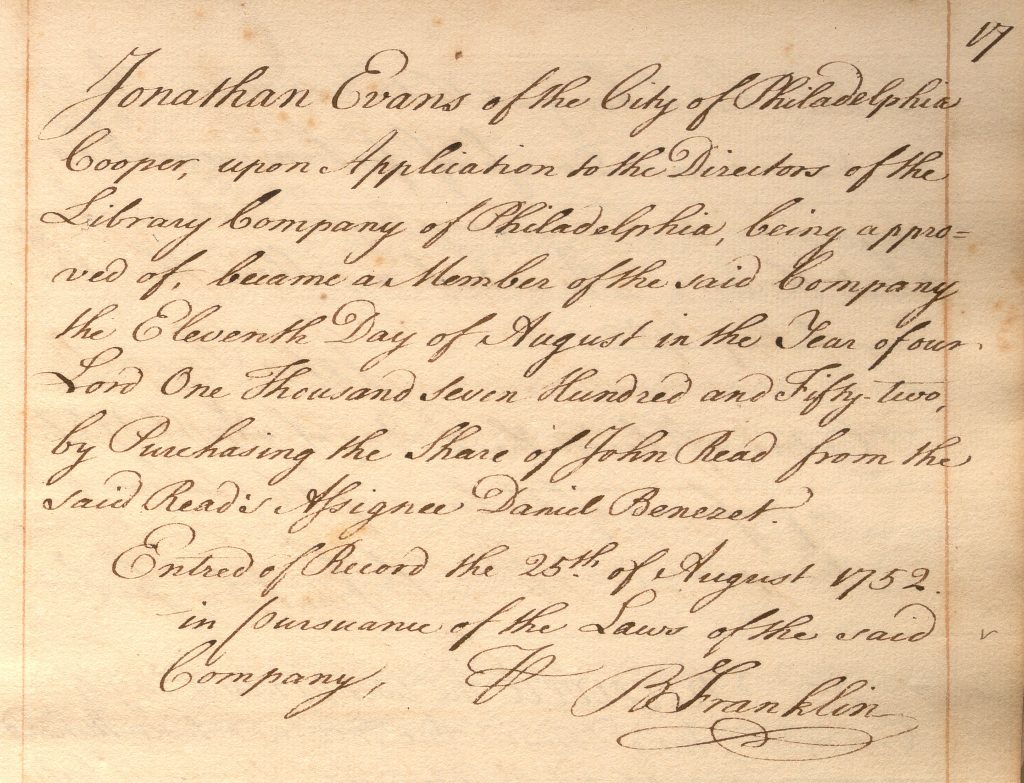
Image: James Read’s “Assignee” Daniel Benezet managed the 1752 share transfer to Jonathan Evans. Detail from Share Record Book A, volume 171, Library Company of Philadelphia records (MSS00270).
Evans too was a merchant. He maintained his Library Company share for twenty-four years until he transferred the share to his son Joel Evans (b. circa 1734) on May 22, 1776.
Joel was a merchant as well. He took over her father’s share #12 during a volatile time in the colonies, and just a few weeks before the Declaration of Independence was issued on July 4, 1776.
Some Philadelphians clearly felt Joel was on the wrong side of the Revolutionary War. Two years after acquiring this share, his name was included in a list of men accused of high treason for aiding the British.[ii]
By 1784, Joel had been living in Kingston, Jamaica for some time, and had been disowned by the Religious Society of Friends for marrying a non-Quaker and having “engaged in a military service with the British Army.” He sent word to the Library Company that he was transferring his share to his brother Jonathan Evans (1759-1839), still in Philadelphia. The transfer was recorded on April 28, 1785.[iii]
Jonathan maintained the share for a decade before he sold it to Benjamin Bryant (d. 1824) on August 19, 1795.
The 1794 Philadelphia directory lists Bryant as a tanner and currier. He maintained the share for twenty-nine years.
By the time of his death, Bryant was living in Abington in Montgomery County, Pennsylvania. His estate administrator Richard M. Shoemaker sold the share to Abel Satterthwaite (1779-1867) on October 13, 1824.
Satterthwaite too lived in Abington in Montgomery County, and he kept the share for only a couple months. He sold the share on December 8, 1824 to Thomas Evans (1798-1868), who was the son of the fifth shareholder Jonathan Evans (1759-1839).
Thomas was a druggist, author, editor and Quaker. He was a member of the group of Quakers who founded Haverford College in 1833, and from 1837 to 1854, he served as editor with his brother William Evans on The Friend’s Library, a compilation of standard Quaker writings. He also authored An Exposition of the Faith of the Religious Society of the Friends (Philadelphia, 1828), among other works.[iv]
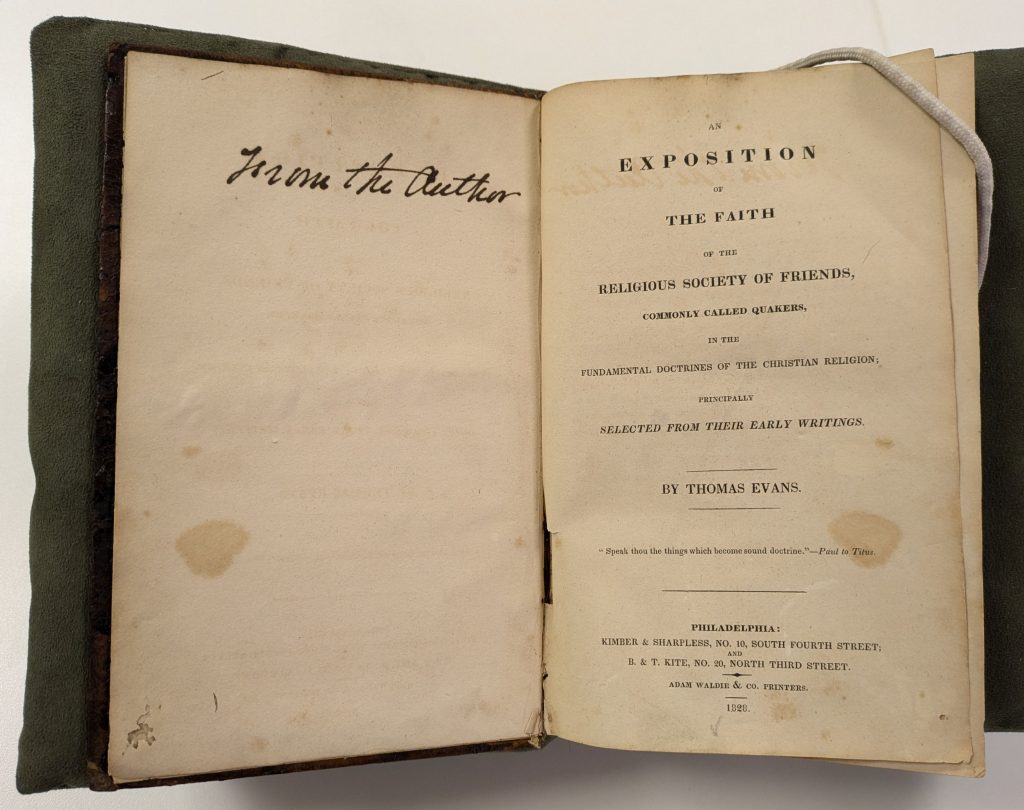
Image: The Library Company’s copy of this 1828 work by shareholder Thomas Evans (1798-1868) was a gift from Evans himself. Thomas Evans, An Exposition of the Faith of the Religious Society of the Friends (Philadelphia, 1828).
Thomas apparently maintained Library Company share #12 for the rest of his life.
After Thomas’s death, his executor and relative Charles Rhoads (1828-1903) sold the share to Thomas’s son John Wistar Evans (1836-1873) on December 7, 1869. More specifically, Rhoads sold the share to J. Wistar Evans as the “trustee of the residuary estate of Thomas Evans.”
J. Wistar maintained the share for a decade.
After J. Wistar’s death, his executors and relatives Jonathan Evans (1843-1911), Thomas P. Cope (1823-1900), and Francis Stokes (1833-1917) sold share #12 to J. Wistar’s sister, Hannah Bacon Evans (1839-1939), on December 4, 1879.
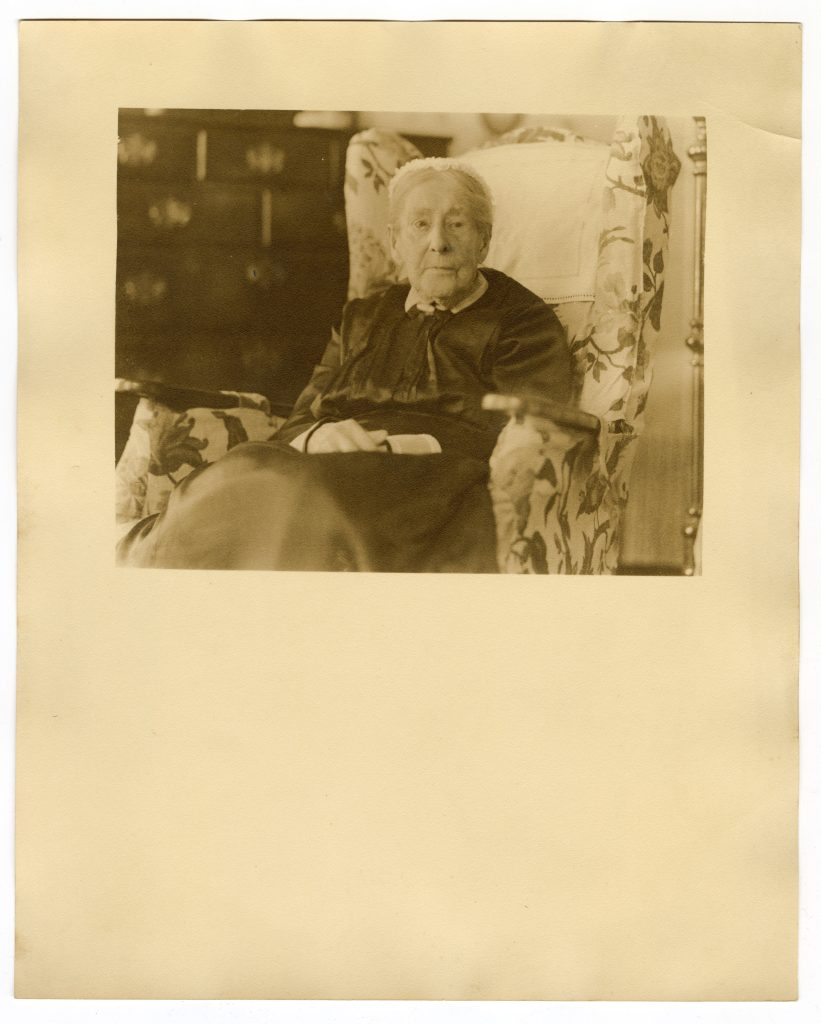
Image: Photograph of Hannah Bacon Evans, Cope-Evans Family Papers, Haverford College Quaker & Special Collections. Courtesy of Haverford College.
Hannah lived to the age of 100, but she owned share #12 only into her 60s.
She sold share #12 to Harold D. Eberlein (1875-1964) on November 1, 1900. Eberlein was a newspaper editor for the Philadelphia Evening Telegraph and the Philadelphia Public Ledger. He was also an antiquarian and author. By the end of his life, he had authored or co-authored more than 50 books and numerous articles about American history, architecture, and interior design, among other topics.
Share History:
- Joseph Wharton (1707-1776), acquired share #12 on November 22, 1731
- John Read, acquired on August 16, 1733
- Jonathan Evans, acquired on August 25, 1752
- Joel Evans (b. circa 1734), acquired on May 22, 1776
- Jonathan Evans (1759-1839), acquired on April 28, 1785
- Benjamin Bryant (d. 1824), acquired on August 19, 1795
- Abel Satterthwaite (1779-1867), acquired on October 13, 1824
- Thomas Evans (1798-1868), acquired on December 8, 1824
- John Wistar Evans (1836-1873), acquired on December 7, 1869
- Hannah Bacon Evans (1839-1939), acquired on December 4, 1879
- Harold D. Eberlein (1875-1964), acquired on November 1, 1900
Shareholders who acquired this share after 1950 are not displayed for privacy reasons.
Learn more about Library Company shareholding today.
[i] “At the Instance of Benjamin Franklin”: A Brief History of the Library Company of Philadelphia (Philadelphia, 2015), 5.
[ii] “A Proclamation by the Supreme Executive Council of the Commonwealth of Pennsylvania,” The Pennsylvania Evening Post, June 25, 1778.
[iii] In 1784, Joel was removed from the Philadelphia Quaker Monthly Meeting for having married in Jamaica to a non-Quaker and having “engaged in a military service in the British Army, contrary to our peaceable principles.” It is unclear if that military service was before or after the Revolution. August 8, 1784 minutes, Minutes of the Monthly Meeting of Friends of Philadelphia for the Southern District, Quaker Meeting Records, Friends Historical Library, Swarthmore College. Many years after his involvement with the Library Company, Jonathan Evans was a key voice in the 1827 separation of Philadelphia Quakers into two splinter groups: “Hicksites” and “Orthodox.”
[iv] James Grant Wilson and John Fiske, eds., Appletons’ Cyclopedia of American Biography, volume II, (New York, 1900), 384. Finding Aid for Thomas Evans Papers, (HC.MC.1324), Quaker & Special Collections, Haverford College, Haverford, PA.