Library Company share #13 was first issued to Nicholas Reddish on November 22, 1731.
Reddish was a saddler and merchant, according to newspaper advertisements from the time. By 1731, he was obviously acquainted with Benjamin Franklin (1706-1790) and his fellow Junto members. That group drew up “Articles of Agreement” on July 1, 1731 to found a library, and Reddish was among the first group of shares issued four months later. These subscribers each invested forty shillings and “promised to pay ten shillings a year thereafter to buy books and maintain a shareholder’s library.”[i]
By 1736, he announced his business partnership with another Library Company shareholder Alexander Paxton (share #23) was ending, but he planned to continue supplying “all sorts of Saddles and Sadlery Ware” and other products at the same shop.[ii]
Reddish sold the share to William Crosthwaite on November 17, 1739.
This is most likely William Crosthwaite (d. 1747), who made “perukes” or a style of wigs popular at that time with long curled hair on the sides and back. Advertisements in the Pennsylvania Gazette newspaper from the 1730s locate Crosthwaite’s shop on Front Street.
However, Crosthwaite was involved in more than just wig-making. Just a few months before he became a Library Company shareholder, Crosthwaite was listed as the contact for “several very likely negro boys, and very good rice by the barrel” from a ship from South Carolina.[iii]
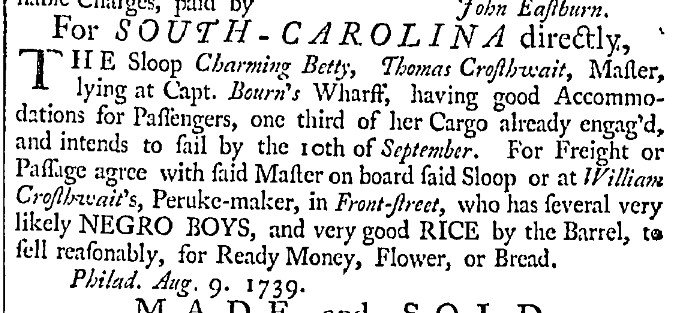
Image: Advertisement, The Pennsylvania Gazette, August 9, 1739.
After Crosthwaite’s death in November 1747, his executor George Orkill published newspaper advertisements noting that Orkill planned to liquidate all of Crosthwaite’s business and personal belongings, including “a young Negroe man, who can shave and dress wigs very well, and a Negroe woman, who can wash, iron, and is a very good cook; also a servant man’s time, who has two years and three months to serve.”[iv]
John Erwin apparently acquired the share either from Crosthwaite directly or from Crosthwaite’s executor, but the Library Company’s records list “no date recorded” for the transaction and provide no further details about Erwin.
John Mease (1746-1826) acquired the share from John Erwin’s estate on November 30, 1769.
The Library Company’s records describe this new owner of the share as “John Mease of Philadelphia merchant.” According to a much later biographical profile, Mease was an original member of the volunteer First Troop Philadelphia City Cavalry, and served throughout the Revolutionary War.[v]
Mease maintained his share in the Library Company for nineteen years. On July 29, 1788, Mease sold his share to his father-in-law, John Miller (1720-1799).[vi]
The Library Company’s records provide no further information about Miller. When he sold the share eleven years later, on November 20, 1799, he sold it to his grandson Dr. James Mease (1771-1846). But Miller also wished to grant “free and equal liberty, from time to time . . . to take out books from the said Library” to two more grandchildren: Thomas C. Mease and Isabella C. Mease (b. 1775), who were James’ siblings.
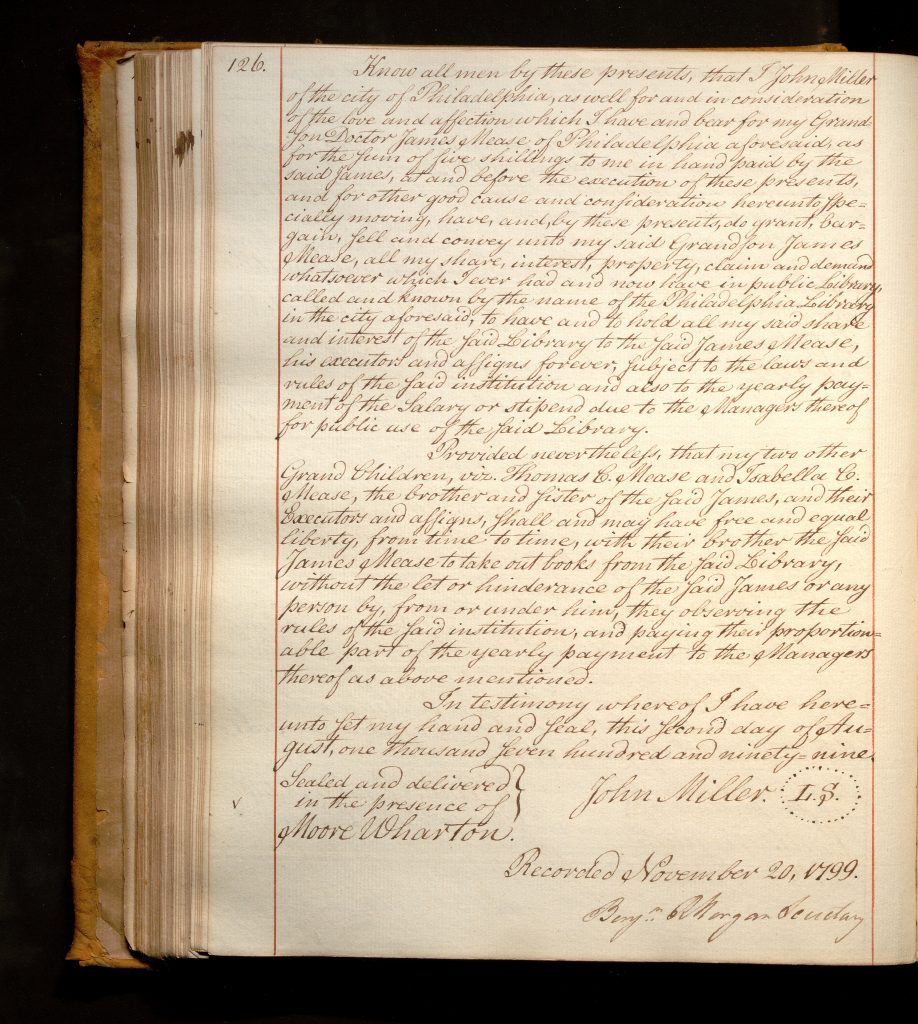
Image: John Miller transferred his share to his grandson Dr. James Mease, but also specified that James’ two siblings, Thomas and Isabella, could have “free and equal liberty, from time to time . . . to take out books from the said Library.” Detail from Share Record Book B, volume 172, Library Company of Philadelphia records (MSS00270).
Dr. James Mease was a physician, scientist, and author with wide-ranging interests. Among other accomplishments, he is credited with inventing tomato catsup.
He also clearly loved books, or at least desired longer hours for accessing them. Fifteen years after acquiring this Library Company share, Mease helped found the Athenaeum of Philadelphia in 1814. He was among the original charter shareholders of that institution, as well as its first vice president.[vii]
Share #13 remained with Dr. Mease’s estate for about twenty-five years after his death, but his sister Isabella Mease (1775-1853) officially acquired the share from the estate on February 8, 1850.
The transfer appears to have been solely to allow Isabella to sell the share. On the same day she acquired it, she sold share #13 to Cecilia Godon.
The Library Company’s records provide no other information about Godon. She maintained the share for the next four years.
Charles Ferguson (1821-1906) acquired the share on August 10, 1854, and maintained it for the rest of his life.
Ferguson made his fortune in coal mines. He and his family lived at 1314 Walnut Street in Philadelphia, and he eventually hired architect Stephen Decatur Button (1813-1897) to build the family a large “cottage” in Cape May, NJ as well.[viii]
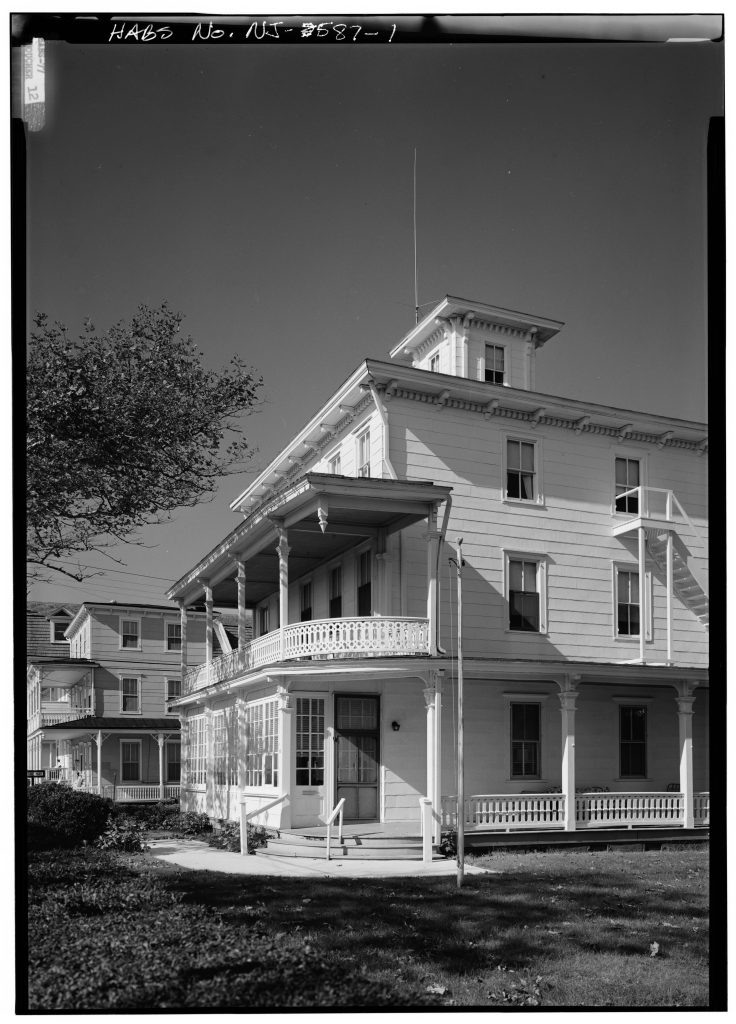
Image: This view of shareholder Charles Ferguson’s Cape May “cottage” shows off its curved second-floor porch and railing. Historic American Buildings Survey, Charles Ferguson House, 101 South Lafayette Street, Cape May, Cape May County, NJ. Courtesy of the Library of Congress.
After Ferguson’s death, his daughter Esther Ferguson Mears (1864-1925) acquired the share on November 5, 1908.
She and her family lived in Philadelphia and in Bar Harbor, Maine. She maintained the share for roughly twenty years until her death. Next, her widower Edward B. Mears (1854-1947) acquired the share on February 2, 1928.
Edward was a lawyer and real estate agent. Library Company records note that his ownership of the share was relinquished on February 4, 1943.
Share History:
- Nicholas Reddish, acquired share #13 on November 22, 1731
- William Crosthwaite (d. 1747), acquired on November 17, 1739
- John Erwin, acquired the share after Crosthwaite but with no date recorded
- John Mease (1746-1826), acquired on November 30, 1769
- John Miller (1720-1799), acquired on July 29, 1788
- Dr. James Mease (1771-1846), acquired on November 20, 1799
- Isabella Mease (1775-1853), acquired on February 8, 1850
- Cecilia Godon, acquired on February 8, 1850
- Charles Ferguson (1821-1906), acquired on August 10, 1854
- Esther Ferguson Mears (1864-1925), acquired on November 5, 1908
- Edward B. Mears (1854-1947), acquired on February 2, 1928
Shareholders who acquired this share after 1950 are not displayed for privacy reasons.
Learn more about Library Company shareholding today.
[i] “At the Instance of Benjamin Franklin”: A Brief History of the Library Company of Philadelphia (Philadelphia, 2015), 5.
[ii] Advertisement, The American Weekly Mercury, May 13, 1736.
[iii] Advertisement, The Pennsylvania Gazette, August 9, 1739.
[iv] Advertisement, The Pennsylvania Gazette, March 1, 1748.
[v] Share Record Book A, volume 171, Library Company of Philadelphia records (MSS00270), 76. James Grant Wilson and John Fiske, eds., Appletons’ Cyclopedia of American Biography, volume IV, (New York, 1900), 284.
[vi] Share Record Book A, 251.
[vii] According to one historian, many founding members of the Athenaeum were also members of either the Library Company of Philadelphia and/or the American Philosophical Society, but “neither of these institutions remained open for extended hours, nor did they specialize in periodicals or books of reference.” Roger W. Moss, “Athenaeum of Philadelphia,” Encyclopedia of Greater Philadelphia, https://philadelphiaencyclopedia.org/essays/athenaeum-of-philadelphia/ (accessed July 29, 2024). For more on Mease, see metadata description of John Neagle (attributed), Mease, Dr. James (1771-1846), oil on canvas, gift of The Philadelphia Society for Promoting Agriculture, courtesy of the Philadelphia Athenaeum http://omeka.philaathenaeum.org/collections/items/show/3119#?c=0&m=0&s=0&cv=0&z=-3143.9187%2C0%2C11801.8375%2C6383 (accessed July 30, 2024).
[viii] “Aged Millionaire Dies in Cape May,” The Philadelphia Inquirer, July 11, 1906.