Library Company share #15 was first issued to Samuel Hale on November 22, 1731.
By 1731, Hale was obviously acquainted with Benjamin Franklin (1706-1790) and his fellow Junto members. That group drew up “Articles of Agreement” on July 1, 1731 to found a library, and Hale was among the first group of shares issued four months later. These subscribers each invested forty shillings and “promised to pay ten shillings a year thereafter to buy books and maintain a shareholder’s library.”[i]
Library Company records provide no further information about Hale. He may have been the potter in Philadelphia who advertised in the Philadelphia Gazette on June 27, 1734 for information about a servant who had run away.
He maintained the share for the next fourteen years, until it was acquired by Christian Grassold on April 18, 1745.
Grassold was a tailor, and he maintained the Library Company share for the next seventeen years.
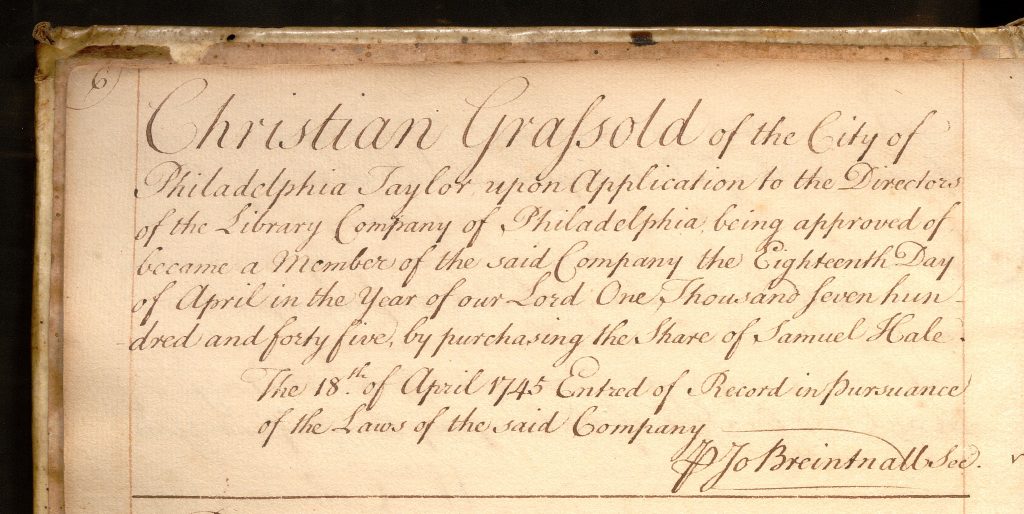
Image: Detail from Share Record Book A, volume 171, Library Company of Philadelphia records (MSS00270).
Grassold sold the share to Townsend White (1704-1791) on January 29, 1762.
White was a merchant according to the Library Company’s share records. He maintained the share for nineteen years, until he sold the share to his son John White on June 16, 1781.[ii]
John maintained the share for more than a decade, until he sold the share to Rowland Evans on August 19, 1793. That same day, Evans immediately sold the share to Abraham Lott (1760-1793).
Lott was a merchant in Philadelphia. Unfortunately, he died just two months after becoming a shareholder, one of many victims of a terrible Yellow Fever epidemic in Philadelphia.[iii]
After Lott’s death, his estate administrator Peter Gordon eventually sold the share to Lott’s business partner, Joseph Higbee (1761-1829), on June 10, 1797.[iv]
In addition to taking over Lott’s share, Higbee was deeply involved in wrapping up Lott’s affairs after his death. In fact, Lott’s gravestone in St. Peter’s Episcopal Churchyard includes the text, “This stone is erected by his friend Joseph Higbee.”[v]
Within a year, Higbee sold the share to Joseph Kirkbride Milnor (1775-1828) on February 20, 1798. A “Jos. Milnor” was among the debts assumed by Higbee from previous shareholder Abraham Lott’s estate, according to his estate paperwork, but it is unclear if this subsequent share transfer was related to that debt.
Milnor too was a merchant, and he and Higbee had become partners sometime before 1803. In fact, Milnor named one of his children “Joseph Higbee Milnor,” and gave Higbee as a middle name to several other children. However, the two men placed an advertisement in the Philadelphia Gazette on May 3, 1803 that their partnership was ending, and that the business would continue by Higbee alone.[vi]
Milnor maintained his Library Company share for fifteen years total, and then he sold the share to James Martin on May 8, 1813.
The 1813 Philadelphia directory lists three men named James Martin: one was a bookbinder and seller based on High (or Market) Street; one was a junior grazier based on South Second Street; and one was a merchant based on North Front Street.
Whichever Martin owned the Library Company share, he maintained it for the next twenty-one years. He eventually sold the share to Uriah Hunt (1796-1867) on January 3, 1834.
Hunt was a bookseller, according to the 1835-1836 Philadelphia directory. He was also a publisher, according to multiple items in the Library Company’s collections.
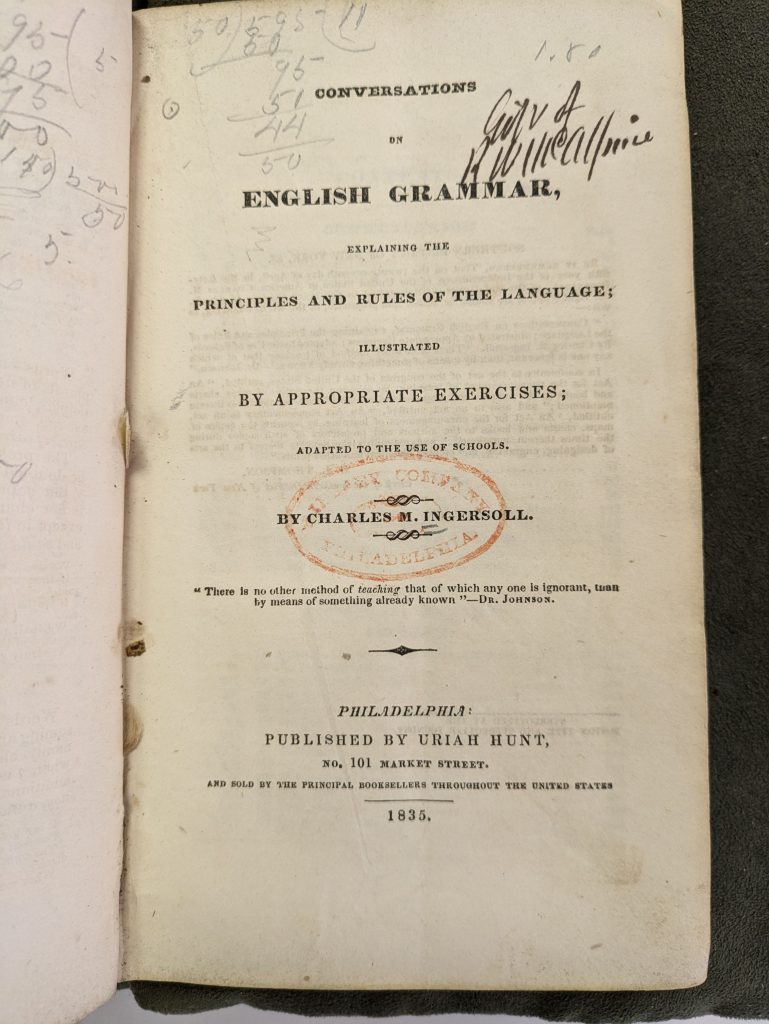
Image: Shareholder Uriah Hunt published this school book in the Library Company’s collection. Charles M. Ingersoll, Conversations on English Grammar (Philadelphia, 1835).
Hunt did not keep his Library Company share for long. He sold the share that same year to Peter Wright (1791-1856) on September 6, 1834.
Wright is listed in the 1835-1836 Philadelphia directory as a “China merchant.” He maintained the share for the next eleven years. During that time, he brought his two oldest sons into his business, which became Peter Wright & Sons.[vii]
He sold the share to Edward Taylor Randolph (1815-1876) on February 7, 1845.
Randolph owned the Library Company share for the rest of his life, but his estate then maintained the share for another fifty-one years. It is unusual for a share to remain associated with an estate for so long, but the trustee for Randolph’s estate eventually sold the share to Norman Dunning (1893-1962) on July 7, 1927.
By 1930, Norman was working as secretary at an ice plant according to the U.S. Census that year.
It is likely that the “ice plant” was part of Standard Ice Co.; his father George A. Dunning (1858-1950) served as its president. Norman’s stepmother, Martha Binney Dunning (1866-1954), was well-known both in Philadelphia high society and as a Pennsylvania leader in the women’s suffrage movement.
Norman maintained his Library Company share for twelve years, and eventually sold the share to George Dunning on June 8, 1939.
There are at least two men with that name who could have been the new shareholder. Norman’s seventeen-year-old son was named George A. Dunning, II (1922-2001), but it seems more likely that Norman sold the share to his father George A. Dunning (1858-1950). Library Company records indicate that the share was relinquished on July 18, 1950, which is less than four months after the death of the elder George Dunning.
Share History:
- Samuel Hale, acquired share #15 on November 22, 1731
- Christian Grassold, acquired on April 18, 1745
- Townsend White (1704-1791), acquired on January 29, 1762
- John White, acquired on June 16, 1781
- Rowland Evans, acquired on August 19, 1793
- Abraham Lott (1760-1793), acquired on August 19, 1793
- Joseph Higbee (1761-1829), acquired on June 10, 1797
- Joseph Kirkbride Milnor (1775-1828), acquired on February 20, 1798
- James Martin, acquired on May 8, 1813
- Uriah Hunt (1796-1867), acquired on January 3, 1834
- Peter Wright (1791-1856), acquired on September 6, 1834
- Edward Taylor Randolph (1815-1876), acquired on February 7, 1845
- Norman Dunning (1893-1962), acquired on July 7, 1927
- George Dunning, acquired on June 8, 1939
Shareholders who acquired this share after 1950 are not displayed for privacy reasons.
Learn more about Library Company shareholding today.
[i] “At the Instance of Benjamin Franklin”: A Brief History of the Library Company of Philadelphia (Philadelphia, 2015), 5.
[ii] Share Record Book A, volume 171, Library Company of Philadelphia records (MSS00270), 183.
[iii] Lott’s death on October 6, 1793 appears in a list of the “most noted inhabitants of Philadelphia, who have died since the first of August” in Matthew Carey, A Short Account of the Malignant Fever, Lately Prevalent in Philadelphia: With a Statement of the Proceedings That Took Place on the Subject in Different Parts of the United States (Philadelphia, 1793).
[iv] The firm of “Lott & Higbee” is noted throughout the list of administrative expenses of Lott’s estate. See Abraham Lott will in City of Philadelphia, Administration Files, No 169-204, 205a-B, 206-230, 1794. Courtesy of AncestryLibrary.com.
[v] “Abraham Lott,” Find a Grave https://www.findagrave.com/memorial/86908376/abraham-lott (accessed August 30, 2024).
[vi] “Joseph Kirkbride Milnor,” Find a Grave https://www.findagrave.com/memorial/54172678/joseph_kirkbride_milnor (accessed September 18, 2024).
[vii] Edward Needles Wright, “The Story of Peter Wright & Sons Philadelphia Quaker Shipping Firm 1818-1911,” Quaker History Vol. 56, No. 2 (August 1967), 67-89.