Library Company share #19 was first issued to John Roberts on November 22, 1731.
It is not clear which of several “John Roberts” might have owned share #19. Certainly, by 1731, this John was obviously acquainted with Benjamin Franklin (1706-1790) and his fellow Junto members. That group drew up “Articles of Agreement” on July 1, 1731 to found a library, and Roberts was among the first group of shares issued four months later. These subscribers each invested forty shillings and “promised to pay ten shillings a year thereafter to buy books and maintain a shareholder’s library.”[i]
He may be the “Captain Roberts” (d. 1739) who had opened a coffeehouse in 1720 on Front Street and hosted meetings of the Library Company’s Directors at least by April 1734. The Library Company’s Directors minutes note that monthly meetings were held at his “house” until November 12, 1739, when the meeting was listed as held at “(the widow of) John Roberts’s.” Widow Roberts continued to operate the business and host Library Company Directors meetings until 1754.[ii]
But a different “John Roberts” acquired Library Company share #61 on June 11, 1734, while “Captain Roberts” was still alive. Library Company records show that this Roberts “relinquished the share,” but no date was assigned to that relinquishing.
Then-Librarian William Parsons (1701-1757) paid the annual dues for a “John Roberts” in 1737.[iii]
The next mention of John Roberts in Library Company records relates to his bequest of share #19 to his son, Robert Roberts. The extract of the will specifies that the owner was “John Roberts of Merion.”[iv]
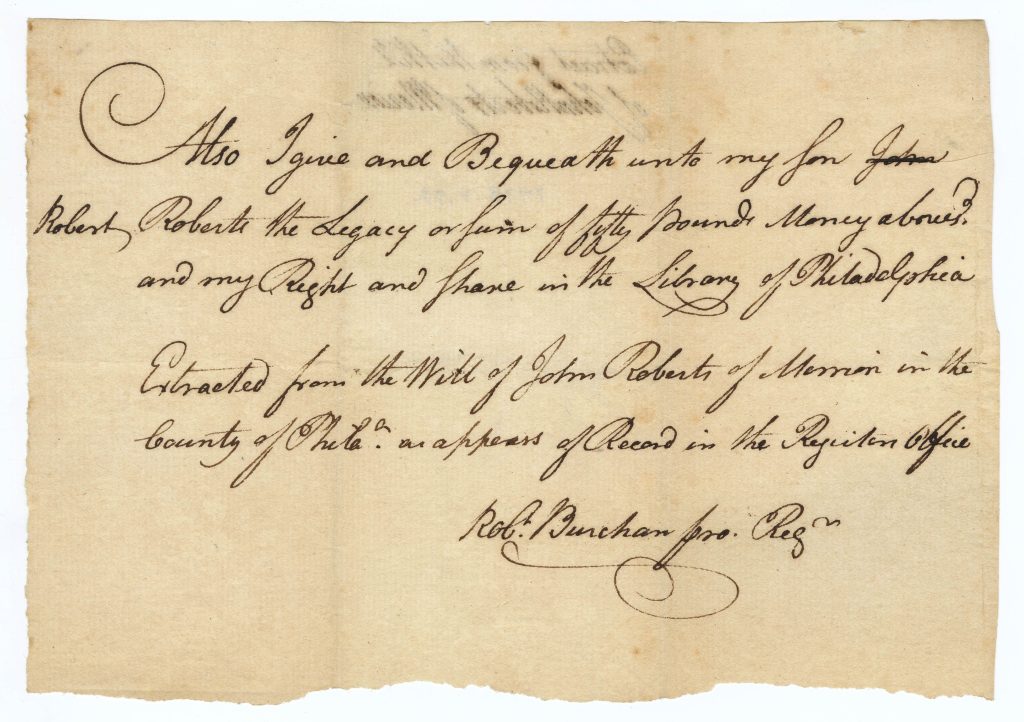
Image: This extract from “the will of John Roberts of Merrion” details that John’s son Robert Roberts is to inherit John’s Library Company share. Will Extract from John Roberts of Merion About Share Bequest to Son Robert (share #19), box 15, folder 8, Library Company of Philadelphia records (MSS00270).
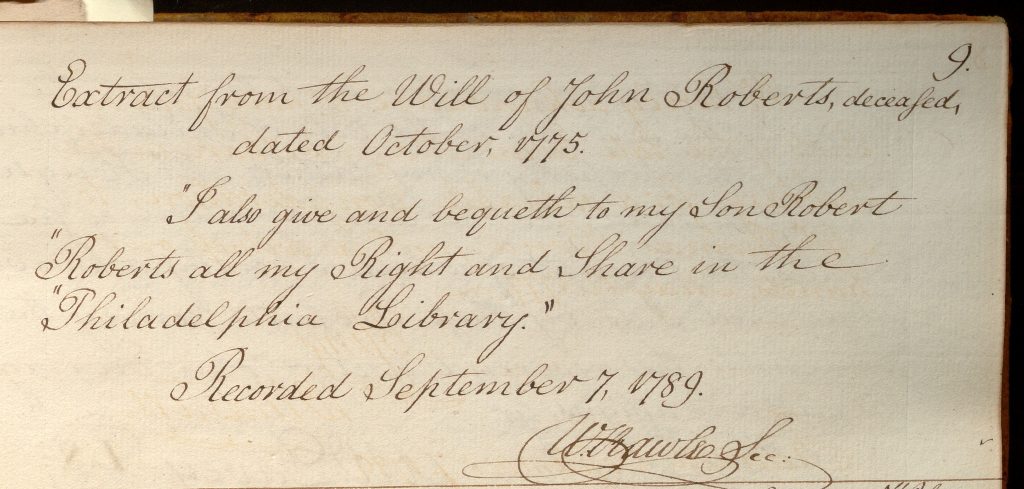
Image: John Roberts’ will extract is also summarized in the Library Company’s Director minutes. The minutes omit the detail that it is “John Roberts of Merion,” but include the date of the will and the date the transfer was recorded by the Library Company. Detail from Share Record Book B, volume 172, Library Company of Philadelphia records (MSS00270).
So while it is unclear which “John Roberts of Merion” previously owned the share, it nevertheless passed to John’s son, Robert Roberts, via a will dated October 1775. The transfer was recorded by the Library Company on September 7, 1789.
Unfortunately, it is unclear which of several men by that name owned this Library Company share.
Death records kept by Arch Street Meeting show at least two Quaker men named Robert Roberts, one who died in 1791 at the age of 48 and one who died in 1793 at the age of 46. It’s also possible that shareholder Robert Roberts lived outside the city in Merion, like his father before him.[v]
Library Company records show only that after shareholder Robert’s death, his widow Elizabeth Roberts sold share #19 to Edward Roberts on February 13, 1794.
Edward is almost certainly a relative given his surname, but his relationship to Robert or John is unclear.
He eventually sold the share to John Roberts on November 6, 1807. This John is also likely a relative, but the Library Company’s records do not shed light on his relationship to the previous Roberts shareholders.
Twenty-three years later, his estate’s “sole administratrix” Hannah Roberts sold the share to Edward W. Roberts on July 7, 1830.
Again, the Library Company’s records do not shed light on how Edward W. Roberts may have been related to the previous Roberts shareholders, but it is reasonable to assume he too was a relative.
He maintained the share for only two years before selling it to Mott Hooton on November 14, 1832.
Hooton maintained the share for three years, and sold it to Ralph McClintock on December 4, 1835. The 1837 Philadelphia directory lists McClintock as a broker based on South Street.
The Library Company’s share records indicate that McClintock’s attorney, John J. Smith, Jr., sold the share to Israel Morris II (1811-1905) on July 7, 1837.
Interestingly, the Library Company’s Librarian in 1837 was also named John J. Smith, Jr. (1798-1881). It is unclear if the librarian was acting as attorney for this transaction or if the two men simply had the same common name.[vi]
Morris was a wealthy iron manufacturer, and served for many years as a director of the Bank of North America, the Provident Life and Trust Company, and other financial institutions. He and his family lived at 1202 Arch Street in Philadelphia, but also owned a country home near Villanova.[vii]
After Israel’s death, his son and executor Theodore H. Morris sold share #19 to another of Israel’s sons, William H. Morris (1846-1924), on March 1, 1906.
William maintained the share for the rest of his life. The share passed to William’s son Reginald H. Morris (1887-1957) on February 5, 1925.
Share History:
- John Roberts, acquired share #19 on November 22, 1731.
- Robert Roberts, acquired on September 7, 1789
- Edward Roberts, acquired on February 13, 1794
- John Roberts, acquired on November 6, 1807
- Edward W. Roberts, acquired on July 7, 1830
- Mott Hooton, acquired on November 14, 1832
- Ralph McClintock, acquired on December 4, 1835
- Israel Morris (1811-1905), acquired on July 7, 1837
- William H. Morris (1846-1924), acquired on March 1, 1906
- Reginald H. Morris (1887-1957), acquired on February 5, 1925
Shareholders who acquired this share after 1950 are not displayed for privacy reasons.
Learn more about Library Company shareholding today.
[i] “At the Instance of Benjamin Franklin”: A Brief History of the Library Company of Philadelphia (Philadelphia, 2015), 5.
[ii] Michelle Craig McDonald, “Coffeehouses,” Encyclopedia of Greater Philadelphia https://philadelphiaencyclopedia.org/essays/coffeehouses/ (accessed July 31, 2024). Directors Minutes v. 1, volume 163, Library Company of Philadelphia records (MSS00270), 40-95.
[iii] The original 1737 receipt is in the collections of the Historical Society of Pennsylvania. A photocopy is available in Box 17, Folder 44 in Library Company of Philadelphia records (MSS00270).
[iv] Harry M. Tinkcom, “The Revolutionary City 1765-1783,” Philadelphia: A 300 Year History (New York, 1982), 145.
[v] “Permits for interment in Friends’ Burial Grounds, Philadelphia. From the originals at Arch Street Meeting,” Quaker Meeting Records, Friends Historical Library, Swarthmore College, 132.
[vi] Adding more weight to the idea that the Librarian John J. Smith, Jr. was acting as “attorney” for the transaction: the witness is listed as “Albanus Smith,” which matches the name of the librarian’s son, Albanus Smith (1823-1842).
[vii] Israel Morris II’s father, Israel Wistar Morris (1778-1870), had already acquired Library Company share #493 twenty years earlier on November 11, 1817. For more on Israel II, see “Iron Merchant Ends Busy Career,” The Philadelphia Inquirer, December 14, 1905; and “Will of Israel Morris,” The Philadelphia Inquirer, December 19, 1905.