Library Company share #21 was first issued to Evan Morgan (1709-1763) on November 22, 1731.
Morgan was a merchant and eventually a politician. By 1731, he was obviously acquainted with Benjamin Franklin (1706-1790) and his fellow Junto members. That group drew up “Articles of Agreement” on July 1, 1731 to found a library, and Morgan was among the first group of shares issued four months later. These subscribers each invested forty shillings and “promised to pay ten shillings a year thereafter to buy books and maintain a shareholder’s library.”[i]
Morgan also served as a Director of the Library Company soon after its founding, from 1735 to 1737, and then again from 1740 to 1762. He was a church-warden and vestry-man at Christ Church for more than twenty years, and served as a manager of the charitable Pennsylvania Hospital. He was a member of the House of Representatives for “several years.”[ii]
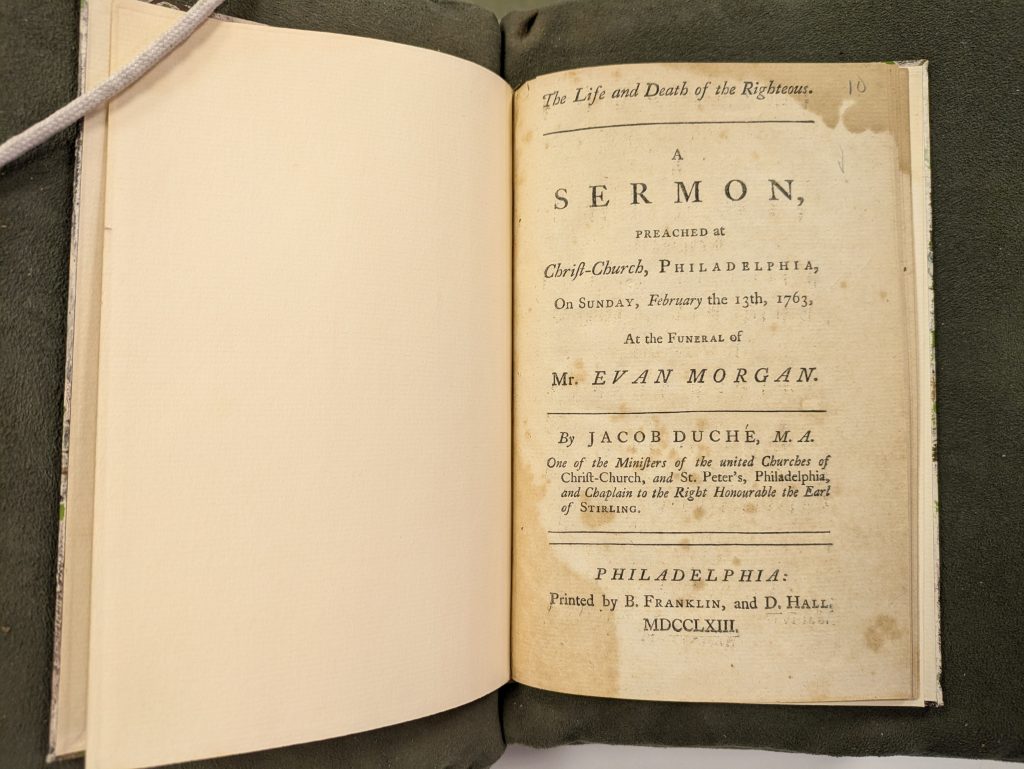
Image: Jacob Duché, The Life and Death of the Righteous: A Sermon Preached at Christ-Church, Philadelphia, on Sunday, February the 13th, 1763, at the Funeral of Mr. Evan Morgan (Philadelphia, 1763).
After Morgan’s death, his executor transferred the share to Morgan’s son-in-law, Dr. Thomas Bond (1743-1793) on May 12, 1777.
Bond’s father, also named Dr. Thomas Bond (1712-1784), had long been acquainted with Franklin and the Library Company. The elder Dr. Bond had owned share #54 from 1741 to 1771, when he transferred that share to his son Richard Bond.
The younger Dr. Thomas Bond identified himself as “Practitioner of Physic” in Library Company records, but he had also operated a stocking and thread business starting in 1766. That business eventually failed and he returned his attention to medicine.[iii]
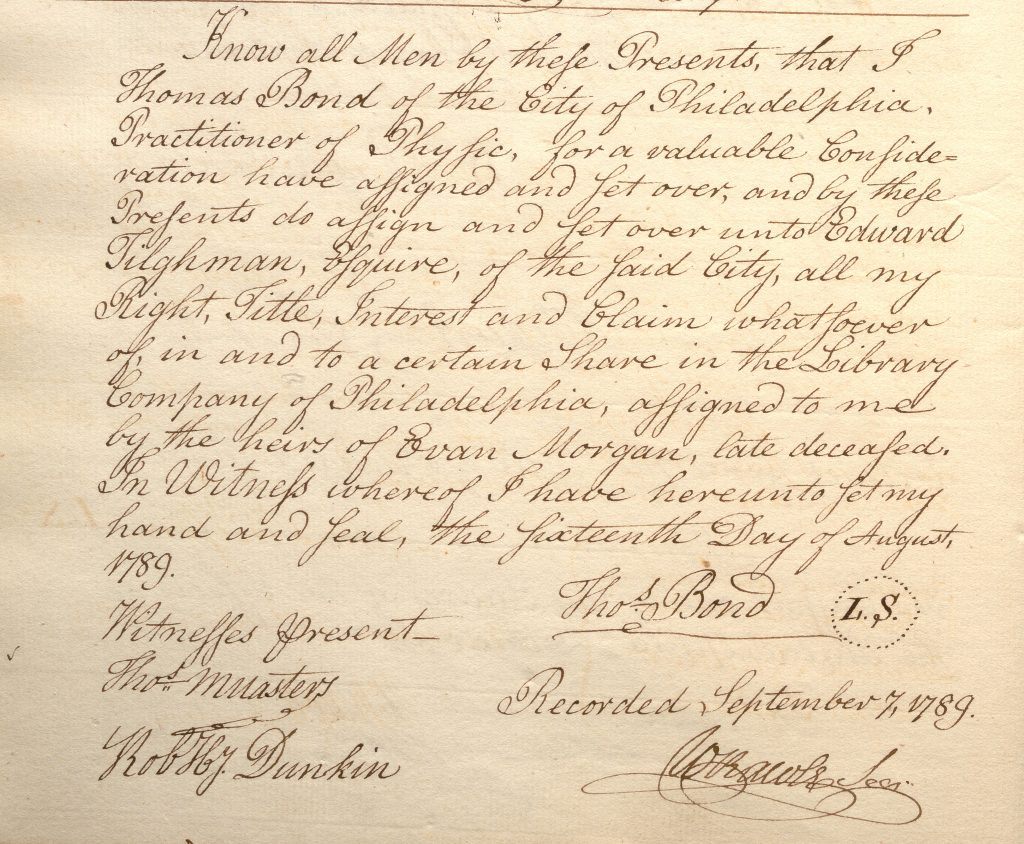
Image: Detail from Share Record Book B, volume 172, Library Company of Philadelphia records (MSS00270).
John Adams wrote to his wife Abigail Adams in 1775 that the younger Bond was “fat and jolly, a Lover of Pleasure.” By the time he acquired this Library Company share, the younger Bond had been appointed an assistant director of the medical corps of the Continental Army and later its purveyor-general.[iv]
The younger Bond sold his Library Company share to Edward Tilghman on September 7, 1789.
This is most likely Edward Tilghman, Jr. (1750-1815), who was a distinguished lawyer in Philadelphia. Among other accomplishments, he served as a trustee of the University of Pennsylvania from 1794 until 1807.[v]
He also was a relative of the wealthy Chew family, and Edward was bequeathed at least one enslaved person in the late 1770s.[vi]
Edward passed away in 1815, but the share continued to be maintained by his estate for another fifty-eight years. Tilghman’s estate administrator William M. Tilghman transferred the share to Edward’s grandson Benjamin Chew Tilghman (1821-1901) on May 1, 1873.
Benjamin too studied law, but eventually pursued a career in business and manufacturing with his brother Richard Tilghman. Benjamin served in the U.S. Army during the Civil War, and eventually served as commander of the 3rd United States Colored Troops.[vii]
In 1870, Benjamin obtained a patent for a process that became known as sandblasting. He was awarded the Franklin Institute’s Elliott Cresson Medal for the invention, and more patents followed.[viii]
Benjamin maintained his Library Company share until 1900, when he transferred it to his nephew, Benjamin C. Tilghman, Jr. (1867-1911), on May 3, 1900.
The younger Benjamin also had a military and business career. He took over the B.C. and R.A. Tilghman Company upon his father’s death.[ix]
After Benjamin’s death, his widow and executor Mary Tilghman transferred the share to Dr. George Kempton Reed (1848-1916) on August 3, 1911.
Dr. Reed was the son of Jacob Reed, who had founded the men’s clothing store Jacob Reed’s Sons. He earned his M.D. from Jefferson Medical College in 1874, and his wife, Dr. Mary Adamson Reed, was a member of the Women’s Medical College of Pennsylvania Class of 1888.[x]
After Dr. Reed’s death, his widow and executor Mary transferred the share to their son George Berkeley Reed (1889-1972) on January 4, 1917.
The Library Company’s records provide no further information about G. Berkeley. The share was eventually marked as forfeited in May 1934.
The share was reissued by the Directors as share #1405 and acquired by H. Gates Lloyd, Jr. on February 4, 1937.
The share was reissued as share #21 by 1998.
Share History:
- Evan Morgan (1709-1763), acquired share #21 on November 22, 1731
- Dr. Thomas Bond (1743-1793), acquired on May 12, 1777
- Edward Tilghman (1750-1815), acquired on September 7, 1789
- Benjamin Chew Tilghman (1821-1901),acquired on May 1, 1873
- Benjamin C. Tilghman, Jr. (1867-1911), acquired on May 3, 1900
- Dr. George Kempton Reed (1848-1916), acquired on August 3, 1911
- George Berkeley Reed (1889-1972), acquired on January 4, 1917
- Reissued as share #1405, H. Gates Lloyd, Jr., acquired on February 4, 1937
Shareholders who acquired this share after 1950 are not displayed for privacy reasons.
Learn more about Library Company shareholding today.
[i] “At the Instance of Benjamin Franklin”: A Brief History of the Library Company of Philadelphia (Philadelphia, 2015), 5.
[ii] Jacob Duché, The Life and Death of the Righteous: A Sermon Preached at Christ-Church, Philadelphia, on Sunday, February the 13th, 1763, at the Funeral of Mr. Evan Morgan (Philadelphia, 1763).
[iii] Thomas Bond is identified with this occupation in the share transaction to Edward Tilghman. Share Record Book B, volume 172, Library Company of Philadelphia records (MSS00270), 8. “Surgeon Thomas Bond, Jr.,” The State Society of the Cincinnati of Pennsylvania, https://pasocietyofthecincinnati.org/gallery_post/surgeon-thomas-bond-jr/ (accessed August 7, 2024).
[iv] John Adams’ correspondence is quoted in “Surgeon Thomas Bond, Jr.,” The State Society of the Cincinnati of Pennsylvania, https://pasocietyofthecincinnati.org/gallery_post/surgeon-thomas-bond-jr/ (accessed August 7, 2024).
[v] University Archives and Records Center, “Edward Tilghman 1750-1815,” Penn Libraries, https://archives.upenn.edu/exhibits/penn-people/biography/edward-tilghman/ (accessed August 7, 2024).
[vi] “Edward Tilghman Jr,” Penn and Slavery Project, http://pennandslaveryproject.org/exhibits/show/slaveownership/earlytrustees/edwardtilghmanjr (accessed August 7, 2024).
[vii] “Third Regiment Infantry USCT,” United States Colored Troops (USCT) Camp William Penn Headquarters, https://www.usct.org/regiments/3rd-infantry-regiment/ (accessed 8/7/2024).
[viii] Joseph Cassidy, “More Than Scratching the Surface,” Pennsylvania Center for the Book, https://pabook.libraries.psu.edu/literary-cultural-heritage-map-pa/feature-articles/more-scratching-surface (accessed August 7, 2024).
[ix] Finding Aid for the Tilghman Family Papers (MS 2821), H. Furlong Baldwin Library, Maryland Center for History and Culture, https://mdhistory.libraryhost.com/repositories/2/resources/730 (accessed 8/7/2024).
[x] Mrs. Reed and her degree are mentioned in “Coming Events in Women’s Clubs,” The Philadelphia Inquirer, February 27, 1916. George’s degree is listed in W. J. Maxwell, General Alumni Catalogue of the University of Pennsylvania (Philadelphia, 1917).