Library Company share #22 was first issued to Thomas Edwards on November 22, 1731.
By 1731, Edwards was obviously acquainted with Benjamin Franklin (1706-1790) and his fellow Junto members. That group drew up “Articles of Agreement” on July 1, 1731 to found a library, and Edwards was among the first group of shares issued four months later. These subscribers each invested forty shillings and “promised to pay ten shillings a year thereafter to buy books and maintain a shareholder’s library.”[i]
The Library Company’s records provide no further information about Edwards, but he maintained the share for nearly five years.
Robert Greenway (d. 1763) apparently acquired the share on June 5, 1736, though that transaction is not recorded in either the Library Company’s share books nor its Directors minutes.[ii]
Greenway was a wine merchant and real estate investor. After ten years as a shareholder, he was appointed to serve as the Library Company’s Librarian on May 5, 1746. He would hold that role until his death seventeen years later.[iii]
By the summer of 1749, the Directors had noticed “sundry” books were missing from the library, and the next year ordered that the books should be “new numbered beginning No. 1” in each size category. Librarian Greenway was assigned the job, and was to be paid for it. He was also charged with making a new catalog of the Library Company’s holdings.[iv]
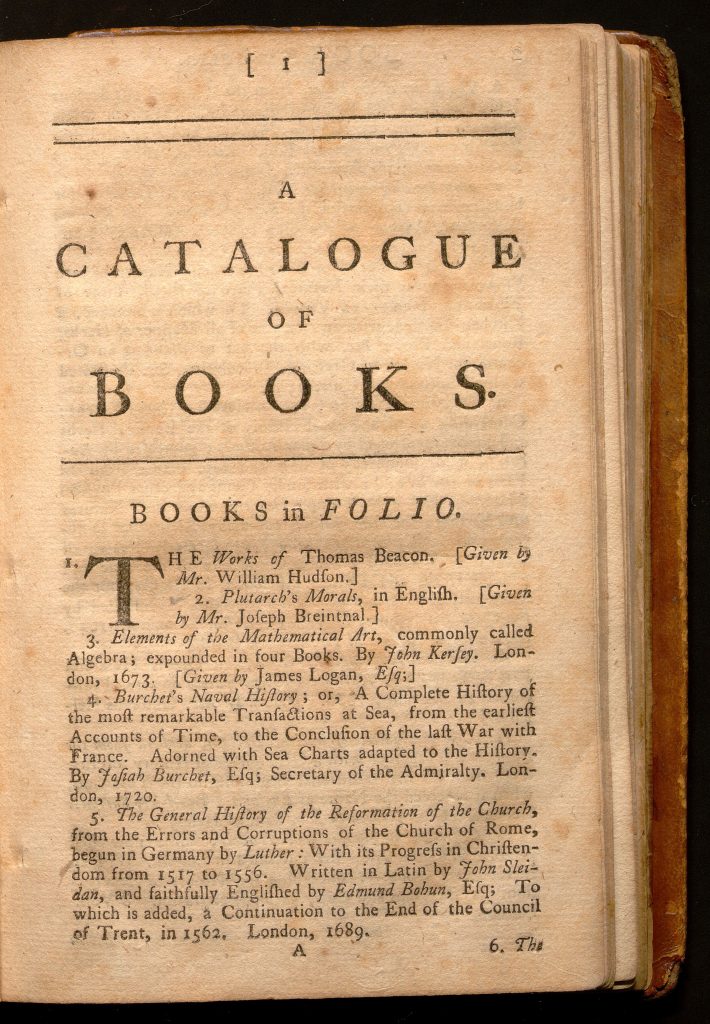
Image: Shareholder and Librarian Robert Greenway numbered the Library Company’s books by size, like folios one through five shown here in the catalog published during his tenure. The Library Company continues this size-based numbering system today. The Charter, Laws, and Catalogue of Books, of the Library Company of Philadelphia (Philadelphia, 1757).
It is unclear when Greenway finished his task, but the next printed catalog that survives dates to 1757 and does indeed list a number before each title.
The Directors minutes include occasional complaints about Greenway missing meetings in the 1750s, but by mid-1762, the tension is obvious. The four Directors who met on August 9, 1762 noted that Greenway had not been following the rule that the Librarian should be present at the Library Company during its open hours. The “Secretary Is desired to enquire of him whether or no it will suit his Business so to do; and if he finds it will not, to look out for some Person to whom it will be convenient, and make Report at the next Meeting.”[v]
At the September 1762 meeting, attended by only two Directors, the Secretary noted that he had indeed brought Greenway a “Copy of the Minute made at last meeting respecting the Duty of the Librarian,” but Greenway had rebuffed him by saying that he didn’t have to listen since the previous meeting had not met quorum.[vi]
Greenway attended two more monthly meetings, in November 1762 and April 1763. However, the Directors noted in the minutes from November 14, 1763 that Greenway was deceased and a new Librarian would be needed.[vii]
Unfortunately, the Directors noted that “a great Number of Books were found missing” from the Library Company during Greenway’s tenure. The Directors enforced a rule that had been created during the previous Librarian’s tenure: that missing books were the financial responsibility of the Librarian.[viii]
The Directors therefore asked Greenway’s executors “Satisfaction for the Books lost out of the Library during the time he served as Librarian.” They even provided a list of titles missing, but nothing came of this request.[ix]
When Greenway’s executor Robert Morris (1734-1806) asked to take over share #22 himself in 1768, the Directors “replied that Robert Greenway had died in the Company’s Debt to a considerable amount, they could not therefore consent to any Person’s enjoying his Share, until the said Debt was discharged.”[x]
Greenway’s debt to the Library Company was apparently never repaid. The Library Company’s records eventually note that Greenway’s share was forfeited in May 1770.
The share then remained dormant for the next 164 years. It was finally reissued by the Directors as share #1339 and acquired by Edgar Scott (1899-1995) on May 7, 1934.
Scott was from a wealthy Philadelphia family; his grandfather was Thomas A. Scott (1823-1881), president of the Pennsylvania Railroad.
Edgar briefly worked as a journalist and playwright after college, but by the time he purchased this Library Company share, he was working as an investment banker. He and his wife Helen Hope Montgomery Scott (1904-1995) lived on her family’s estate, Ardrossan.
He eventually served as a governor of the New York and the Philadelphia-Baltimore Stock Exchanges, as well as a commissioner in Radnor, Pennsylvania. He was also an author: he wrote How to Lay a Nest Egg; Financial Facts of Life for the American Girl (John C. Winston, 1950) that aimed to explain Wall Street for women with money to invest.[xi]
The share was reissued as share #22 by 1991.
Share History:
- Thomas Edwards, acquired share #22 on November 22, 1731
- Robert Greenway (d. 1763), acquired on June 5, 1736
- Reissued as share #1339, Edgar Scott (1899-1995), May 7, 1934
Shareholders who acquired this share after 1950 are not displayed for privacy reasons.
Learn more about Library Company shareholding today.
[i] “At the Instance of Benjamin Franklin”: A Brief History of the Library Company of Philadelphia (Philadelphia, 2015), 5.
[ii] Although the transaction is not recorded in the Directors meeting minutes or share record books, the date is recorded in Chronological Share and Directors Register, volume 193, Library Company of Philadelphia Records (MSS00270). It is unclear how the date was determined for that register.
[iii] Greenway’s occupation is listed in Anna Coxe Toogood, “Historic Resource Study: Independence Mall, the 18th Century Development, Block One, Chestnut to Market, Fifth to Sixth Streets,” National Park Service (Philadelphia, 2001), 29.
[iv] The missing books are mentioned in the minutes for June 12, 1749. The plan to number everything is described as “ordered” in the minutes for September 10, 1750. See Directors Minutes Volume 1, volume 163, Library Company of Philadelphia records (MSS00270).
[v] August 9, 1762 minutes, Directors Minutes Volume 1, volume 163, Library Company of Philadelphia records (MSS00270).
[vi] September 13, 1762 minutes, Directors Minutes Volume 1, volume 163, Library Company of Philadelphia records (MSS00270).
[vii] November 14, 1763 minutes, Directors Minutes Volume 1, volume 163, Library Company of Philadelphia records (MSS00270).
[viii] This quotation dates to before Greenway’s death. January 10, 1763 minutes, Directors Minutes Volume 1, volume 163, Library Company of Philadelphia records (MSS00270).
[ix] December 12, 1763 minutes and December 10, 1764 minutes, Directors Minutes Volume 1, volume 163, Library Company of Philadelphia records (MSS00270).
[x] April 11, 1768 minutes, Directors Minutes Volume 1, volume 163, Library Company of Philadelphia records (MSS00270). Robert Morris later acquired Library Company share #418 on December 1, 1769.
[xi] Wolfgang Saxon, “Edgar Scott, Investment Banker and Main Line Socialite, 96,” The New York Times, May 30, 1995.