Library Company share #1 was first issued to Robert Grace (d. 1766) on November 10, 1731.
Grace was a wealthy ironmaker in Philadelphia. He was also clearly an important friend of Benjamin Franklin (1706-1790). In his autobiography, Franklin described Grace as “a young gentleman of fortune, generous, lively, and witty; he was fond of satire, but he loved his friend still more than an epigram.”[i]
He and Franklin were founding members of both the Junto and the Library Company. Grace was the first to sign the Library Company’s “Articles of Agreement” drawn up on July 1, 1731, and was the first person to be issued a share four months later. He served on the Library Company’s board of directors from 1731 to 1733 and in 1739.
Grace was also the Library Company’s first landlord. According to the Directors’ minutes for November 14, 1732, the Library Company’s very first shipment of books “were taken to Mr. Grace’s Chamber at his House in Jones’s Alley, and there placed on the Shelves.” The first Librarian Louis Timothée (d. 1738) was hired that month, and he “rented the said House of R. Grace.”[ii]
Grace maintained his Library Company share for thirty-two years. He sold it to David Potts on February 19, 1763.
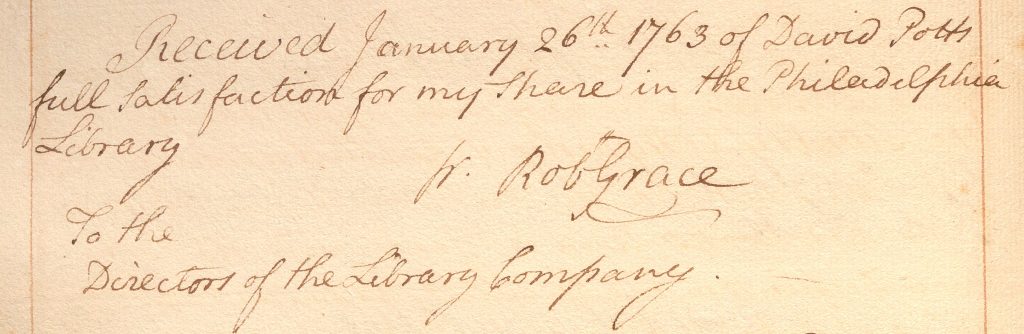
Image: Detail from page 36 in Share record book A, volume 171, Library Company of Philadelphia records (MSS00270).
Potts was most likely a member of his extended family; Grace’s brother-in-law was John Potts (circa 1709-1768) and his stepdaughter was married to Thomas Potts (1735-1796). Library Company records provide no further details about David, and at least three men with that name were alive at that time.[iii]
On December 17, 1764, David Potts sold his Library Company share to Grace’s brother-in-law John Potts (circa 1709-1768).
John was a wealthy iron maker, merchant, developer, and politician. He is credited as being the founder of Pottstown, having begun laying out the town before his death on land he owned near the confluence of Manatawny Creek and the Schuylkill River. John also served in the Pennsylvania Assembly in 1755, from 1759 to 1761, and again in 1766.[iv]
After John’s death, his executor Samuel Potts eventually sold the share to John’s son, Dr. Jonathan Potts (1745-1781), on August 30, 1770. Jonathan sold it the very same day to Caleb Cresson (1742-1816).
Cresson was a Philadelphia merchant. He owned the share for only a year before he sold it to Dr. John Day on November 29, 1771.
Day also owned the share for only a year, and was identified as a “surgeon” when he sold the share to George Graffe/Graff on December 29, 1772.[v]
Graffe was another merchant, according to the Library Company’s share records, and he maintained the share for the next seventeen years. However, he finally turned over share #1 “for the benefit of his creditors,” who then sold it to merchant John Fry on February 5, 1789. Fry held it less than a month before he opted to liquidate: he sold the share to Jeremiah Parker (1758-1827) on February 27, 1789.[vi]
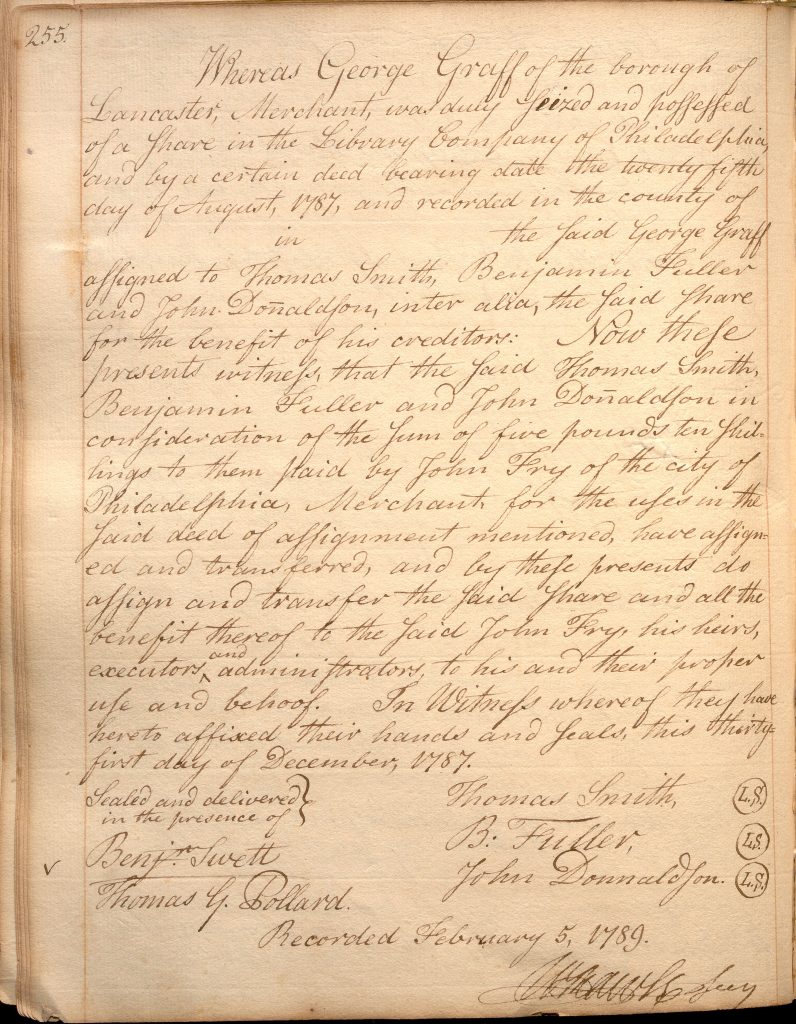
Image: By 1789, George “Graff” was based in Lancaster, and he turned over his Library Company share to Thomas Smith, Benjamin Fuller, and John Donaldson “for the benefit of his creditors.” Share Record Book A, volume 171, Library Company of Philadelphia records (MSS00270).
Parker apparently maintained the share for the rest of his life.
Parker was in business with his uncle and brother as Jeremiah Warder, Parker & Company, and served as a Director of the Bank of the United States for fourteen years. His family’s farm, Peel Hall, would later be sold to become the site of Girard College.[vii]
After his death, and the death of his executor and brother William Parker (1767-1845), the share was sold to Jeremiah’s nephew, William Parker Foulke (1816-1865), on March 5, 1847.
Foulke was a Philadelphia lawyer involved in various intellectual pursuits. At the time he acquired this share, he was deeply involved with the Pennsylvania Colonization Society, which promoted resettling freed Blacks in West Africa. He was also a member of the Philadelphia Society for Alleviating the Miseries of Public Prisons, among other organizations.
Today, he is perhaps best known for his scientific pursuits. In 1858, he led an excavation near Haddonfield, N.J. that found the first full dinosaur skeleton in the United States. Paleontologist Dr. Joseph Leidy (1823-1891) named the dinosaur Hadrosaurus foulkii in Foulke’s honor, and put the bones on display in the Academy of Natural Sciences in Philadelphia.
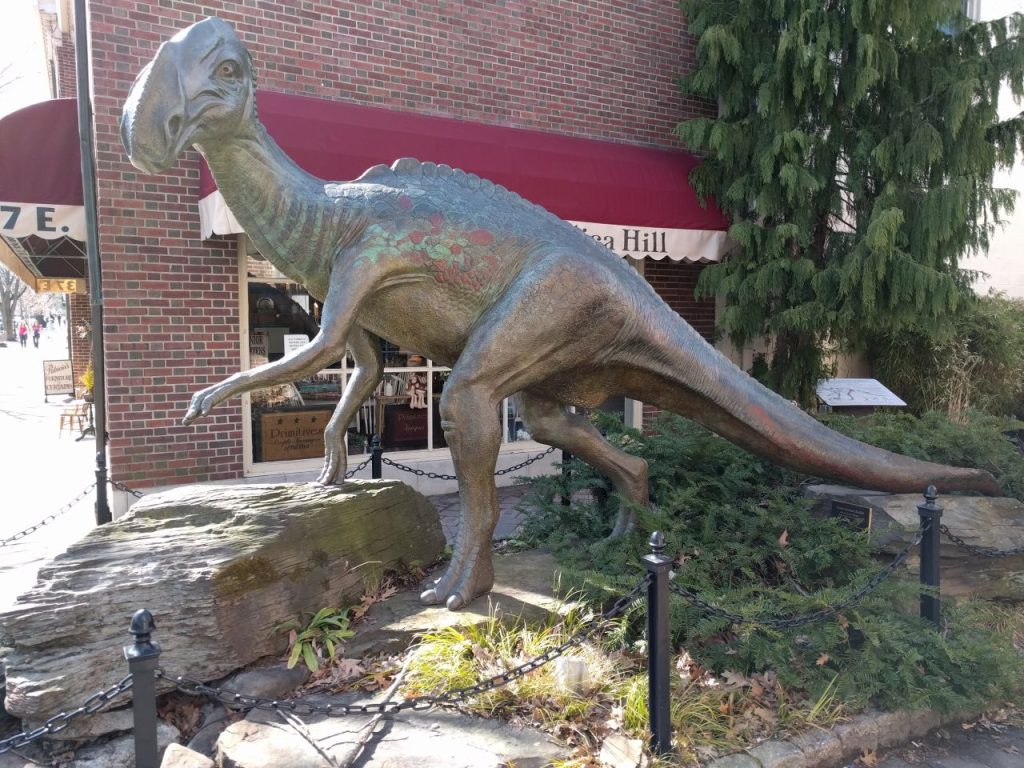
Image: An artist’s sculpture of a Hadrosaurus foulkii is installed in downtown Haddonfield, N.J., to celebrate shareholder William Parker Foulke’s 1858 discovery of its skeleton nearby. Photo courtesy of Dana Dorman.
After Foulke’s death in 1865, the share may have been maintained by his estate. The Library Company officially marked it as “forfeited” in 1897.
In the early 20th century, as was the practice at the time, Library Company Directors reissued share #1 as share #1261. It was acquired by James C. Stillwell on November 2, 1922.
It remained with Stillwell’s estate after his death, with his trustee Fidelity-Philadelphia Trust Company listed as owning the share from 1930 until it was forfeited in 1937.
The share was reissued as share #1 by 2012.
Share History:
- Robert Grace (d. 1766), acquired share #1 on November 10, 1731
- David Potts, acquired on February 19, 1763
- John Potts (circa 1709-1768), acquired on December 17, 1764
- Jonathan Potts (1745-1781), acquired on August 30, 1770
- Caleb Cresson (1742-1816), acquired on August 30, 1770
- Dr. John Day, acquired on November 29, 1771
- George Graffe, acquired on December 29, 1772
- John Fry, acquired on February 5, 1789
- Jeremiah Parker (1758-1827), acquired on February 27, 1789
- William Parker Foulke (1816-1865), acquired on March 5, 1847
- Reissued as share #1261; James C. Stillwell acquired it on November 2, 1922
- Fidelity-Philadelphia Trust Company, acquired on January 2, 1930
Shareholders who acquired this share after 1950 are not displayed for privacy reasons.
Learn more about Library Company shareholding today.
[i] Benjamin Franklin, The Private Life of the Late Benjamin Franklin, LL.D. (London, 1793), 112.
[ii] See the November 14, 1732 minutes in Directors Minutes Volume 1, volume 163, Library Company of Philadelphia records (MSS00270).
[iii] For more on the Potts family, see Daniel Graham, “The Family of John Potts (1709/10-1768), Ironmaster, and Ruth Savage (1715/16-1786) of Pottstown, Pennsylvania Through the Fourth Generation,” available at https://www.montgomerycountypa.gov/DocumentCenter/View/20685/Dan-Graham-Research?bidId (accessed June 28, 2024).
[iv] Graham, 22.
[v] See page 103 in Share Record Book A, volume 171, Library Company of Philadelphia records (MSS00270).
[vi] By 1789, George “Graff” was based in Lancaster, and he turned over his Library Company share to Thomas Smith, Benjamin Fuller, and John Donaldson “for the benefit of his creditors.” Share Record Book A, volume 171, Library Company of Philadelphia records (MSS00270).
[vii] “Obituary Notice of the late Jeremiah Parker, Deceased,” Poulson’s American Daily Advertiser, November 3, 1827. Henry D. Biddle, “Owen Biddle,” The Pennsylvania Magazine of History and Biography, v. 16 no. 3 (October 1892), 317.