Library Company share #5 was first issued to Joseph Breintnall (d. 1746) on November 10, 1731.
Breintnall was a scrivener, public servant, author, poet, and colleague of Benjamin Franklin (1706-1790). He was also an amateur scientist who experimented with solar heat and botany.
He was an original member of Franklin’s Junto discussion group, and he joined with Franklin and his fellow Junto members to draw up “Articles of Agreement” on July 1, 1731 to found the Library Company. Breintnall was among the first group of shares issued four months later. These subscribers each invested forty shillings and “promised to pay ten shillings a year thereafter to buy books and maintain a shareholder’s library.”[i]
Breintnall served as the first Secretary of the Library Company, a role he held until his death in 1746. One biographer points out that this role “introduced [Brientnall] to a larger world.”[ii] For instance, Breintnall exchanged letters with the Library Company’s London book agent, Peter Collinson, about his study of plants as well as other scientific topics. Between circa 1731 and circa 1744, Breintnall created hundreds of leaf prints as records of botanical specimens he gathered himself and from networks.
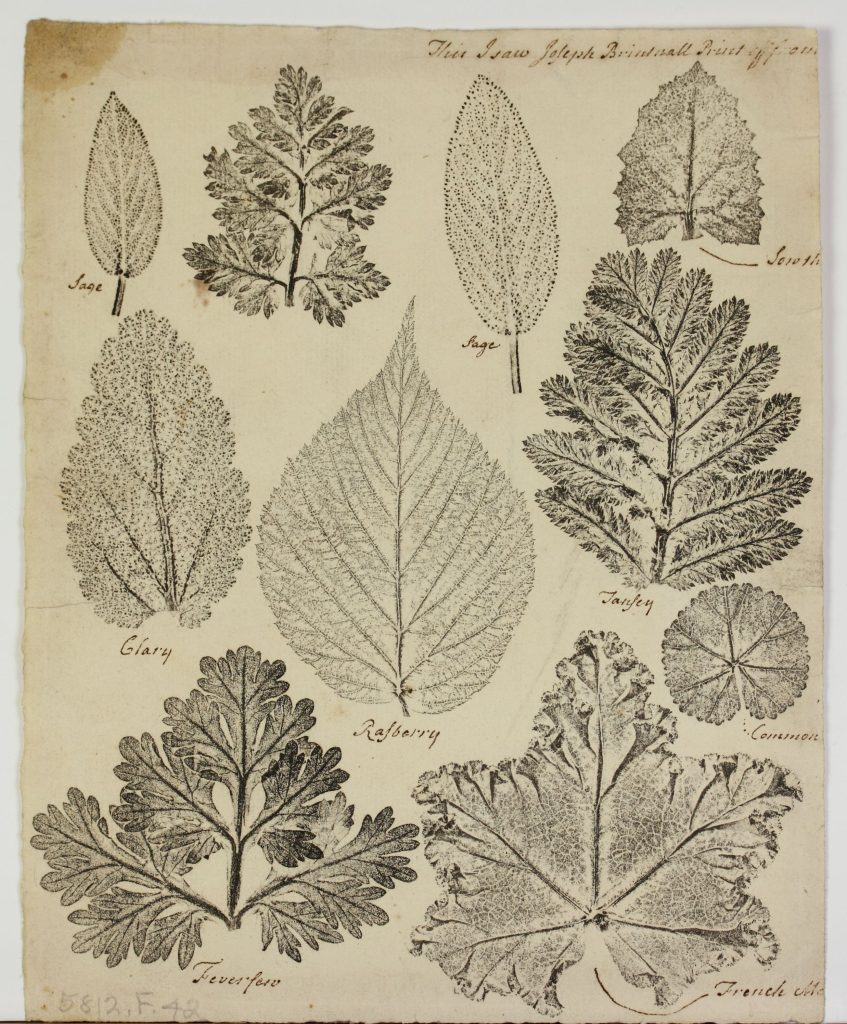
Image: Joseph Breintnall, [Nature prints of leaves] [graphic] (Philadelphia, circa 1731-circa 1744). Gift of Mrs. Joseph Breintnall, 1746.
Breintnall may have used his experience with leaf printing to assist Franklin in the creation of a metal cast of a leaf impression used to print currency incapable to be counterfeited.[iii]
After Brientnall’s death, the Library Company’s directors recorded in the minutes that he had “faithfully served . . . many years, without any adequate Recompence.” The directors voted unanimously to give a “present of £15 to his Widow for the use of his Family; and that his son George shall have the free use of the Books in the Library during Life.”[iv]
Two years later, when Joseph’s widow, Esther Breintnall, decided to sell Joseph’s share, the directors “agreed unanimously” that her and Joseph’s son George “shall continue to enjoy the free use of the Books” as long as he left “satisfactory” promissory notes.[v]
Esther Breintnall sold the share to Dr. Richard Farmer (d. 1791) on January 12, 1749.[vi]
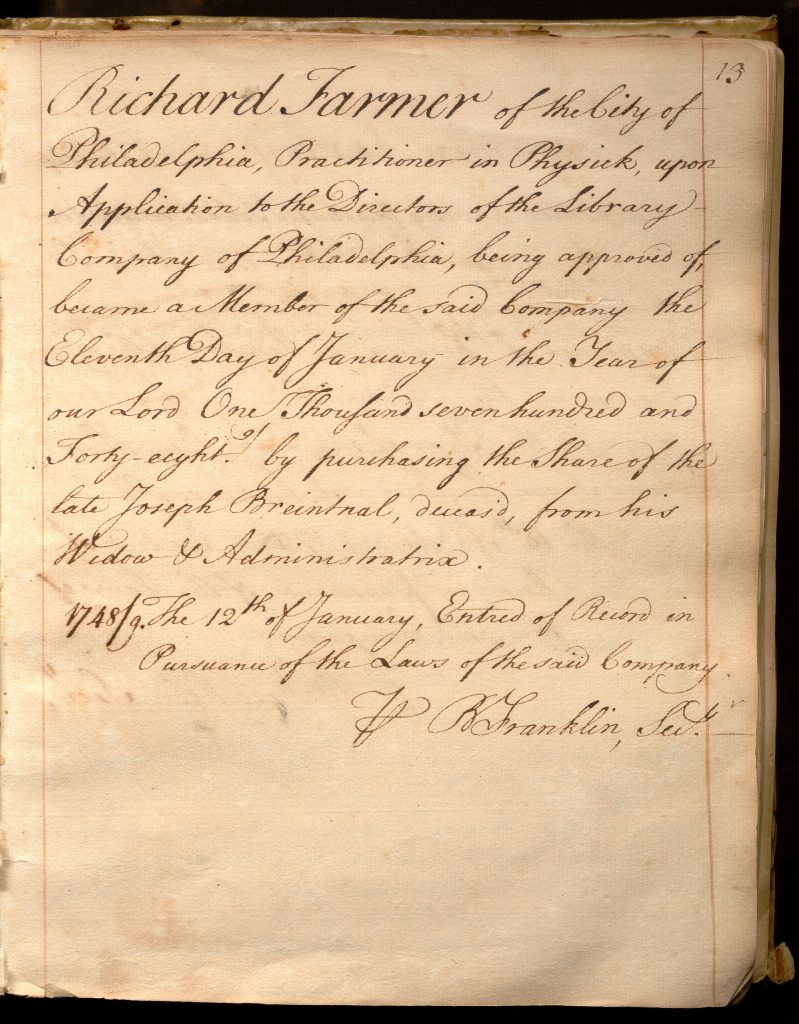
Image: Detail from Share Record Book A, volume 171, Library Company of Philadelphia records (MSS00270).
Library Company records provide no other details about Farmer, but he maintained the share for the next fifteen years.
By the time Farmer sold the share in 1764, he was living in London according to the share transaction record. He sold the share to Peter Campbell on November 25, 1764, and the transfer was witnessed by artist Benjamin West (1738-1820) and James Logan (1728-1803). The official transfer from Farmer to Campbell was recorded in Library Company records on July 27, 1765.[vii]
Library Company Share Record Book A indicates that new shareholder Peter was the son of deceased Philadelphia merchant Thomas Campbell.
Peter Campbell maintained the share for twelve years, and then sold it back to the same Dr. Richard Farmer (d. 1791) on March 11, 1776.[viii]
This time, Farmer owned the share until his death in 1791, and then it was maintained by his estate for another fifteen years.
Farmer had named his daughter Sarah Farmer Bower to be executrix of his estate after his death, but it was Richard F. Bower, gentleman from Northern Liberties, who finally sold the Farmer estate’s share to Edmund J. Hollinshead, saddler, on May 12, 1806. The transfer was recorded in Library Company records more than four years later, on October 31, 1811.[ix]
This transfer might have been finally recorded because Hollinshead himself had already sold the share. His sale to John L. Leib apparently occurred in December 1809, but it wasn’t recorded by the Library Company until December 14, 1811.[x]
The 1810 Philadelphia directory listed Leib as an “attorney at law & clerk of the Orphan’s court,” based on South 6th Street.
Leib maintained the share for the next few years. James Ronaldson, attorney for Leib, sold the share to Elijah Dallett (1777-1847) on April 4, 1817. The transfer was witnessed by Elijah’s brother Thomas Dallett (1775-1832) and their brother-in-law Thomas Lay.[xi]
Elijah and Thomas Dallett operated a soap and candle-making business. Thomas moved to Venezuela in 1822 to open a branch of their chandlery business, and the two brothers also eventually invested in a business that became the Red D Line, a main transportation link between the U.S. and Venezuela from roughly 1820 to 1936.[xii]
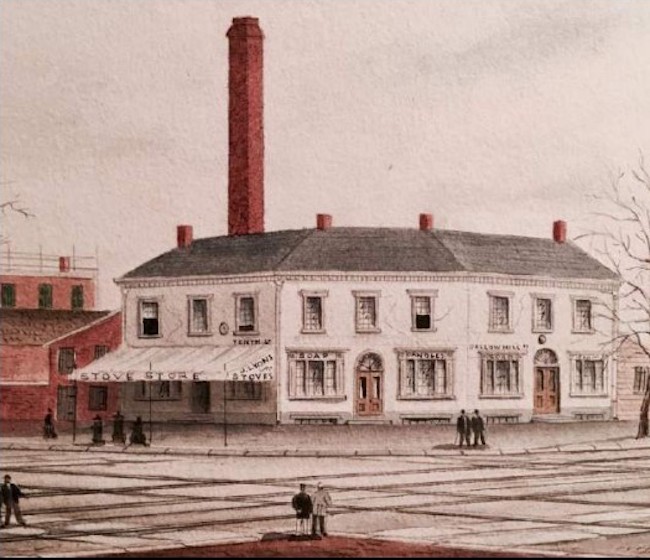
Image: Dallett’s Chandlery is depicted in this 1884 image of the buildings at 10th Street, Callowhill Street, and Ridge Avenue. B. R. Evans, Dallett’s Old Soap Manufactory, Northeast Corner Tenth and Callowhill Streets (1884). Watercolor. Benjamin Evans Watercolor Collection.
Elijah had other interests as well. Three years after becoming a Library Company shareholder, Elijah helped found the Musical Fund Society of Philadelphia.[xiii]
Elijah sold the share to his son Gillies Dallett (1819-1885) on March 6, 1843.
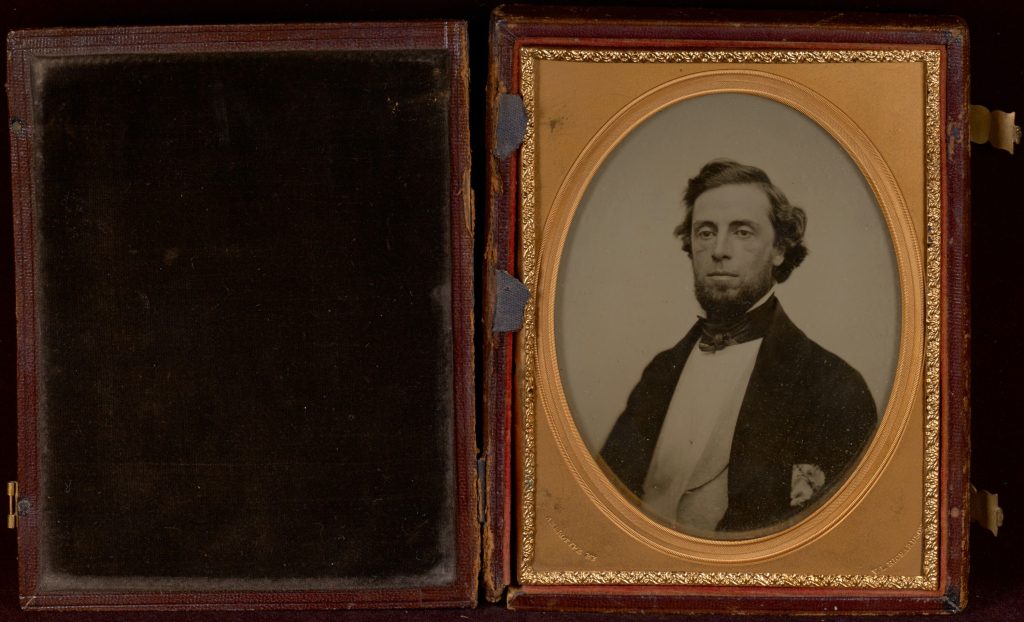
Image: V. L. Richardson, [Portrait of Mr. Gillies Dallett] (1860s). Hand-colored ambrotype. Courtesy of the J. Paul Getty Museum, Los Angeles, 84.XT.442.4.
Gillies and his brother Elijah Jr. (1802-1873) continued the business after their father’s death, and Gillies maintained his Library Company share for the rest of his life.
Gillies’ son and his surviving executor Elijah Dalley (1855-1939) sold the share to himselfon August 3, 1922. He maintained the share for the rest of his life.
After his death, his executors Henry Wiener, Jr. and William M. David sold the share to the younger Elijah’s son, Anthony Joseph Dallett (b. 1890) on April 3, 1940.
Anthony sold the share to Francis James Dallett, Jr. on December 6, 1945.
Share History:
- Joseph Breintnall (d. 1746),acquired share #5 on November 10, 1731
- Dr. Richard Farmer (d. 1791), acquired on January 12, 1748
- Peter Campbell, acquired on July 27, 1765
- Dr. Richard Farmer (d. 1791), acquired on March 11, 1776
- Edmund T. Hollinshead, acquired on October 31, 1811
- John L. Leib, acquired on December 14, 1811
- Elijah Dallett (1777-1847), acquired on April 4, 1817
- Gillies Dallett (1819-1885), acquired on March 6, 1843
- Elijah Dallett (1855-1939), acquired on August 3, 1922
- Anthony Joseph Dallett (b. 1890), acquired on April 3, 1940
- Francis James Dallett, Jr., acquired on December 6, 1945
Shareholders who acquired this share after 1950 are not displayed for privacy reasons.
Learn more about Library Company shareholding today.
[i] “At the Instance of Benjamin Franklin”: A Brief History of the Library Company of Philadelphia (Philadelphia, 2015), 5.
[ii] Stephen Bloore, “Joseph Breintnall, First Secretary of the Library Company,” The Pennsylvania Magazine of History and Biography, Vol. 59, No. 1 (1935), 48.
[iii] For an overview of Breintnall’s and Franklin’s use of leaf-printing on paper currency, see Matthew Wills, “The First Green Money: Nature-Printed Currency,” JSTOR Daily, March 7, 2025 https://daily.jstor.org/the-first-green-money-nature-printed-currency/ (accessed June 24, 2025).
[iv] “Free for his life” ostensibly meant that he would not need to pay annual dues. Of course, while son George Breintnall was still a minor, someone approved by the directors would sign notes for him. See May 5, 1746 minutes, Directors Minutes Volume 1, volume 163, Library Company of Philadelphia records (MSS00270).
[v] November 7, 1748 minutes, Directors Minutes Volume 1, volume 163, Library Company of Philadelphia records (MSS00270).
[vi] Photostat of January 11, 1748 share transfer from Esther Breintnal to Dr. Richard Farmer (share #5) (12482.F.239), Box 17, Folder 45, Library Company of Philadelphia records (MSS00270). January 9, 1749 minutes, Directors Minutes Volume 1, volume 163, Library Company of Philadelphia records (MSS00270).
[vii] Share Record Book A, volume 171, Library Company of Philadelphia records (MSS00270), 44.
[viii] The Library Company’s share book recorded the new owner as Richard “Farmar,” but it also specifies that he is the same person who sold the share to Campbell back in November 1764. See Share Record Book A, volume 171, Library Company of Philadelphia records (MSS00270), 133.
[ix] Richard Farmar will in Pennsylvania, U.S., Wills and Probate Records, Wills of Philadelphia County, Vol W-X, 1789. Courtesy of AncestryLibrary.com.
[x] Share Record Book B, volume 172, Library Company of Philadelphia records (MSS00270), 307.
[xi] According to family information from Richard Dallett, Thomas Lay had married Elijah and Thomas’s sister Catherine at Christ Church in 1808. Richard Dallett, e-mail message to author, March 20, 2023. Share Record Book C, volume 173, Library Company of Philadelphia records (MSS00270), 47.
[xii] Richard Dallett, e-mail message to author, March 20, 2023. Jordan Keiffer, “Ghost Signs of Philadelphia: Esslinger’s Brewery in Callowhill,” Hidden City, March 1, 2023, https://hiddencityphila.org/2023/03/ghosts-signs-of-philadelphia-esslingers-brewery-in-callowhill/ (accessed June 24, 2025).
[xiii] Richard Dallett, e-mail message to author, March 20, 2023.