Library Company share #6 was first issued to Anthony Nicholas (d. 1751) on November 10, 1731. Nicholas was a prosperous blacksmith in Philadelphia.
By 1731, he was obviously acquainted with Benjamin Franklin (1706-1790) and his fellow Junto members, and he signed the “Articles of Agreement” drawn up by that group on July 1, 1731 to found a library. He was among the first group of eleven shares issued four months later, and also served on the Library Company’s board of directors in 1731 and in 1732, when the Library Company hired its first librarian.[i]
Nicholas was also connected to Franklin’s efforts to improve fire-fighting in the city. He built a fire engine for the Philadelphia Common Council and offered to sell it to the committee in 1735. Unfortunately for Nicholas, the committee deemed the engine “very heavy, Unwieldy, & requires much Labour to Work the Same, that some parts are made of wood which ought to have been Brass.”[ii]
Nicholas maintained his ownership of Library Company share #6 until his death in 1751, and it remained part of his estate until it was officially transferred to his son Samuel Nicholas (1744-1790).
Both of Samuel’s parents had died by the time he was seven. His uncle Attwood Shute, who served as mayor of Philadelphia from 1756 to 1758, sent him to the Academy of Philadelphia, which was the secondary school attached to what is today the University of Pennsylvania. Samuel remained in school there until the end of 1759.[iii]
In 1769, at the age of twenty-five, he took over his father’s share at the Library Company.
Samuel is best known as being the first Commandant of the Marine Corps.
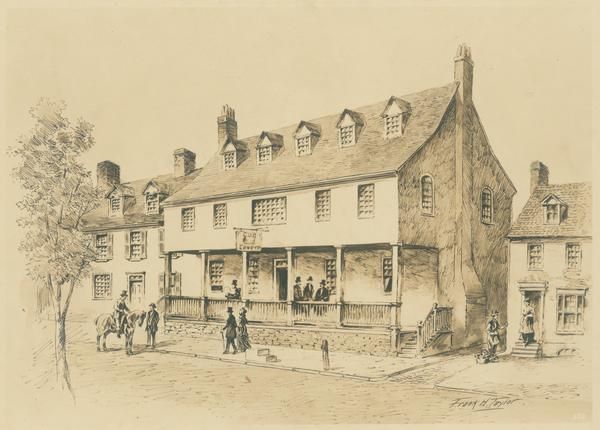
Image: Samuel is said to have used Philadelphia’s Tun Tavern as his base for recruiting men to join the Marine Corps. Frank H. Taylor, The Tun Tavern (circa 1922). Illustration. Frank H. Taylor Collection.
In 1775, he was the first officer commissioned for the two Marine battalions that had been authorized by the Continental Congress in November of that year. He recruited sixty-two men to serve as Marines about the gun frigate Alfred, and ignored orders to attack Lord Dunmore’s ships in the Chesapeake and led an attack on forts in Nassau instead. When he returned to Philadelphia in 1776, he was promoted from Captain to Major, but he never returned to sea. Instead, he “was ‘drafted’ by Washington, along with his eighty-man battalion, to take the place of artillerymen when enlistments expired.”[iv]
He married Mary Jenkins in 1778 and they had at least six children. After the war, he worked as an innkeeper at the Sign of the Conestoga Wagon tavern, owned by his mother-in-law and located on today’s Market Street. He also fought a long battle for the naval “pay and emoluments” he felt due. He joined the Society of the Cincinnati of Pennsylvania in 1783, and served on its Standing Committee from 1785 to 1788. He died from yellow fever in 1790.[v]
After Samuel’s death, the share eventually passed to his son, also named Samuel Nicholas. Samuel acquired share #6 on July 3, 1830 and maintained it until 1853.
The share then remained dormant for eighty-one years until it was acquired by Ada Heilner Haeseler Lewis (1900-1967) on February 1, 1934.
Ada served for more than thirty years on the Philadelphia Board of Education. She graduated from Wellesley College in 1921, and earned an A.M. in History from the University of Pennsylvania in 1922. By 1925, Ada was living in London, but she married a fellow American, John F. Lewis, Jr. The couple were living a prosperous life in Philadelphia by 1930 according to the U.S. Census, and they eventually had at least three children.[vi]
Ada began serving on the Philadelphia Board of Education in the 1930s. In 1939, she was nominated and ran as a Democratic candidate for the Pennsylvania State Senate, but lost to Republican A. Evans Kephart. By 1942, she was serving as an Associate Trustee of the University of Pennsylvania. She was also the first president of the Penn women’s Phi Beta Kappa organization. In 1945, she became the first woman to serve the University of Pennsylvania as a member of the Constituent Board of Liberal Arts.[vii]
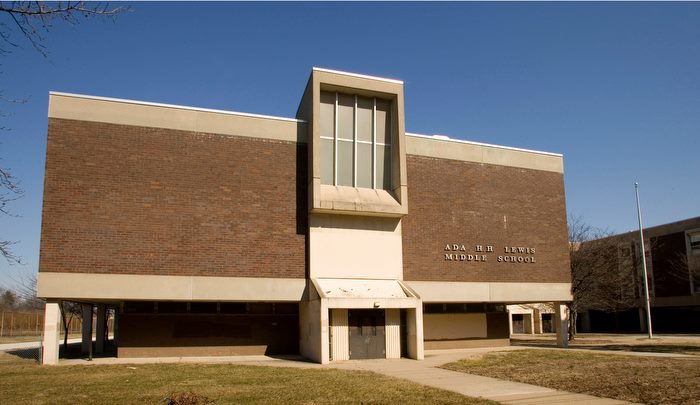
Image: Ada H. H. Lewis Middle School (undated). Photograph. Courtesy of Ada Lewis Middle School Facebook Group (Philadelphia).
In 1962, Ada was named a Distinguished Daughter of Pennsylvania, an honor bestowed by the governor for providing “benefits to a wide community and meritorious service of value to the public.” The article announcing the honor described her as the “recipient of three honorary degrees” and “vice president of the Philadelphia Board of Public Education.”[viii]
Six years after her death, the Philadelphia School District named a new, state-of-the-art middle school in Germantown/Mount Airy in her honor. The school opened to much acclaim in September 1973, but closed in 2008.[ix]
Share History:
- Anthony Nicholas (d. 1751), acquired share #6 on November 10, 1731
- Samuel Nicholas (1744-1790), acquired on June 8, 1769
- Samuel Nicholas, acquired on July 3, 1830
- Ada Heilner Haeseler Lewis (1900-1967), acquired on February 1, 1934
Shareholders who acquired this share after 1950 are not displayed for privacy reasons.
Learn more about Library Company shareholding today.
[i] “At the Instance of Benjamin Franklin”: A Brief History of the Library Company of Philadelphia (Philadelphia, 2015), 5. You can see the Library Company’s contract with its first librarian Louis Timothée at Founders Online, “Agreement between Louis Timothée and Directors of Library Company,” https://founders.archives.gov/documents/Franklin/01-01-02-0085 (accessed March 2, 2022).
[ii] J. A. Leo Lemay, The Life of Benjamin Franklin, Volume 2: Printer and Publisher, 1730-1747 (Philadelphia: University of Pennsylvania Press, 2005), 362-370.
[iii] University of Pennsylvania, “The Un-Quaker Commandant,” The Pennsylvania Gazette, https://thepenngazette.com/the-un-quaker-commandant/ (accessed March 2, 2022).
[iv] The State Society of the Cincinnati of Pennsylvania, “Maj. Samuel Nicholas,” The State Society of the Cincinnati of Pennsylvania, https://pasocietyofthecincinnati.org/gallery_post/maj-samuel-nicholas/ (accessed March 2, 2022).
[v] Ibid. University of Pennsylvania, “The Un-Quaker Commandant,” The Pennsylvania Gazette, https://thepenngazette.com/the-un-quaker-commandant/ (accessed March 2, 2022).
[vi] Ada Haeseler and Frederick Lewis marriage certificate, 1925, available on AncestryLibrary.com as U.S., Consular Reports of Marriages, 1910-1949. Legenda 1921 (Wellesley, MA: Wellesley College, 1921). University of Pennsylvania, “Women at Penn: Timeline of Pioneers and Achievements,” Penn Libraries, https://archives.upenn.edu/exhibits/penn-history/women-timeline/1933-1950 (accessed March 2, 2022).
[vii] “Republicans Gain in State Voting,” The Patriot, November 9, 1939. University of Pennsylvania, “Women at Penn: Timeline of Pioneers and Achievements,” Penn Libraries, https://archives.upenn.edu/exhibits/penn-history/women-timeline/1933-1950 (accessed March 2, 2022).
[viii] Distinguished Daughters of Pennsylvania, “About,” Distinguished Daughters of Pennsylvania, http://distinguisheddaughtersofpa.org/About/ (accessed March 2, 2022). “Mrs. Nauman is Named a Distinguished Daughter,” Sunday Patriot-News, September 30, 1962.
[ix] Valerie Russ, “The Fight for Ada Lewis,” Philadelphia Inquirer, June 13, 2007, https://www.inquirer.com/philly/hp/news_update/20070613_THE_FIGHT_FOR_ADA_LEWIS_SRC_votes_June_20_on_schools_fate.html (accessed May 6, 2024).