Library Company share #16 was first issued to David Bush (circa 1707-1792) on November 22, 1731.
By 1731, Bush was obviously acquainted with Benjamin Franklin (1706-1790) and his fellow Junto members. That group drew up “Articles of Agreement” on July 1, 1731 to found a library, and Bush was among the first group of shares issued four months later. These subscribers each invested forty shillings and “promised to pay ten shillings a year thereafter to buy books and maintain a shareholder’s library.”[i]
He apparently gifted at least one title to the Library Company: Robert Beverley’s History of Virginia.[ii]
By the end of his life, Bush was a merchant and a justice of the peace based in Wilmington, Delaware. In 1785, he wrote a letter to fellow Library Company shareholder Benjamin Franklin to celebrate Franklin’s return to the U.S. In the letter, Bush noted that they hadn’t seen each other for many years, and fondly reminisced about “Our small Club.”[iii]
In Bush’s 1792 will, he bequeathed his Library Company share to his “son David Bush, during his life . . . and his heirs, who shall be called David after him, or the next oldest son who shall be called David by either George or John Bush . . . wishing it may remain in the family name David Bush.”[iv]
Library Company records give no indication that the share was transferred to Bush’s son David or other namesake after his death. But as he wished, the share remained in the name of “David Bush” for more than 30 years.
The share was eventually sold by “estate administrator” and Library Company Librarian John J. Smith, Jr. (1798-1881) to Rev. Charles Philip Krauth (1797-1867) on June 7, 1830.
Krauth was a Lutheran pastor. By the time he purchased this Library Company share, he was a trustee of the Lutheran Theological Seminary in Gettysburg, Pennsylvania, and in 1834, he became the first president of what is today Gettysburg College.[v]
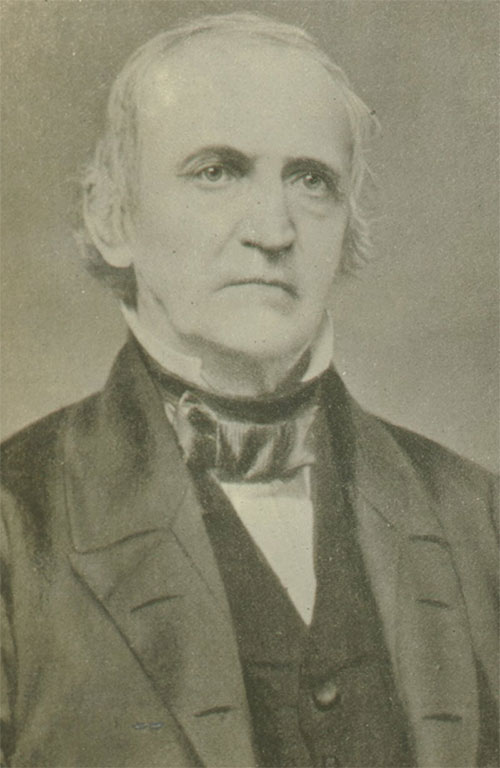
Image: Charles Philip Krauth. Courtesy of Gettysburg College.
Certainly, the Library Company was not very convenient for a resident of Gettysburg. Krauth sold the share to William Norris (1802-1867) on September 5, 1834.
Norris was a builder of steam locomotives. The 1835-1836 Philadelphia directory lists his occupation as simply “America steam carriage co.” Indeed, he had founded that company with Major Stephen H. Long. When his partner left the company, Norris renamed the business “Norris Locomotive Works.” It was one of the dominant builder of locomotives in the U.S. from the 1830s into the 1860s.
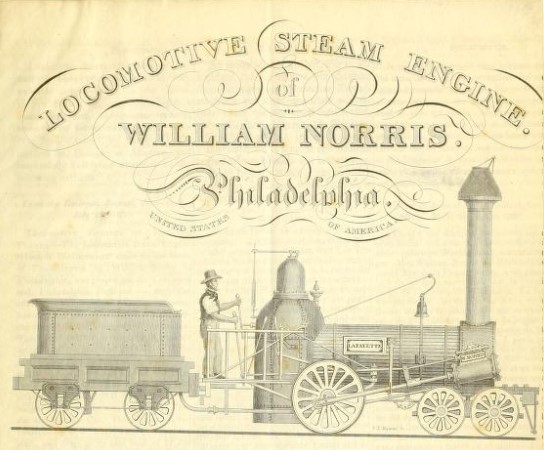
Image: Detail from Locomotive Steam Engine of William Norris, Philadelphia (Philadelphia, 1838). Courtesy of Boston Public Library.
Norris maintained his Library Company share for the next twelve years. His attorney O. A. Norris eventually sold the share on his behalf on April 5, 1845 to Enoch C. Wines (1806-1879).
Wines had been working as a teacher at Central High School for about a decade, but the year before he acquired this share, he had founded a boarding school in Burlington, New Jersey. Wines maintained his Library Company share for the three years he served as that school’s principal. Later in life, he became a minister and eventually dedicated his life to improving conditions for prisoners.[vi]
Wines sold the share to John Rice (1812-1880) on December 8, 1848.
Rice was a successful builder and real estate investor in Philadelphia. By the time he purchased this share, he had been a member of the Carpenter’s Company for nine years.
He built a number of notable buildings, including the armory at Broad and Race Streets; the building that became the Mercantile Library; a number of banks and markets; and private homes like the Ogontz mansion owned by financier Jay Cooke (1821-1905). He also served on the Public Building Commission as well as the Parks Commission, among other roles.[vii]
A few years before his death, Rice sold a parcel of land to the Library Company at Juniper and Locust Streets. That land, combined with several other parcels, became the home of the Library Company’s second, circulating branch. The branch building, designed by architect Frank Furness (1839-1912), opened on February 24, 1880 – just one day after Rice’s death.
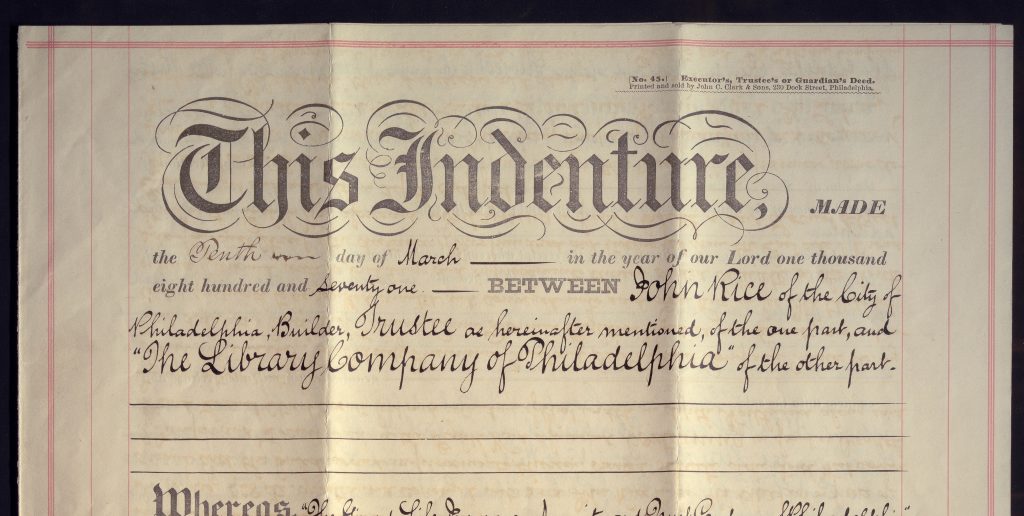
Image: Detail from 1871 indenture in Deeds, Agreement, and Other Documents Related to Juniper and Locust Property – John Rice to Library Company (12482.F.313), box 11, folder 7, Library Company of Philadelphia records (MSS00270).
John sold his Library Company share to his daughter Evelyn Rice Sibley (1851-1929) on January 8, 1880. The Library Company’s records indicate that she was still “Evelyn Rice” on the date of the transaction, but she married later that year and became Evelyn Sibley.[viii]
Library Company records provide no further information about Evelyn, but she maintained her Library Company share for forty-nine years.
After her death, Evelyn’s executrix and daughter Christine Sibley Frazier (1883-1969) transferred the share from her mother’s estate to herself on March 5, 1931.
Library Company records indicate that Frazier relinquished the share on July 1, 1947.
Share History:
- David Bush (circa 1707-1792), acquired share #16 on November 22, 1731
- Rev. Charles Philip Krauth (1797-1867), acquired on June 7, 1830
- William Norris (1802-1867), acquired on September 5, 1834
- Enoch C. Wines (1806-1879), acquired on April 5, 1845
- John Rice (1812-1880), acquired on December 8, 1848
- Evelyn Rice Sibley (1851-1929), acquired on January 8, 1880
- Christine Sibley Frazier (1883-1969), acquired on March 5, 1931
Shareholders who acquired this share after 1950 are not displayed for privacy reasons.
Learn more about Library Company shareholding today.
[i] “At the Instance of Benjamin Franklin”: A Brief History of the Library Company of Philadelphia (Philadelphia, 2015), 5.
[ii] Edwin Wolf 2nd, “Franklin and His Friends Choose Their Books,” The Pennsylvania Magazine of History and Biography, vol. LXXX, no. 1 (January 1956), 19.
[iii] The Papers of Benjamin Franklin, “From David Bush (unpublished),” October 10, 1785, https://franklinpapers.org/framedVolumes.jsp?tocvol=43 (accessed August 28, 2024).
[iv] David Bush will in Wills of New Castle County, Vol L-N, 1777-1794. Courtesy of AncestryLibrary.com.
[v] “Charles Philip Krauth,” Gettysburg College, https://www.gettysburg.edu/about-the-college/college-history/college-presidents/krauth (accessed August 28, 2024).
[vi] “Dr. Wines dead,” The New York Times, December 11, 1879. James Grant Wilson and John Fiske, eds., Appletons’ Cyclopedia of American Biography, volume VI, (New York, 1889), 563.
[vii] “Deaths of Prominent Citizens—John Rice, David Landreth and Dr. T. L. Leavitt,” The Philadelphia Inquirer, February 24, 1880.
[viii] Chronological Share and Directors Register, volume 193, Library Company of Philadelphia records (MSS00270).