
A Tour of the Library Company’s Buildings Over its First 150 Years
Dana Dorman, Archivist, Library Company Papers Project
Over the course of its long history, the Library Company of Philadelphia has had many homes. Our ongoing work in the Library Company Papers Project is helping to provide new access to the records that document those moves over our first 150 years of operations.
The first few homes for the Library Company were actually in the residences of its Librarians.
The Library Company hired its first Librarian, Louis Timothée (d. 1738), in November 1732. When Timothée left for Charleston the following year to become a printing partner of Benjamin Franklin (1706-1790), Franklin himself took over as Librarian.
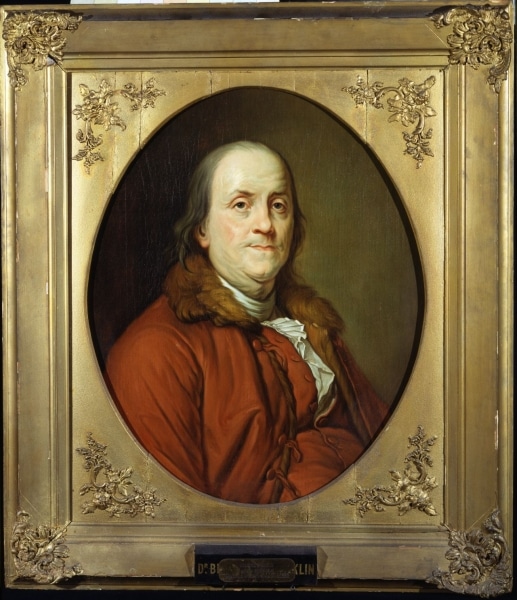
Image: Ann Leslie from the original by J. S. Duplessis, Benjamin Franklin (circa 1858). Oil on canvas. Gift of Ann Leslie.
Franklin therefore also took over responsibility for storing the Library Company’s books and other items while he served as Librarian from December 1733 to March 1734.
William Parsons (1701-1757) took over as Librarian in March 1734. Parsons served for the next twelve years, and was the final Librarian expected to house the collection in his personal living quarters.
Unlike his predecessors, Parsons eventually had to find room for an 11.3-foot-tall storage cabinet in addition to the books and other items. John Penn (1700-1746) had given the Library Company a glass air-pump in 1738 “to show the Nature & Power of the Air,” and the Library Company commissioned the large Palladian-style cabinet to house it.[i]
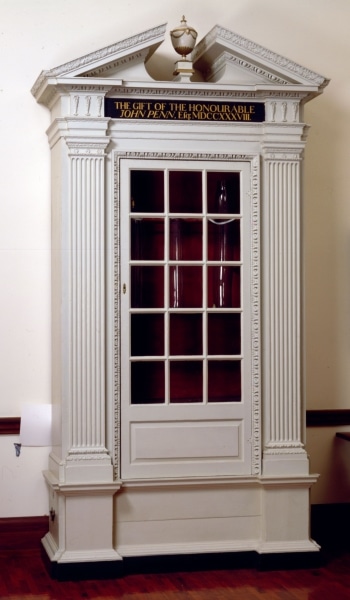
Image: John Harrison, Air-Pump Case (Philadelphia, 1739).
The Library Company’s minutes don’t specifically record Parsons’ opinion about the new cabinet, but at the next month’s meeting of the Directors, Parsons told them they “should raise his Salary, or take the Books from his House & appoint another Librarian.”[ii]
The Library Company moved to rented space the very next year.
From 1740 to 1773, the Library Company was based on the second floor of the newly finished west wing of the State House of Pennsylvania (now Independence Hall).
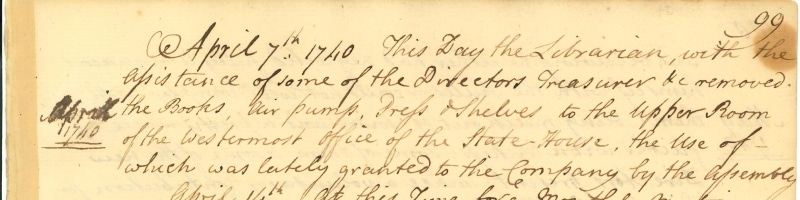
Image: The April 7, 1740 Directors’ minutes note that the books, glass air pump, and shelves were moved to the State House on that day. Detail from Directors Minutes Volume 1, 1731-1768, Volume 163, Library Company of Philadelphia Records (MSS00270), Library Company of Philadelphia.
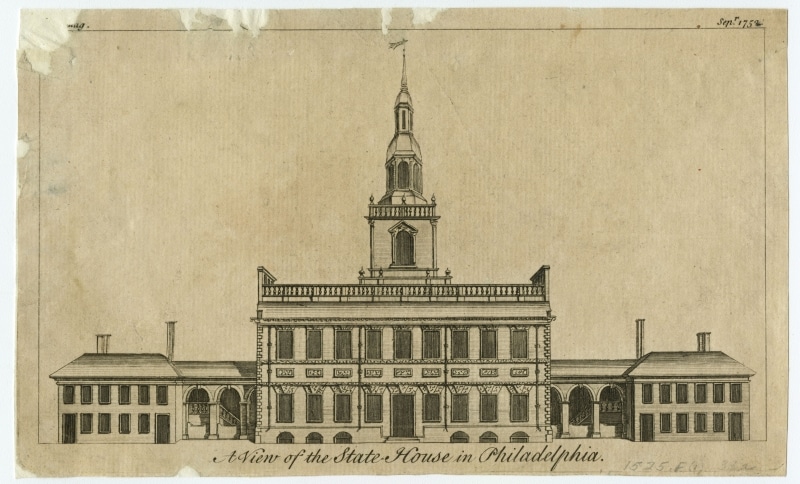
Image: George Heap, A View of the State House in Philadelphia (London, 1752).
Over the years, the Library Company’s collections continued to grow, especially after it merged with the Union Library Company in 1769. That library had recently absorbed the Association Library Company and Amicable Library Company, so the Library Company now included the Union Library’s combined collections, shareholders, and building on Third Street.
At first, the Library Company maintained the two spaces: Librarian Ludovic Sprogle was put in charge of the collection at the State House, while Librarian John De Mauregnault was responsible for the items at “the House on Third Street.” But after the collections were compared and duplicates sold off, the Library Company moved the consolidated holdings to its two rooms at the State House and rented out the former Union Library Company building for extra income.[iii]
The Library Company was interested in constructing its own building, and had petitioned the Pennsylvania Assembly more than once for permission to build in the yard of the State House. However, by 1773, the Directors opted to rent space in the newly constructed Carpenters’ Hall, located roughly one block away near 4th and Chestnut Streets.
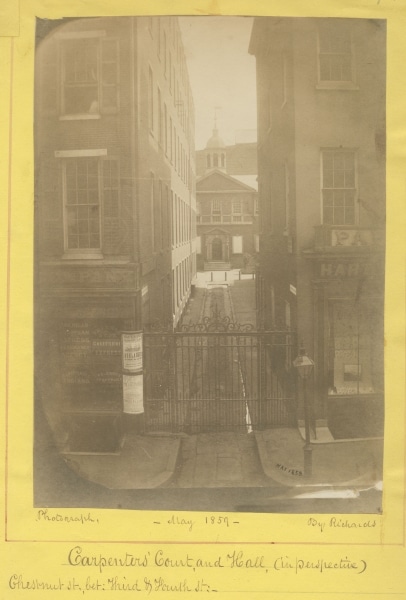
Image: F. De B. (Frederick De Bourg) Richards, photographer. Carpenters’ court and hall (in perspective), Chestnut St. bet. Third and Fourth St. [graphic] / Photograph by Richards. (Philadelphia, 1859). Photographic print.
Of course, very soon after the Library Company moved into the second floor of Carpenters’ Hall, another group began using the first floor: the First Continental Congress.
The Directors of the Library Company voted in August 1774 to offer free use to the delegates of “such Books as they may have occasion for” if they took a “Receipt for them.” Later, the Directors offered the same borrowing privileges to the delegates of the Second Continental Congress, the Constitutional Convention, and members of Congress while the federal capital was based in Philadelphia.[iv]
Finally, in 1789, the Library Company’s Directors and shareholders voted to move forward with plans to “erect a suitable Building with Cellars, the said Building to be two stories high, and of a size sufficient to accommodate and serve the Purposes of the Library.”[v]
The Library Company secured a lot near the corner of 5th and Chestnut Streets, and the new building opened on New Year’s Day, 1791.
According to a fire insurance survey, the first floor “was fitted up with book shelves to the ceiling on the east, or rear, side and in part on either end. The highest shelves were reached from a ‘light’ gallery which ran along in front . . . Upstairs there were three rooms: one for Directors’ meetings, one apparently for the scientific apparatus, and one of unknown use, possibly the Librarian’s office.”[vi]
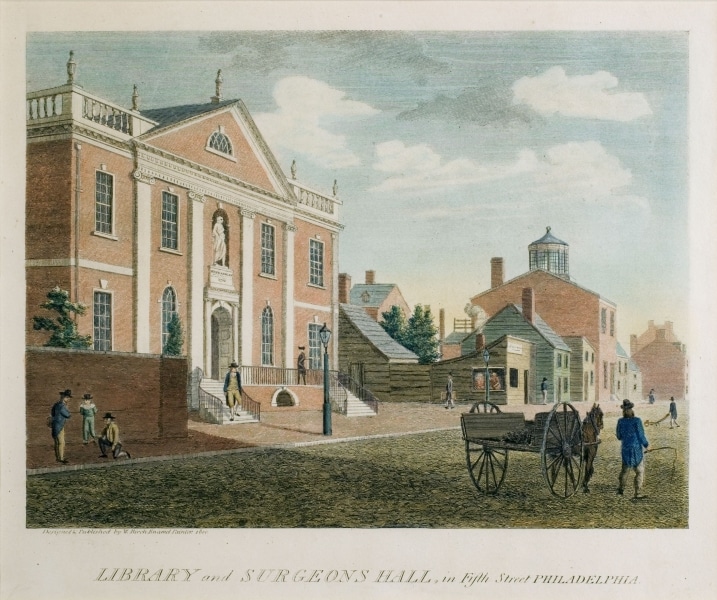
Image: William Birch. Library and Surgeon’s Hall, Fifth-street (Philadelphia, 1800). Engraving.
However, almost immediately upon moving into its new building, the Library Company had to begin considering an expansion. In 1792, the General Assembly annexed the Loganian Library to the Library Company, with the condition that it be maintained in a separate building. The Loganian addition was built on the east side of the library, and opened in 1794.[vii]
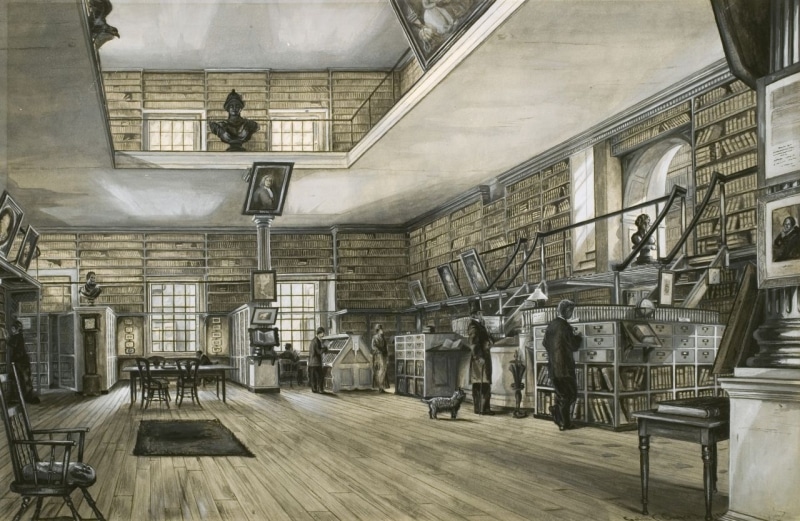
Image: In this interview view, the arched doorway on the right connects to the Loganian Library room located on the east side of the building. Colin Campbell Cooper, Jr. [Main hall, Library Company of Philadelphia, Fifth and Library Streets, Philadelphia] [graphic] (Philadelphia, [1879]). Watercolor.
The Library Company constructed one more addition to the building by 1835—a one-story brick wing on the north side—but eventually decided that it needed a fully “fire proof” structure.[viii]
A building fund was launched in 1856, but it was a generous 1869 bequest from shareholder Dr. James Rush (1786-1869) that spurred the Library Company’s next move. Rush left the Library Company an estate worth nearly $1 million, but included a variety of restrictions for the gift.
For instance, the will dictated that Rush’s executor (and brother-in-law) Henry J. Williams (1791-1879) use the bequest to purchase a large lot at Broad and Christian Streets and construct a new building for the Library Company. Shareholders protested that the location was inconvenient, but Williams held firm.
Library Company shareholders eventually voted to accept the gift, but the bequest spurred at least four lawsuits, required a new state law to change the Library Company’s charter, and dictated that Rush and his wife Phoebe Ann Ridgway Rush (1799-1857) be interred in the new building, among other things.
The new Ridgway Building opened in 1878.
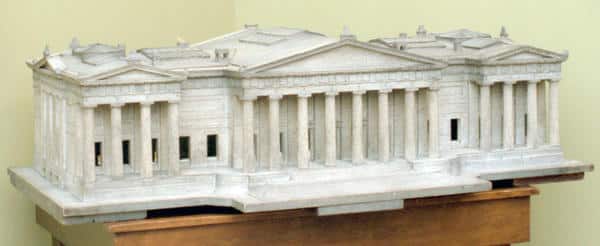
Image: Addison Hutton, Model for the Ridgway Library (Philadelphia, circa 1870).
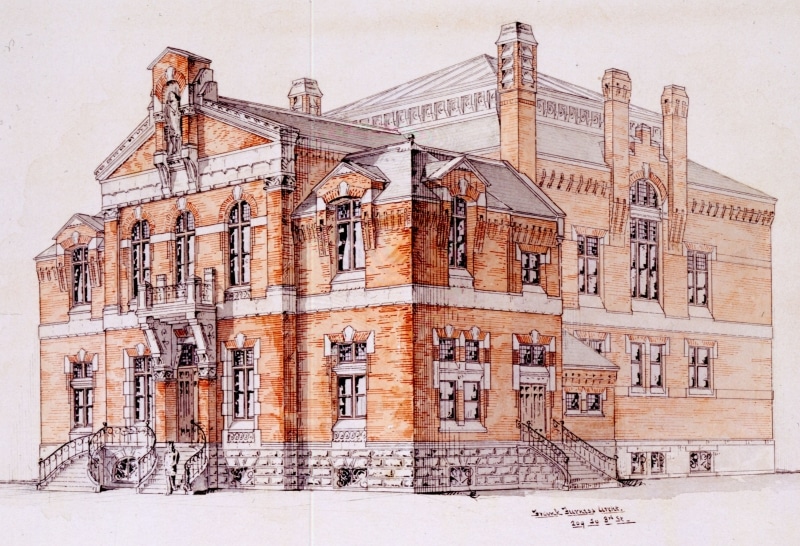
Image: Frank Furness, Juniper and Locust Street Building (Philadelphia, circa 1879). Ink and wash drawing.
Given the divided opinions about the location, the Library Company used its building fund to construct a second, more convenient building at Juniper and Locust Streets. Designed by architect Frank Furness (1839-1912), that circulating branch opened on February 24, 1880.[ix]
You can learn more about where the Library Company moved after 1881 by reading “At the Instance of Benjamin Franklin:” A Brief History of the Library Company of Philadelphia (Philadelphia, 2015).

Any views, findings, conclusions, or recommendations expressed in this blog post do not necessarily represent those of the National Endowment for the Humanities.
[i] See minutes from May 1, 1738 in Directors Minutes Volume 1, 1731-1768, Volume 163, Library Company of Philadelphia Records (MSS00270), Library Company of Philadelphia.
[ii] See minutes from October 8, 1739 in Directors Minutes Volume 1, 1731-1768, Volume 163, Library Company of Philadelphia Records (MSS00270).
[iii] See minutes from May 2, 1769 in Directors Minutes Volume 2, 1768-1785, Volume 164, Library Company of Philadelphia Records (MSS00270). Dorothy Fear Grimm, “A History of the Library Company of Philadelphia 1731-1835” (PhD dissertation, University of Pennsylvania, 1955), 148.
[iv] See minutes from August 31, 1774 in Directors Minutes Volume 2, 1768-1785, Volume 164, Library Company of Philadelphia Records (MSS00270).
[v] See minutes from June 4, 1789 in Directors Minutes Volume 3, 1785-1794, Volume 165, Library Company of Philadelphia Records (MSS00270).
[vi] Quoted in Grimm, 179
[vii] Grimm, 182.
[viii] Charles E. Peterson, “Library Hall: Home of the Library Company of Philadelphia 1790-1880,” Proceedings of the American Philosophical Society Volume 95, No. 3 (1951), 281-282.
[ix] In 1884, the Library Company sold its original building at 5th and Chestnut Streets to Anthony J. Drexel. He demolished the structure to build the headquarters of the Drexel & Company Bank. The Drexel Building later housed the library of the American Philosophical Society (APS) for about twenty years; APS then built its Library Hall as a recreation of the Library Company of Philadelphia’s original 1791 building.

