The Fabricated World in Your Hands

The paper and propaganda engineers of movable advertisements produced popular metamorphic works of art that engaged and persuaded their viewers to see, want, and strive for or reject the imagined, and for many, fictional world represented in their hands. The advertising pieces on display in this section and throughout the exhibition often rely on complex themes of nostalgia and progress; contrived everyday representations of rural, suburban, and urban life; gender objectification; and racial exclusion and prejudice. The typically white male dominated world seen in the hands of those of the past can be enraging, startingly familiar, and/or jarringly unexpected.
“… in looking over … advertising … did you ever give serious thought to the art … displayed therein … for human comfort, health, and luxury…”

“Art of Advertising,” Saginaw News, October 29, 1892

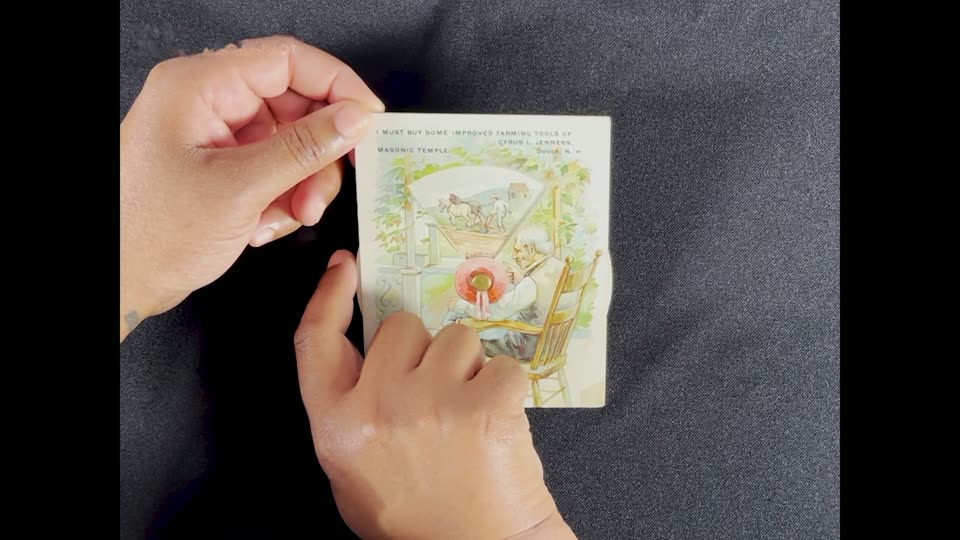
I Must Buy Some Improved Farming Tools of Cyrus L. Jenness, Masonic Temple, Dover, N.H. (United States, ca. 1890). Color photomechanical. Turn wheel. Robert Staples Metamorphic Collection.

This advertisement for the New Hampshire hardware store of Cyrus L. Jenness (1848-1929) shows the affecting and effective messaging possible through a wheel device. Reflecting Jenness’s lineage as a descendant of a long-standing farming family, the print relays the romance, nostalgia, and generational pride of rural life through a tableau showing a grandfather telling a story to his grandchild. Based on a “year in the life” of a farmer motif, the scrolling scenes end with “One pipe before bedtime.” The end of the day episode pictures a moment equally common to 19th-century rural, suburban, or urban life.

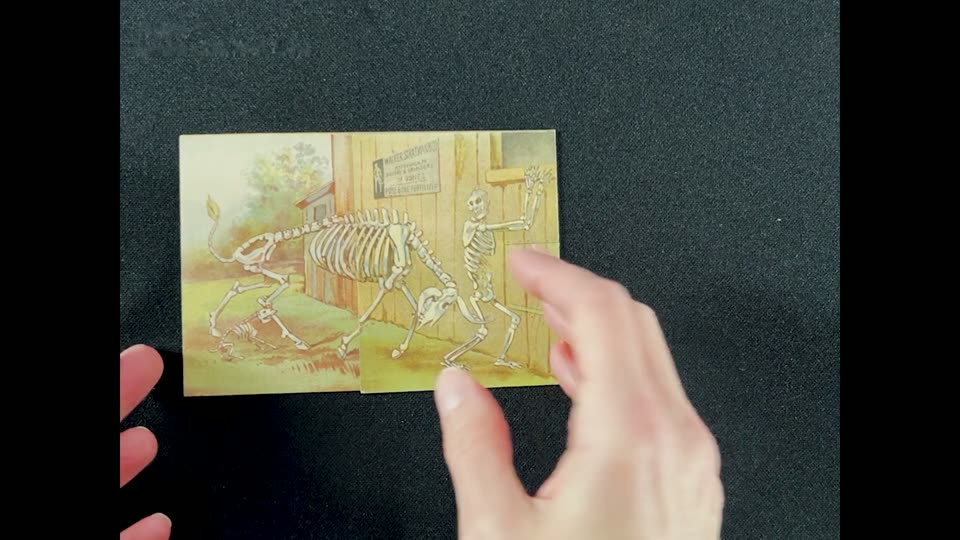
Walker, Stratman & Co. Boilers & Grinders of Bones and Manufacturers of Pure Bone Fertilizers. Allegheny, PA. ([Pittsburgh]: [Walker, Stratman & Co.], ca. 1890). Chromolithograph. Fold out. Robert Staples Metamorphic Collection.

A portrayal of a day in the life of a Walker, Stratman, & Co. employee takes an irreverent turn in this advertisement for the fertilizer manufactory. Conceived in an absurdist and graphic manner, the fold-out card depicts the economic, agricultural, and social realities and sensibilities of husbandry during the 19th century. Further exhibiting the no-waste principles of the era, the Pittsburgh firm also processed animal by-products into soap and candles.

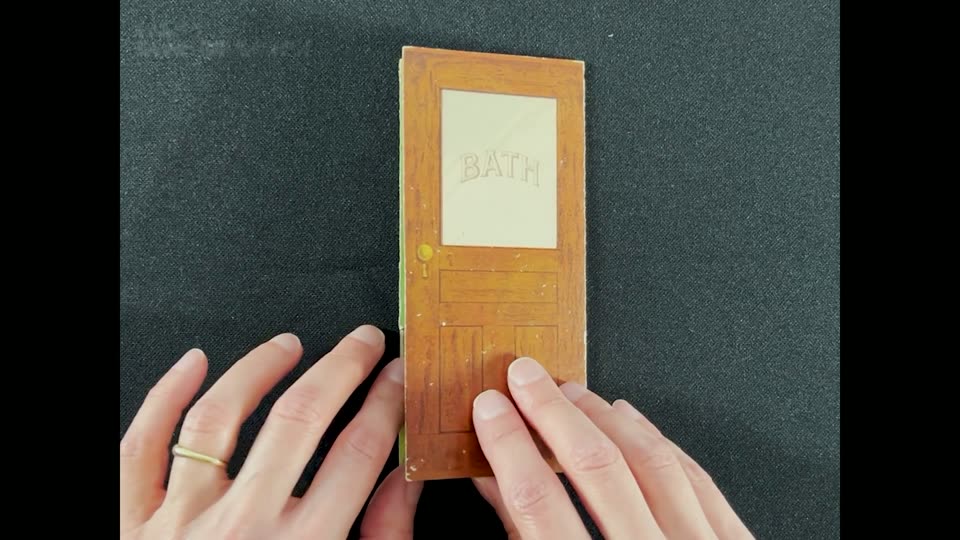
Bath. “The early bird catches the Worm” Chas. Eitapence & Co. Hardware, Tinning, Plumbing and Steam Fitting, Worcester, N.Y. ([Worcester, N.Y]: [Chas. Eitapence & Co.], ca. 1900). Chromolithographs. Fold out. Robert Staples Metamorphic Collection. Variant copy demonstrated in video.

Also, on the spectrum of 19th-century satirical portrayals of rural figures is this “behind the scenes” fold-out advertisement. To market their “Sanitary Plumbing,” Chas. Eitapence & Co. chose a “fish out of water” rendering of a man from the country unfamiliar with indoor toilets. Nestled behind several lines of prophetic prose declaring the healthfulness of Eitapence plumbing, our early riser appears almost like a bird in a bird bath as he washes his hair in a lodging house water closet free from the potential for germs.

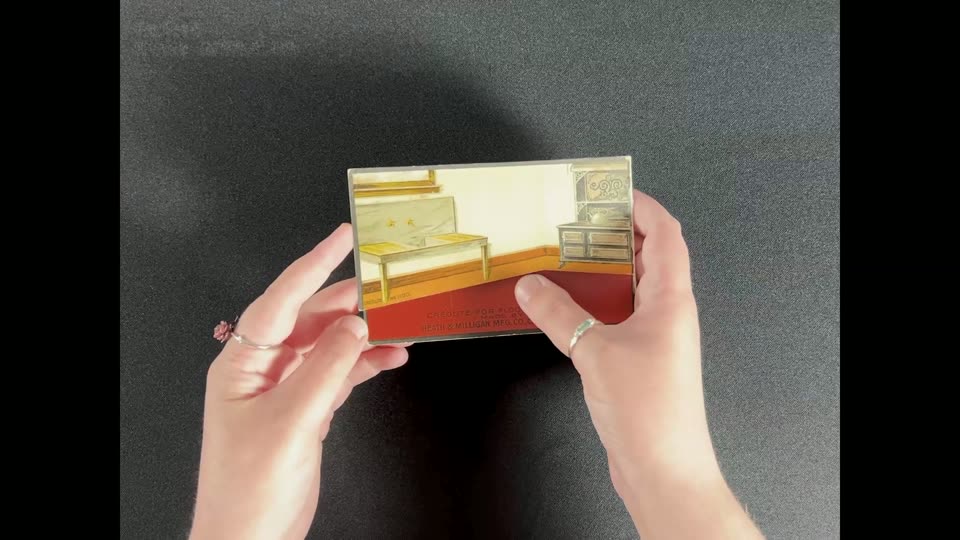
Creolite for Floor Painting. Made By Heath & Milligan Mfg. Co., Chicago. U.S.A. (Chicago: Heath & Milligan Mfg. Co., 1902). Printed by Gray Lith Co., N.Y. and Chicago. Chromolithograph. Fold out. Robert Staples Metamorphic Collection.

Not meant to appeal to the “early bird” rural consumer represented in the previous advertisement, Heath & Milligan’s targets the suburban homeowner. Established in Chicago in 1851, the national paint company often used untraditional marketing tactics for their trade. This novelty allowed the householder to mix and match colors of floor paints for various rooms of the house while also possibly imagining other interior decorating ideas. The format provided simulations like computer generated design tools of today.

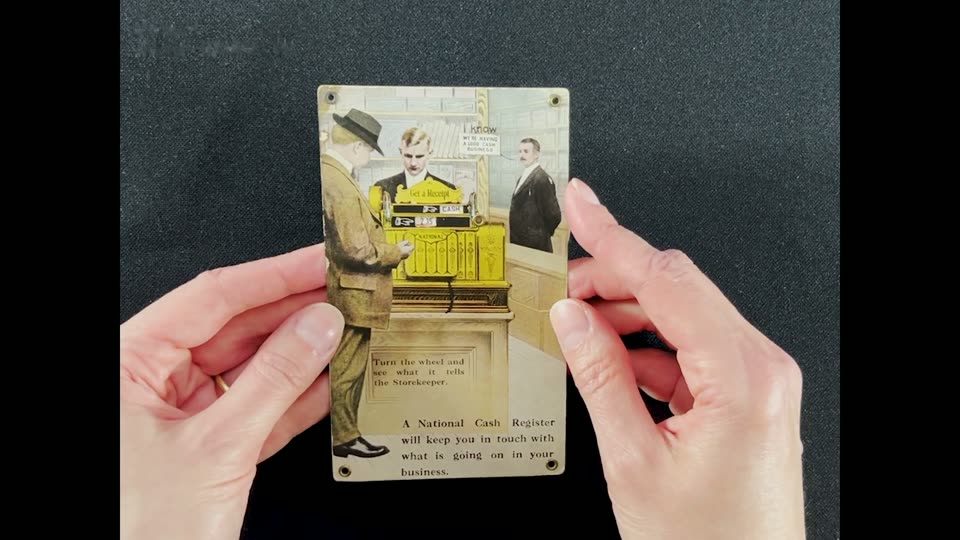
A National Cash Register will keep you in touch with what is going on in your business ([Dayton, OH]: [National Cash Register Co.], ca. 1915). Color photomechanical. Wheel. Robert Staples Metamorphic Collection.

In the days before electronic and touch screen sales, mechanical cash registers served this pertinent role in retail stores. By the time of this ad geared to merchants, National Cash Register Co., established in 1884, dominated the market in the production of these devices meant to prevent embezzlement and fraud through cash drawers and printed receipts. This dynamic is smartly and practically conveyed with this mechanical composed of twelve windows showing variant possible exchanges between a customer, cashier, and storekeeper.

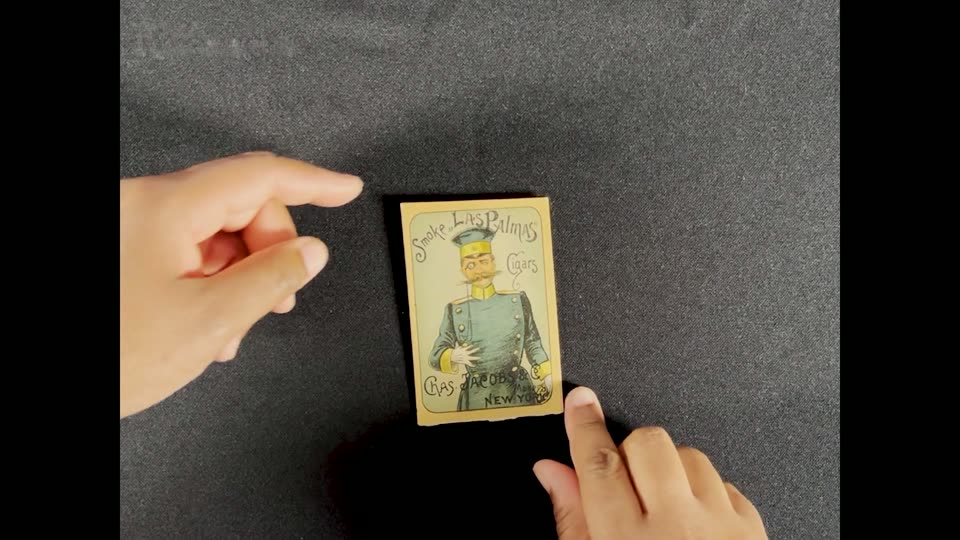
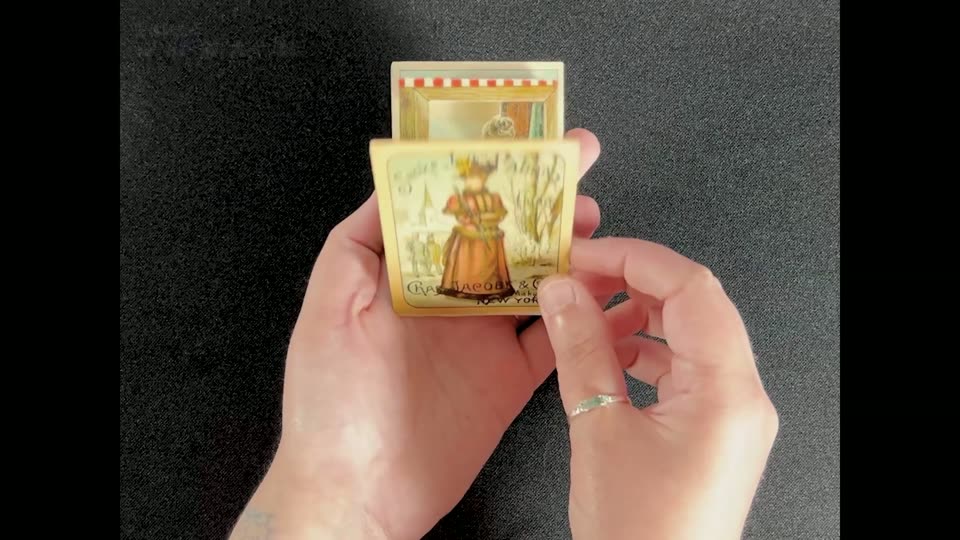
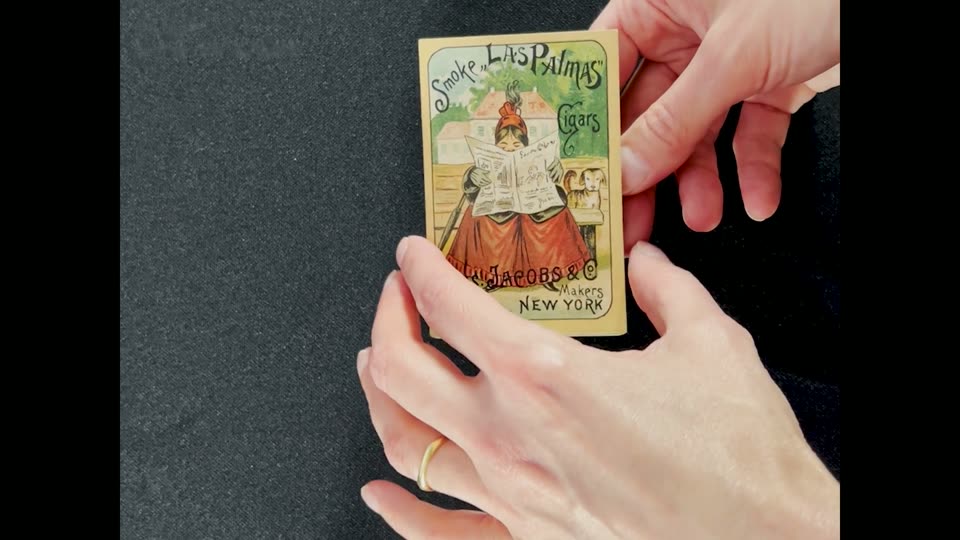
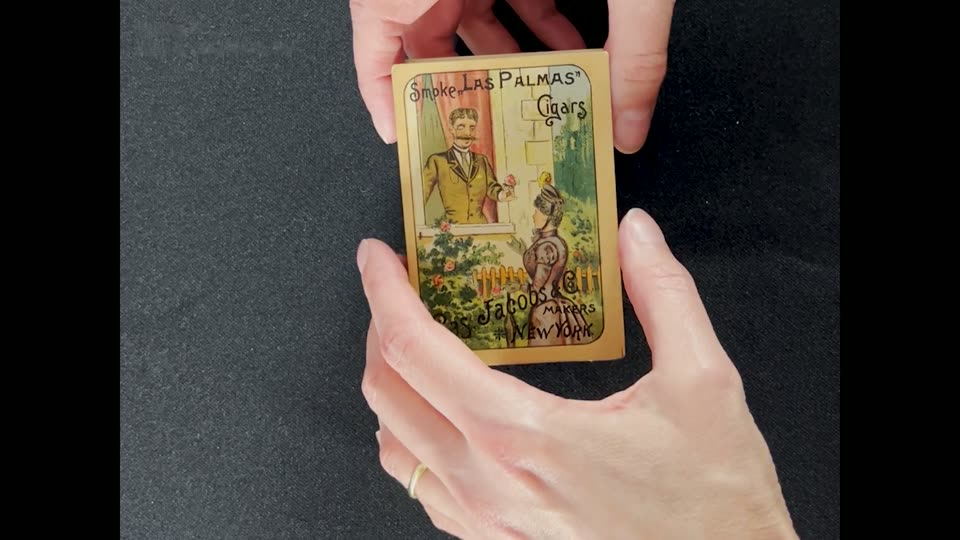
Series of pop-up advertisements, “Smoke ‘Las Palmas’ Cigars,” Chas. Jacobs & Co. Makers New York. ([New York]: [Chas. Jacobs & Co.], ca. 1900). Chromolithographs. Pop up. Robert Staples Metamorphic Collection.

A little larger than the size of matchbooks, these advertising premiums for the New York tobacco firm first established in San Francisco in 1883 recommend: “Smokers of the ‘Las Palmas’ Cigars are entitled to a set, get them of your dealer.” A selection from about a dozen in the series, the pop-up trinkets show leisurely, ironic, and farcical situations. While only some repurposed foregrounds like with the beach scenes, all provide windows onto memorable, often embarrassing moments in life which most anyone of the Jacobs’s era and today can relate and appreciate.

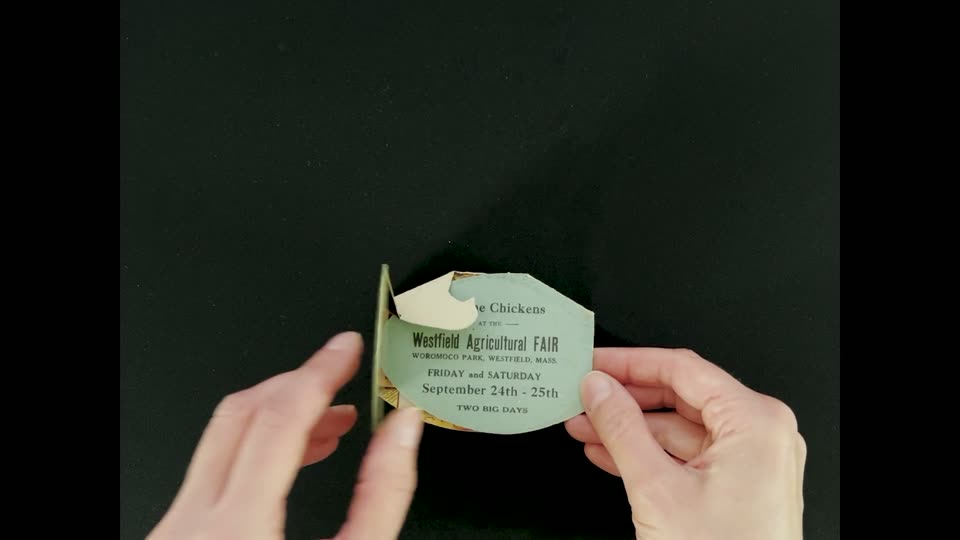
Which was First, the Chicken or the Egg? See the Chickens at The Westfield Agricultural Fair, Woromoco [sic] Park, Westfield, Mass. (Cincinnati, OH: Hennegan, 1915). Color photomechanical. Pop up. Robert Staples Metamorphic Collection.

Printed by the Cincinnati-firm Hennagan, one of the premier printing companies of the turn of the 20th century, this pop-up promotion unironically showcases a woman in urbane attire, one of the “chickens,” to be seen at the first Westfield Agricultural Fair. Marketed as a family exposition that would be a “credit to the town,” the event received days of local press beforehand, including a mention about the $385 worth of premiums devoted to the Poultry Department.

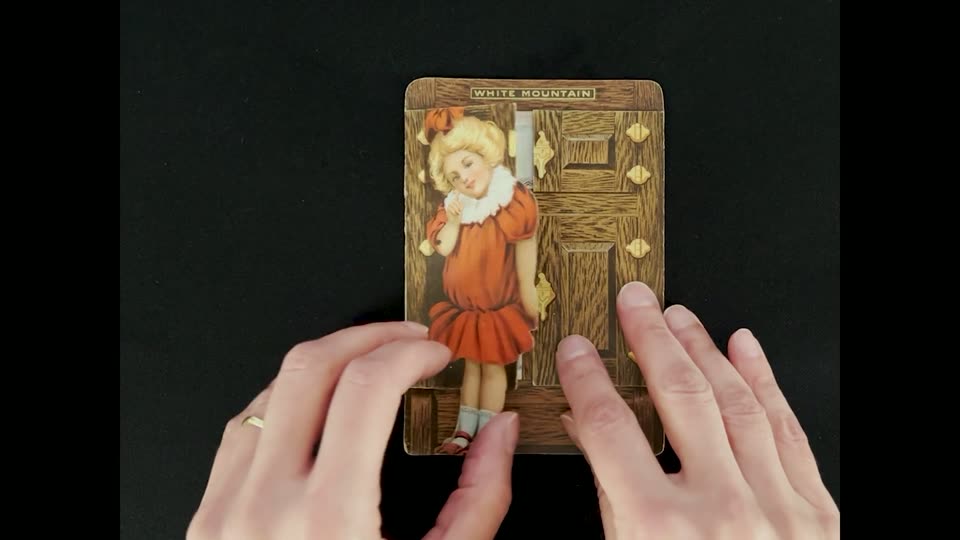
White Mountain Refrigerators. Maine Manufacturing Co. Nashua, N.H. Largest Refrigerator Factory in the World (New York: American Lithographic Co., ca. 1907). Chromolithograph. Pop up. Robert Staples Metamorphic Collection.

Coquettishly posed before a wood-paneled “White Mountain” refrigerator, the young girl model opens a door to a colorful bounty of food typical of a family of means. The “chest with the chill in it” produces not only a shiver for the homemaker-to-be, but an opportunity to display a modern feature of the unit purported as “in over a million homes.” More properly described as an ice box that sold for about $20-$30, the appliance symbolized the changing domestic environment of the early 20th century. In the decades to come, refrigerators would further evolve from luxuries to everyday commodities that changed the diets and lifestyles of those who owned them.

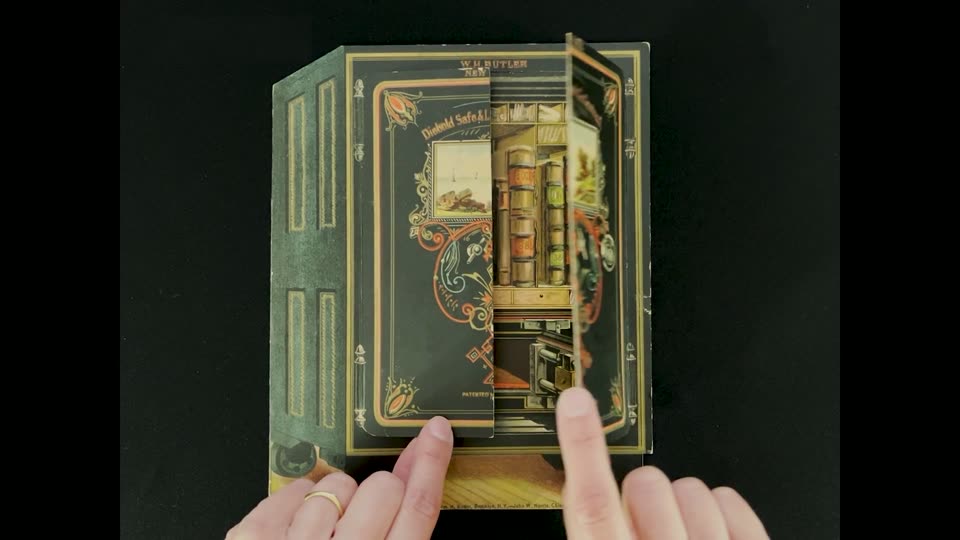
Diebold Safe & Lock Co., Canton, O. (Brooklyn, N.Y.: Wm H. Butler and Chicago: John W. Norris, copyright 1884, printed 1887). Chromolithograph. Fold out. Robert Staples Metamorphic Collection.

Like the “White Mountain” refrigerator, this “W.H. Butler” fire-proof safe appears more like a stylish piece of furniture than a container. Designed from an 1877 patent (No.188,775) meant to “produce a safe that is strong, durable, neat, and can be furnished at a very reasonable cost,” the storage device invited marketing as a fold-out print. “Doors” adorned with a landscape view open to shelves and drawers of valuables and secrets to which the manipulator of the device could playfully feel like their guardian or their thief.

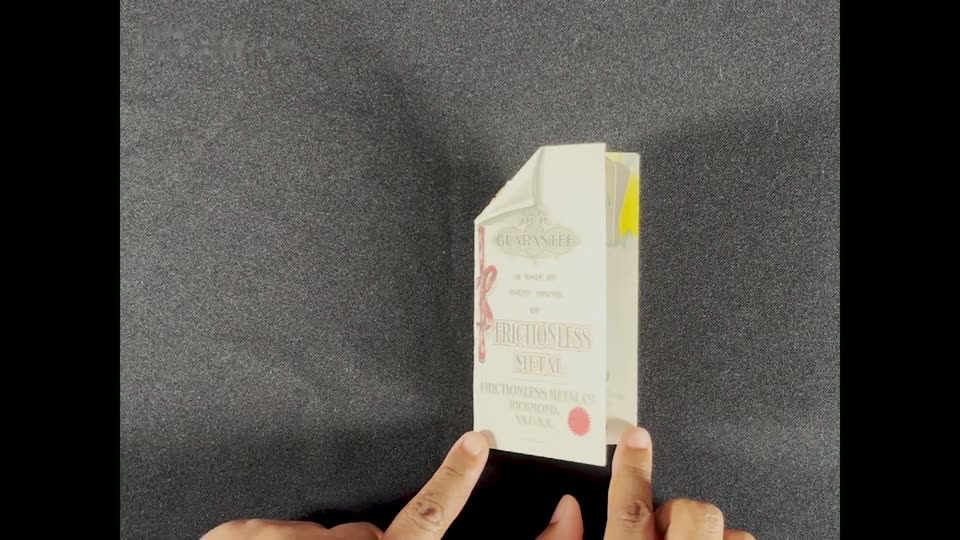
Our Guarantee is Back [sic] Every Pound of Frictionless Metal. Frictionless Metal Co. Richmond, Va. U.S.A. Held Up Everywhere as the Best in the World (Richmond: Frictionless Metal Co., 1901). Printed by American Lithographic Co., N.Y. Patented by Albert Operti. Chromolithograph. Pop up. Robert Staples Metamorphic Collection.

Conceived with the identical pop-up design as the Remington typewriter advertisement meant for office proprietors in the Pleasant Devices section, this one is meant for men of industry. Composed with an idealized and virulent portrayal of an iron worker, the man attired in shirt sleeves and jeans, emerges from his paper enclosure and effortlessly lifts a bar of “Frictionless” metal over his head. Embodying the globalist motto of the company established in 1887, “Held Up Everywhere as the Best in the World,” he stands firmly upon a pedestal of metal bars destined to become mechanical bearings to more efficiently operate factories like the ones depicted in the stylized background behind him.

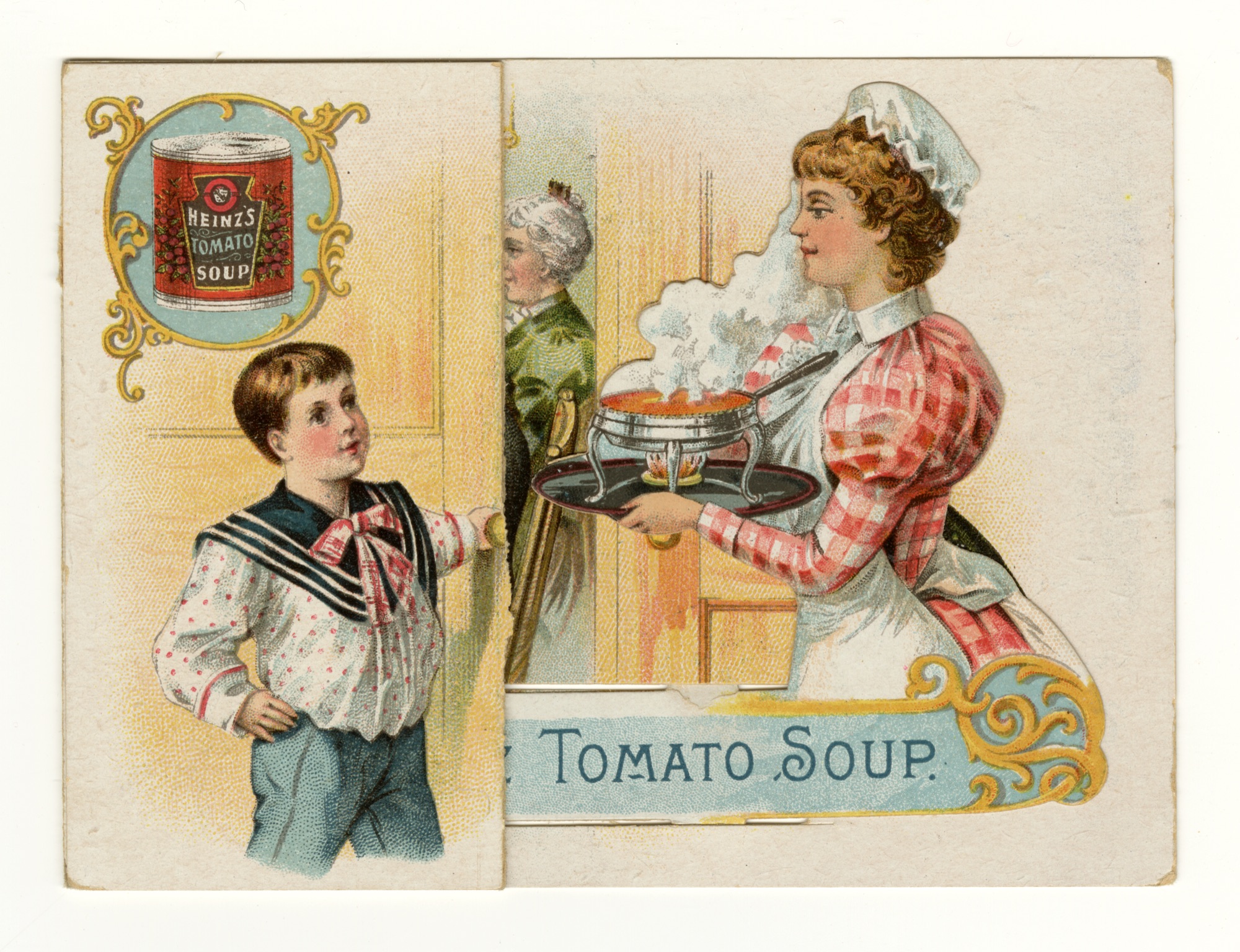
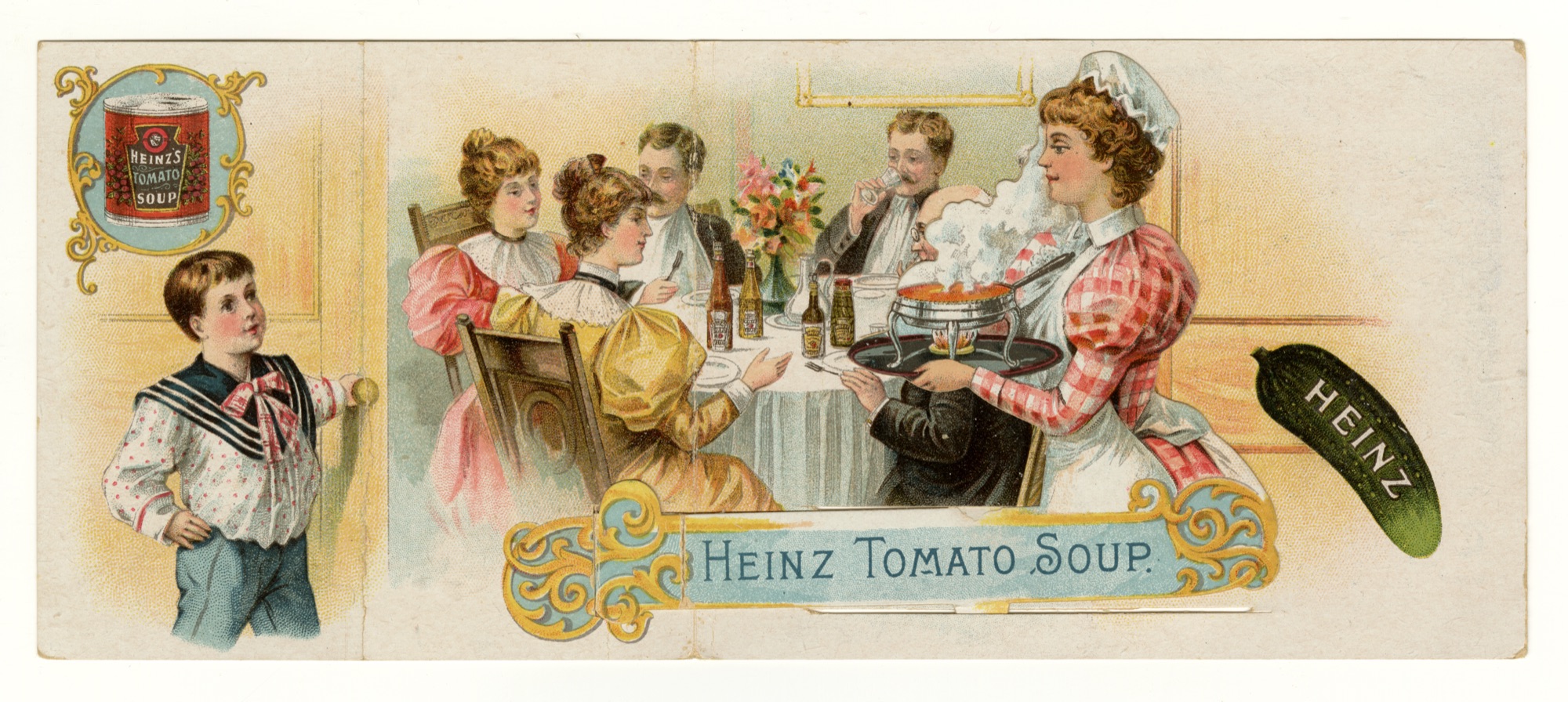
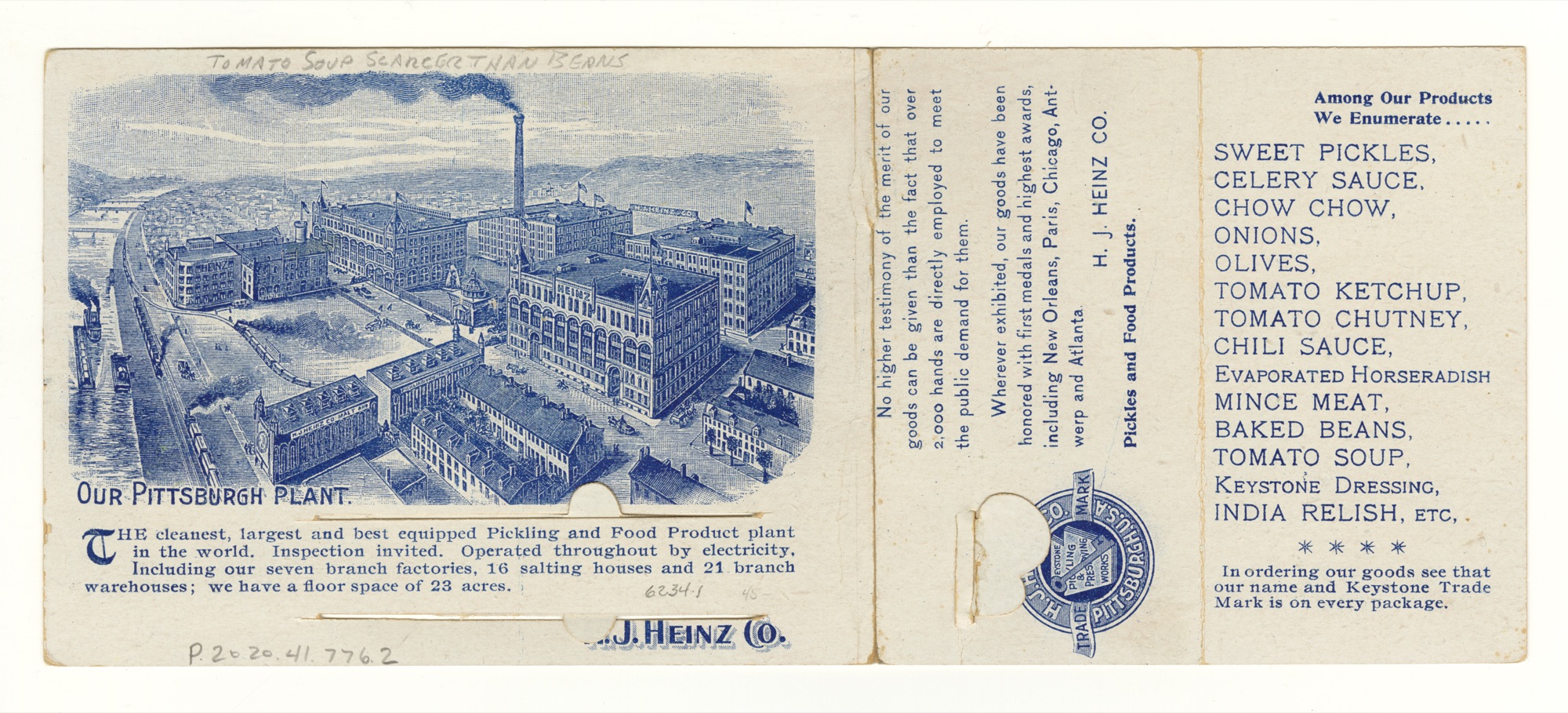
Heinz Tomato Soup. H.J. Heinz Co. (Pittsburgh: H.J. Heinz Co., ca. 1900). Chromolithographs. Pull tab. Robert Staples Metamorphic Collection.

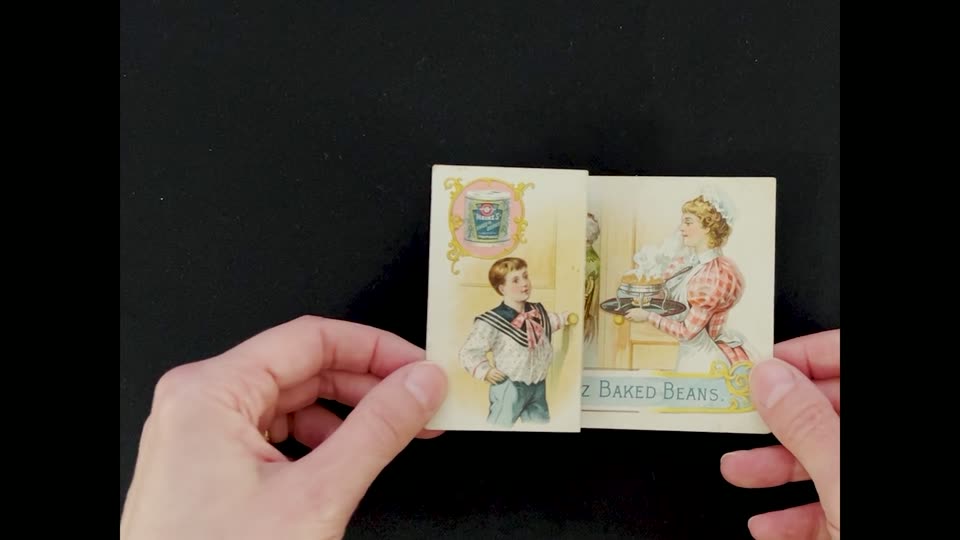
Heinz Baked Beans. H.J. Heinz Co. (Pittsburgh: H.J. Heinz Co., ca. 1900). Chromolithograph. Pull tab. Robert Staples Metamorphic Collection.

Associated primarily with ketchup today, the Heinz brand encompassed a variety of food products, particularly canned, when established in 1869 by Henry J. Heinz (1844-1919). Known for using original advertising in national campaigns, the firm operated on the principle of mass production for mass consumption. Unsurprisingly, this pull-tab device uses every part of the work to market the firm’s modern plant, variety of safely processed products, and popularity. Although the scene behind the door may be unexpected, a domestic worker serving a chafing dish of food from a can was most likely to happen in well-to-do homes in the early 1900s.

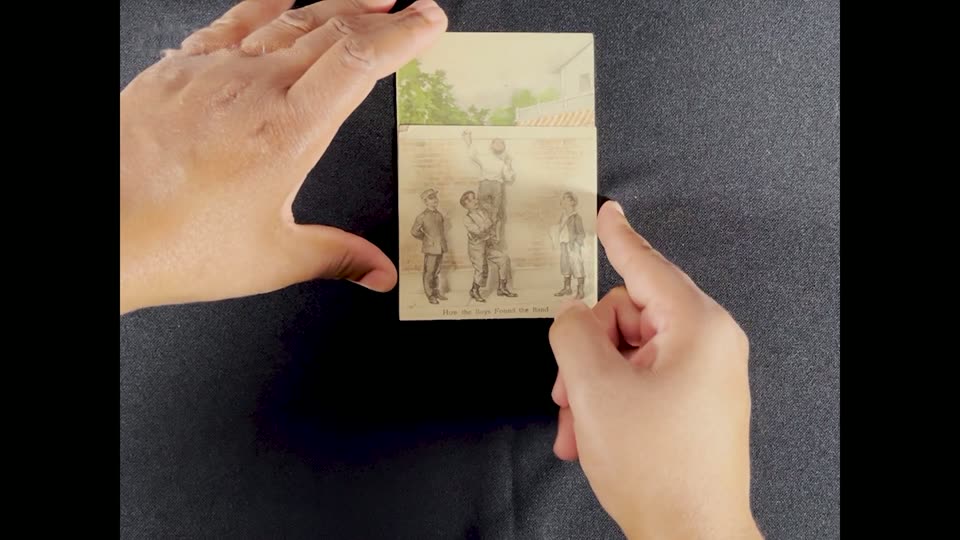
How the Boys Found the Band. The Edison Phonograph ([New York]: [National Phonograph Co.], ca. 1900). Color photomechanical print. Fold out. Robert Staples Metamorphic Collection.

This fold-out promotion states “Mr. Edison wants to see a Phonograph in every home.” Designed in a transformation format, the advertisement starts with a group of working boys, as implied by their attire, at the wall of a suburban residence. They have been fooled into looking for a band. It ends with a sentimental and aspirational picture of life, a middle-class home made happy by the machine first invented by Thomas Edison (1847-1931) in 1877. The boys, and the possible purchaser of the Edison invention, discovered not only a phonograph but a life “in easy enjoyment of pleasing melodies” at home to which they could aspire.

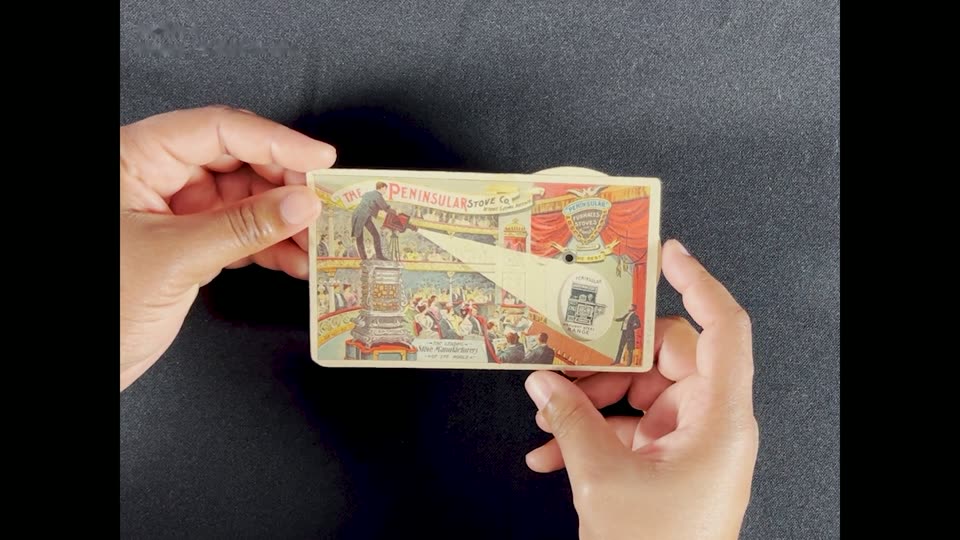
The Peninsular Stove Co. Detroit. Chicago. Buffalo. The Leading Stove Manufactory of the World (Cincinnati: Achert & Henkel, ca. 1895). Chromolithograph. Wheel. Robert Staples Metamorphic Collection.

While the phonograph was meant to keep folks entertained at home, the Peninsular Stove Co. provides a clever view of the joys of entertainment outside one’s abode. In operation 1881-1929, the firm manufactured stove models with majestic names and decorative, ornate designs like the “Regal Peninsular” strategically placed for utmost effect on this turn-dial marketing device. The pedestal for the operator of a magic lantern projector, the stove visually dovetails those successively seen in dissolving views on the screen over the stage. The appliances’ designs seamlessly complement those of the attire of the elegantly dressed theater attendees, patrons able to afford the units that could cost up to a few hundred dollars.

Of their Time: Race, Gender, and Status

Given the motives of advertising to influence and persuade, advertisements also document and reflect empowering, transgressive, and ugly aspects in our visual culture. Metamorphic works disseminating imagery portraying reclamations of racial, gender, and social identities; systemic inequalities and racism; and violence against communities outside the white majority necessitate difficult and deliberative reflections about the creators’ and viewers’ conscious and subconscious understandings of them. The messages intended and received can be subversive, evoke challenging and disturbing questions about their purpose, or profoundly harm and offend.

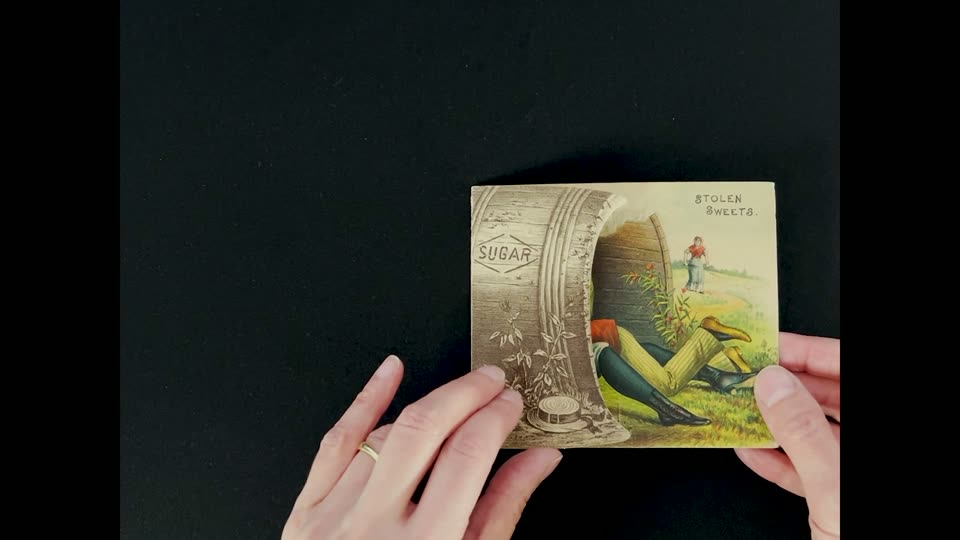
Stolen Sweets. Hello There, Central!!! Old Judge Cigarettes! (New York: Giles Litho. & Liberty Printing Co., 1888). Chromolithograph. Fold out. Robert Staples Metamorphic Collection.

As seen in other sections of the exhibition, tobacco advertisements contain some of the most provocative imagery based on sexual innuendo. This fold-out, “reveal” card incorporates many visual codes with multiple possible meanings. Meant to challenge presumptions of its then contemporary viewer of the sweets that were stolen and by whom, some 19th-century viewers could likely perceive a blatant allusion to same-sex intimacy that may be read as more than friendship and boyish pranks. A “comic” piece, the advertisement representing LGBTQ+ history expands our understanding of the visual portrayals of gender and personal relationships during the 19th century.

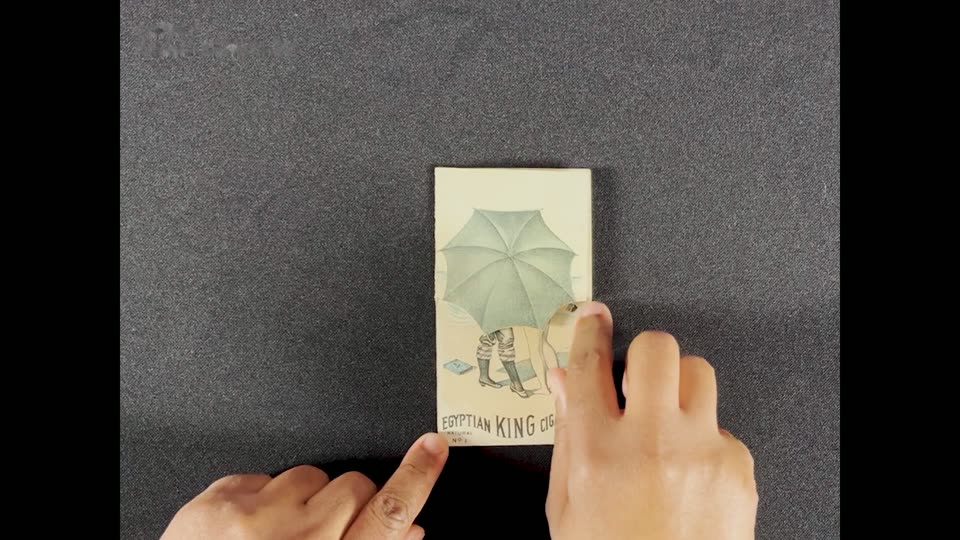
Egyptian King Cigarettes. Compliments of Yak Oussani & Co. Manufacturers of Egyptian King Cigarettes … Pan-American Exposition. Buffalo. 1901 (New York?, 1901). Chromolithographs. Fold out. Robert Staples Metamorphic Collection.

Composed with similar visual codes as Stolen Sweets, this tobacco advertisement also conveys transgressive suggestions about gender roles and dynamics, as well as queer intimacies. Yak Oussani (ca. 1865-1903), émigré from Baghdad and manufacturer of Egyptian King Cigarettes, also pushed boundaries in his business operations. He and his brother Joseph (ca. 1868-1932) opened probably the first Turkish smoking parlor, one frequented by men and women, in New York in 1895. Often raided by the police and targeted in the press, the parlor purportedly may have also served as a brothel.

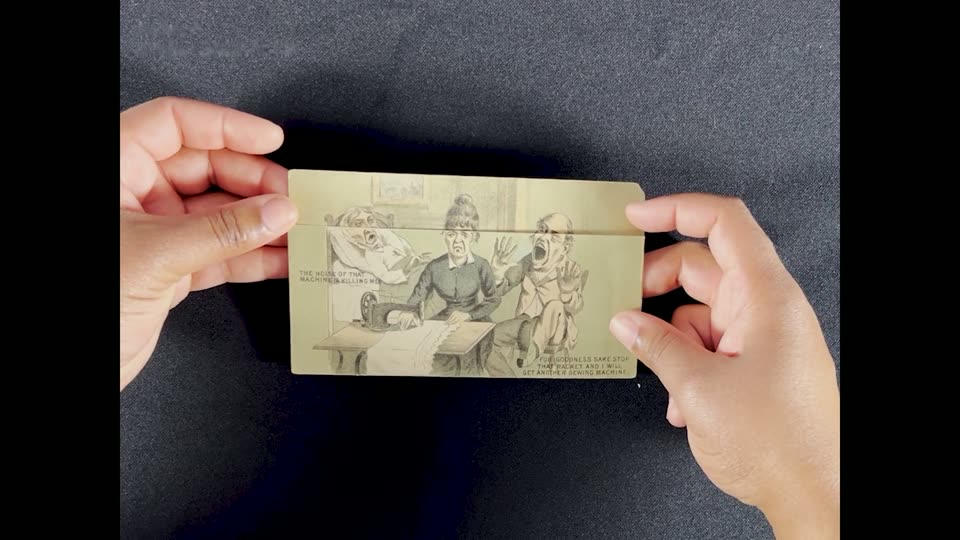
The White Sewing Machine Manufactured by The White Sewing Machine Co. (Cleveland: W.J. Morgan & Co., ca. 1880). Chromolithographs. Fold out. Robert Staples Metamorphic Collection. Variant copy demonstrated in video.

Showing “before” and “after” scenes of miserable and then pleasant sewing machine experiences, this circa 1880-fold-out trade card for the White Sewing Machine Co. proves unique beyond its novelty format. It appears to portray an African American family without exaggerated features and not in a racist, farcical situation in contrast to depictions often seen in period advertisements. Established originally in Massachusetts in 1858, the White firm worked with retailers like the Philadelphia business Rishel & Trump to sell their machines. As a partnership that included a woman, Rishel & Trump was an unorthodox business. Just out-of-her teens Alice C. Rishel (b. ca. 1860) operated the firm with machinist Charles E. Trump (1844-1908).

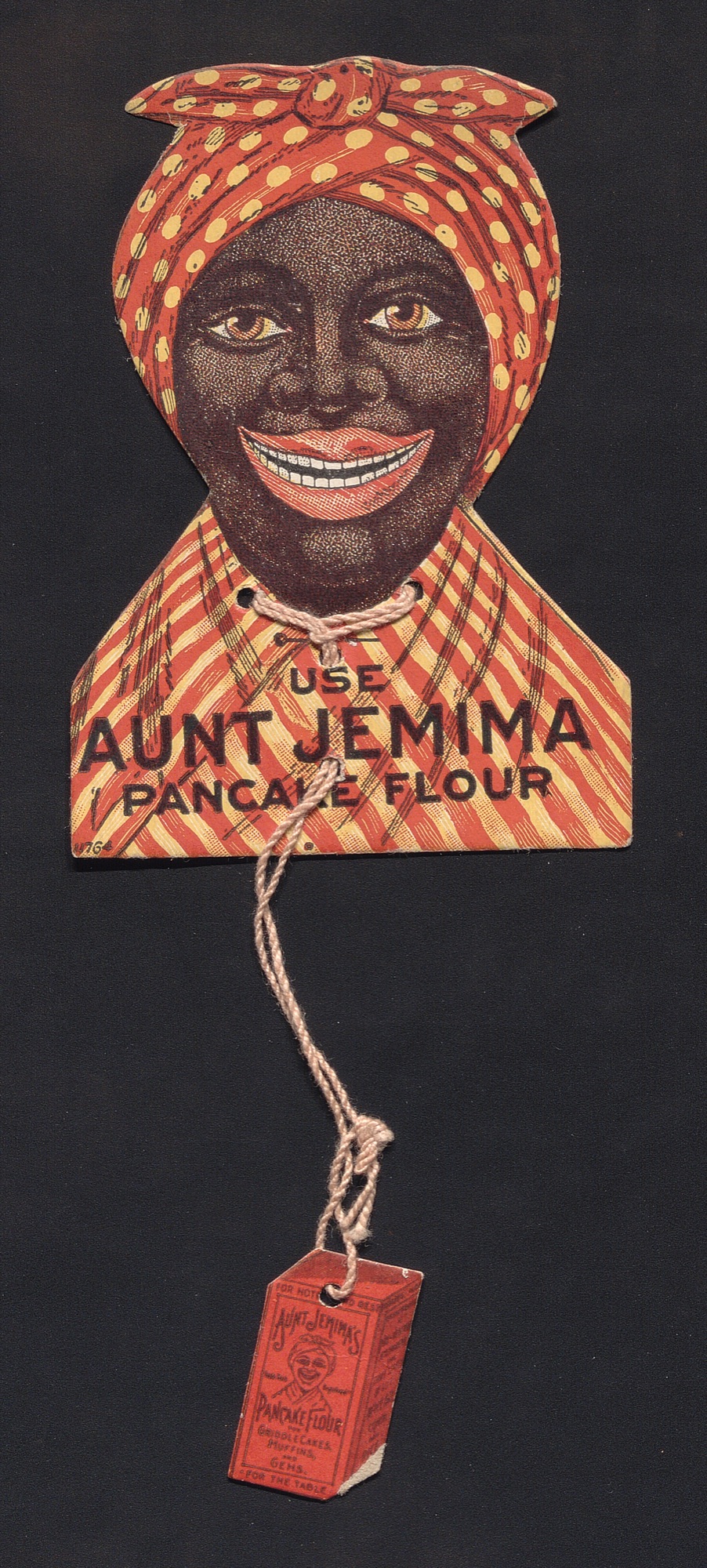
Use Aunt Jemima Pancake Flour (St. Joseph, MO: R.T. Davis Mill Co., ca. 1895). Color relief print. Puzzle. Robert Staples Metamorphic Collection.

Unlike the White Sewing Machine Co. advertisement, most portrayals of Black men, women, and children on the metamorphic works in the Staples Collection are racist caricatures. Among them is an early representation of the Aunt Jemima maternal figure and trademark that was discontinued in 2021. A standard minstrel character, a Black mammy, inspired the figure first devised in 1889. This circa 1895 puzzle piece produced during an appalling era of mass public lynchings in the country is alarmingly composed with a string around the figure’s neck. The ‘toy” constituted an insidious marketing strategy disguised as nostalgia for a mythical version of the “old South.” Horrific in content and context, the Aunt Jemima puzzle demonstrates how racism infiltrates and becomes normalized in the visual culture of the past and present.

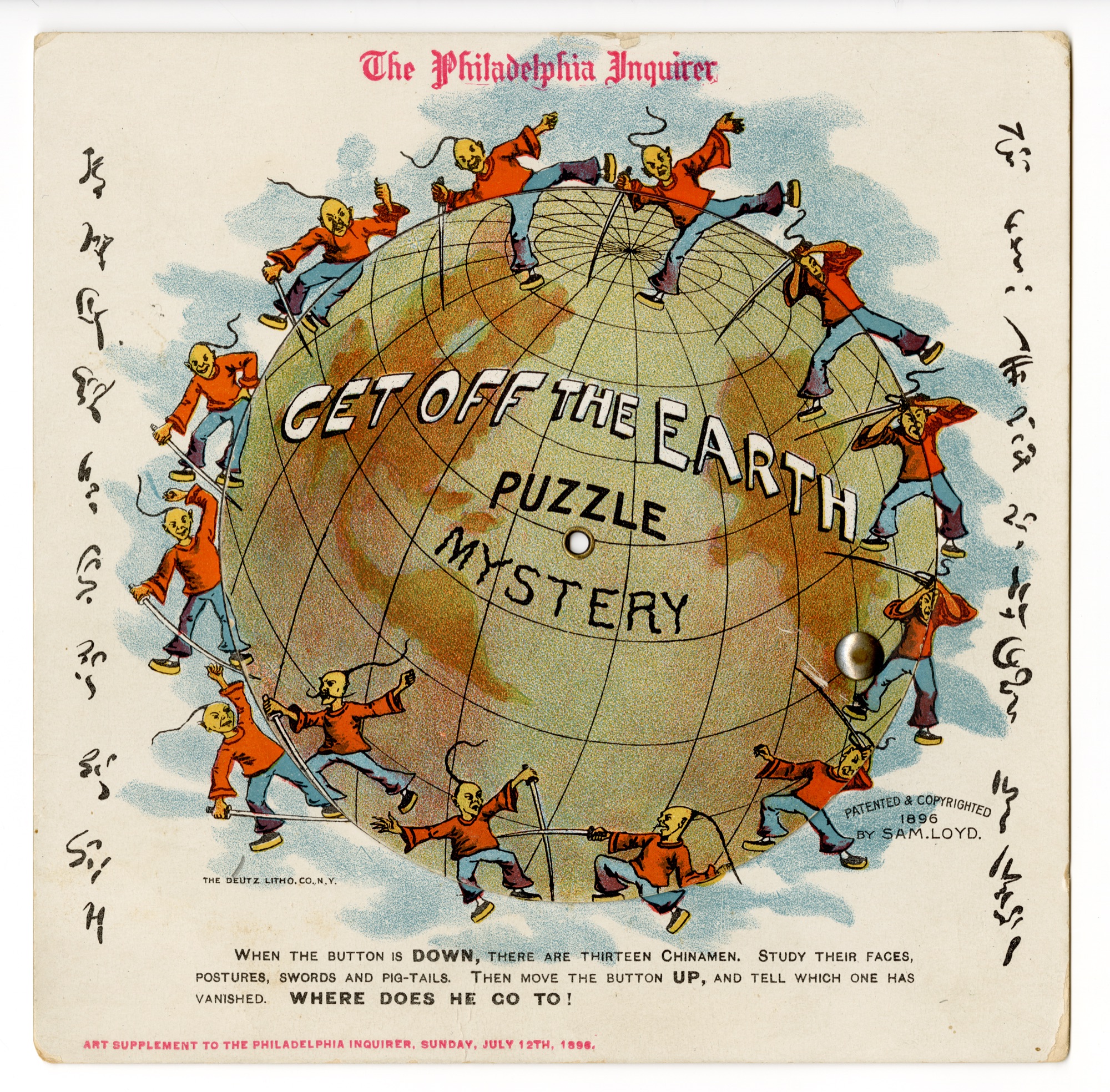
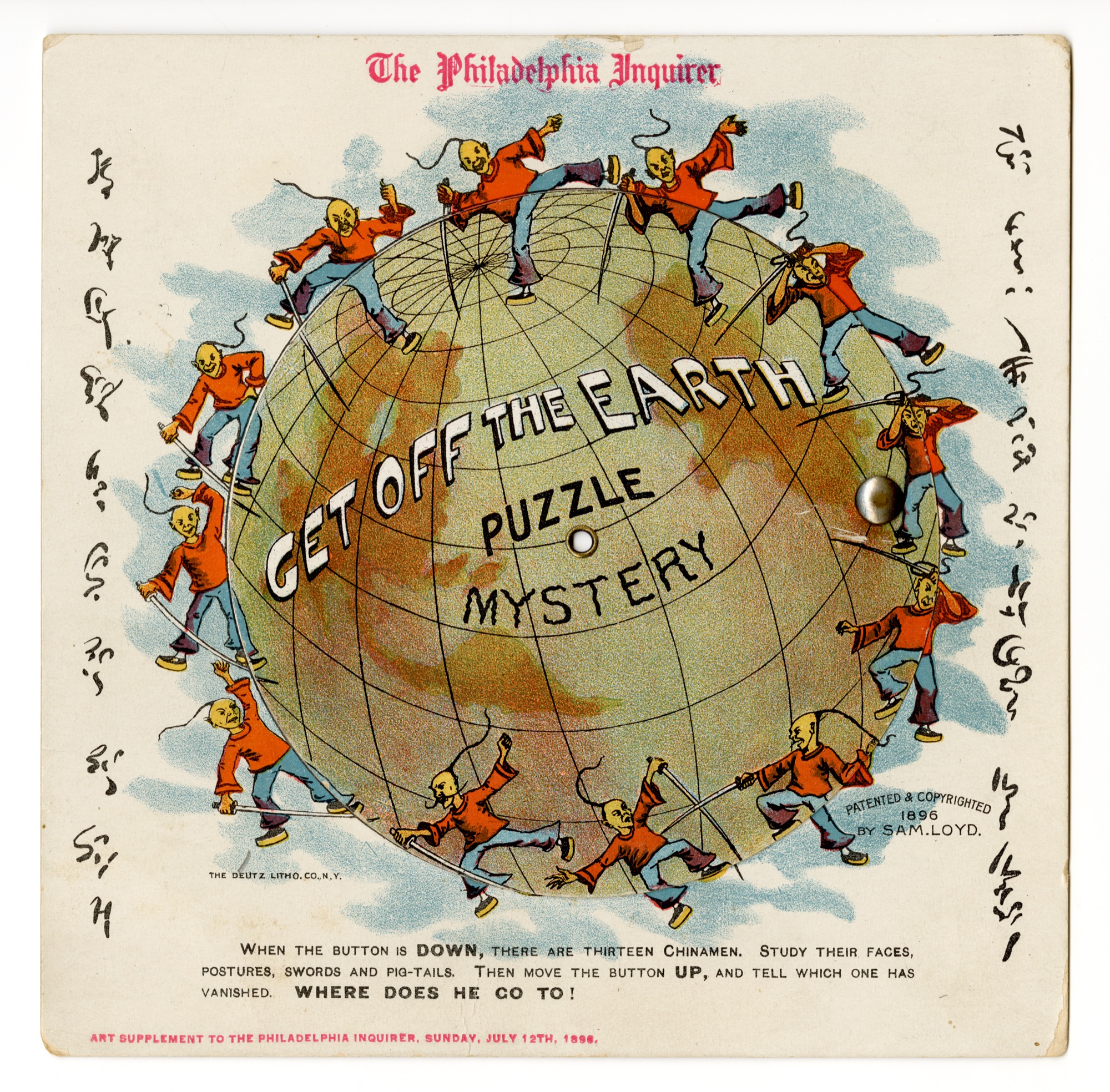
Get Off the Earth Puzzle Mystery. Art Supplement to the Philadelphia Inquirer (New York: Sam Lloyd, 1896). Printed by The Deutz Litho. Co., N.Y. Chromolithograph. Wheel. Robert Staples Metamorphic Collection.

The normalizing and normalization of racist imagery is also seen in this anti-Asian art supplement to the Philadelphia Inquirer issued in July 1896. Created by a Philadelphia-born puzzle author, it propagated the racist social ethos promulgated by the Geary Act of 1892 that extended the Chinese Exclusion Act of 1882 in the ban of Chinese immigration. The mechanical premium meant to increase newspaper subscriptions may have also been created in rebuke of the May 1896 Supreme Court decision in the case Wong Wing v. United States. The decision established that non-citizens subject to criminal proceedings were entitled to the same constitutional protections available to citizens.