
Architects of History: Recent Acquisitions in Black Women’s History
Over the past year, Reference Librarian and Afro-Americana Subject Specialist Wynn Eakins has worked to expand the Library Company’s collections documenting Black women’s roles as architects of American culture, society, business, and education. Following coverage of one notable acquisition in The Philadelphia Inquirer, this article highlights the broader scope of these collecting efforts. To support continued acquisitions in this area, consider contributing to New Acquisitions for the Library Company’s Program in African American History.
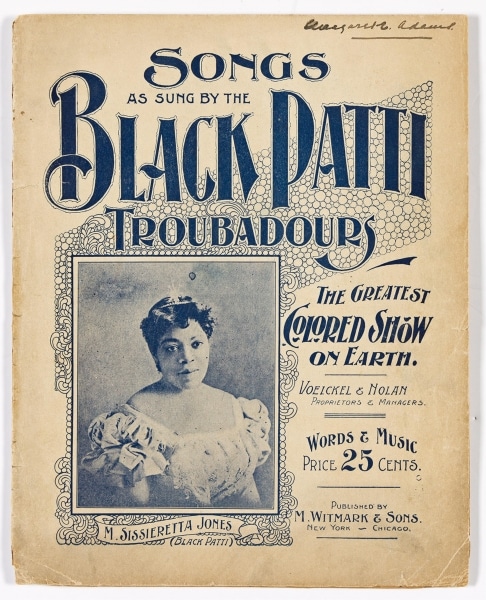
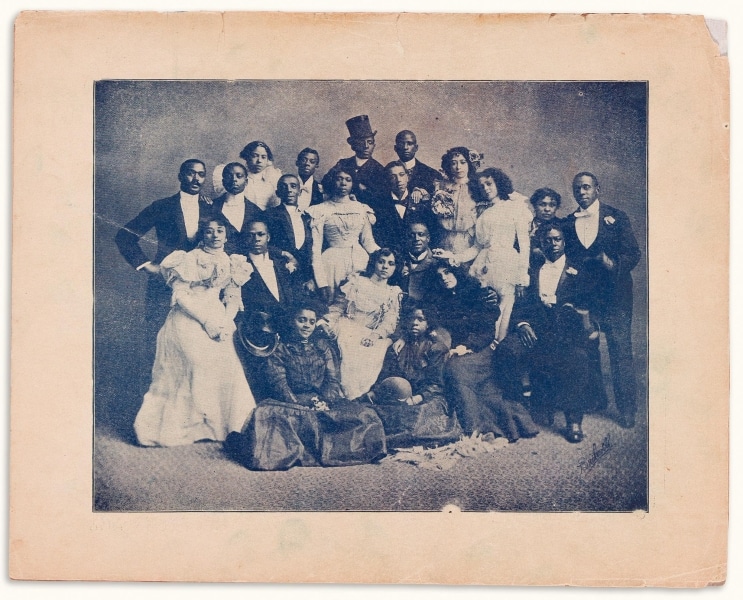
Among the most decorative of these items is Songs as Sung by the Black Patti Troubadours, the Greatest Colored Show on Earth (c. 1900), a rare songsheet in its original illustrated wrappers, featuring a portrait of Matilda Sissieretta Jones. She preferred to be addressed as “Madame Jones,” and actually took much offense to the dismissive moniker, “the Black Patti,” coined by her critics. [i] Madame Jones was a classically trained soprano and featured artist with the Jubilee Singers, who performed in concert across North America, Europe, and the West Indies in the 1890s, became the first Black woman to sing at Carnegie Hall in 1893, and later found regular work on the vaudeville circuit from 1896 to 1916 with the Troubadours.
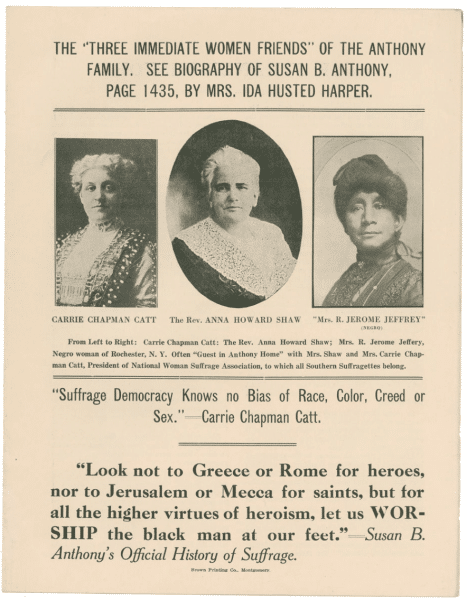
Next is The “Three Immediate Women Friends” of the Anthony Family (1918). Though these recent acquisitions are intended to capture instances of Black women’s autonomy and achievements, you will notice this item is, in fact, a racist anti-suffrage a broadsheet. The quotations on the first page are included to ridicule the suffragettes’ beliefs, and the interior pages feature an article by confederate veteran, James Callaway, repudiating the women’s publication History of Woman Suffrage (1881) in defense of the “future civilization, tranquility, and prosperity” of the South. [ii]
Yet, the broadside now offers us a subversive reading for its depiction of Black suffragist Hester C. Jeffrey. Born to free parents in Norfolk, Virginia, Jeffrey was a well-educated musician and organizer who eventually settled in Rochester, NY, becoming the head of the local Susan B. Anthony Club for Colored Women, President of the State Federation of Colored Woman Clubs, and leader of several other civic initiatives. [iii]
The portrait of Mrs. Jeffrey here was meant to spread her likeness at the height of an era plagued by lynching, functionally making this broadsheet a threat of violence, and yet it is also the only known image of Jeffrey in our collections. Despite the continued voter suppression of Black women following the ratification of the 19th amendment, her image alongside the most eminent women’s rights activists of the time is evidence of Black women’s central role in the movement, and speaks to our ongoing work in the struggle for political representation.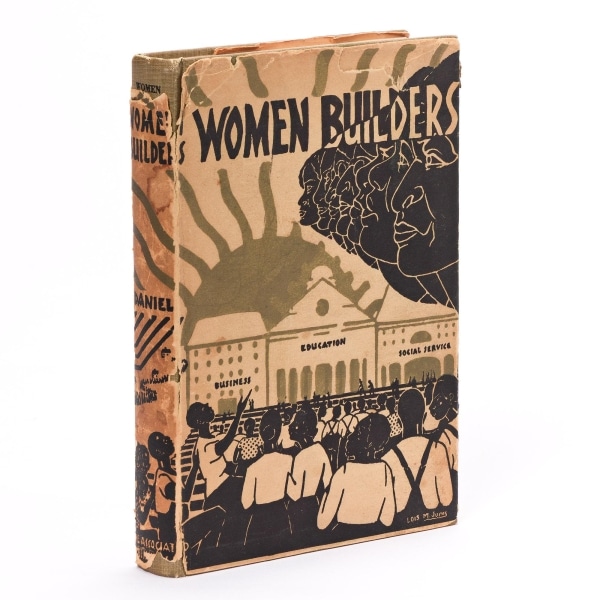
An exciting addition to our rare books collection is this copy of the beautifully illustrated Women Builders (1931) by Sadie Iola Daniel, featuring biographies of Black women central to abolition, education, and uplift in the Southern Atlantic, including Lucy Craft Laney, Maggie Walker, Mary McLeod Bethune, and more. Throughout its pages you’ll also find plates depicting the neighborhoods, businesses, schools, and other social service institutions these women raised in their communities. A second edition was printed in 1970, but even that copy is rare to find on the market, so we are lucky to have won this first edition in relatively good condition.
Despite the deep research and personal details that elucidate the lives of this volume’s pioneering Black women, far less can be found on the author, Sadie Iola Daniel, save the record of her final resting place at Glenwood Cemetery in Washington, D.C. [iv] To quote her own introductory words, she is among the “certain negro women” who, “realizing the terrible barrier of illiteracy, have devoted their lives to this unselfish service [of] the enlightenment and improvement of their race. Of these thousands we cannot write the full story,” (Daniel, page xv).
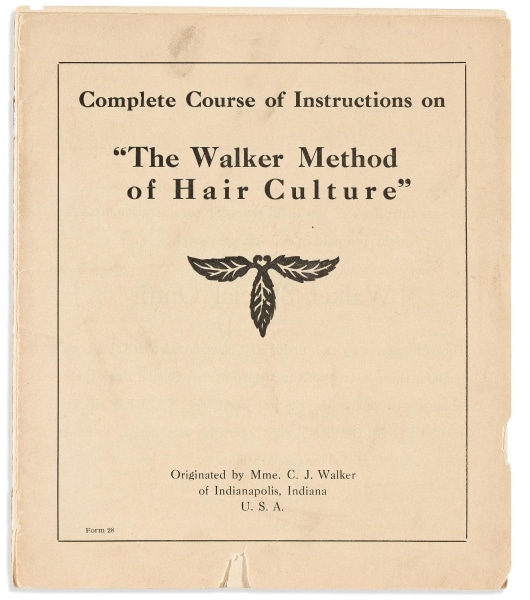
Lastly, the Library Company now holds what may be the only extant copy of Madam C.J. Walker’s Complete Course of Instructions on “The Walker Method of Hair Culture.” This illustrated manual instructs saleswomen, also known as “Walker agents,” on how to perform haircare, build clientele, and sell the full “Walker Outfit,” including treatments, styling products, hot combs, brushes, and more.
Born Sarah Breedlove in 1867, on a former plantation in Louisiana, Madam Walker endured hardship in her early life as an orphan and survivor of domestic abuse. Widowed by her twenties and determined to escape the limitations of domestic labor, she developed her own line of haircare products. With wise investments of her early capital, she became the first woman in American history widely recognized as a self-made millionaire, rising from a domestic servant to the head of the nation’s largest, most successful black-owned company in less than fifteen years. Walker was also a dedicated philanthropist, contributing tens of thousands of dollars to Black civic organizations, schools, orphanages, and anti-lynching campaigns.
Beyond its research value for the study of African American haircare and styling, this pamphlet offers insight into the agency Black women cultivated for themselves, both nationally and here in Philadelphia. As documented in the Walker Family Archives, Madam Walker convened her First National Convention at Philadelphia’s Union Baptist Church, bringing together women who had once earned meager wages as washerwomen, cooks, and sharecroppers, but who now had opportunities to earn hundreds of dollars per week as hair culturists. [v] Published circa 1910–1916, this pamphlet may even have circulated at the convention. A note printed on the lower back wrapper, addressed directly to the agents, remains an inspiring testament to their perseverance, and to the determination of all Black women represented throughout these acquisitions, in forging paths to prosperity and independence. It reads:
“Above all things, have confidence in yourself. We know you can succeed, and you also must know it. Keep at the work until you master it. We stand always ready to help you. Consult us freely on any point. Never give up.”
Reference Librarian, Afro-Americana Subject Specialist
—
i. Britannica Editors. “Matilda Sissieretta Jones.” Encyclopedia Britannica, 20 Jun. 2026, https://www.britannica.com/biography/Matilda-Sissieretta-Jones.
ii. “The ‘Three Immediate Women Friends’ of the Anthony Family.” Biblio, Seth Kaller Inc., www.biblio.com/book/three-immediate-women-friends-anthony-family/d/1360467712.
iii. “Historic Marker: Hester C. Jeffrey.” William G. Pomeroy Foundation, www.wgpfoundation.org/historic-markers/hester-c-jeffrey/.
iv. “Sadie Iola St. Clair, (3 Aug 1892–26 Jun 1975).” Find a Grave, www.findagrave.com/memorial/168459350/sadie_iola-st_clair.
v. Bundles, A’Lelia. “Madam C. J. Walker’s First National Convention (August 30–31, 1917).” A’Lelia Bundles, Aug. 2017, aleliabundles.com/madam-c-j-walkers-first-national-convention-august-30-31-1917/.

Leave a Reply
Want to join the discussion?Feel free to contribute!