
Looking Back at The Public Universal Friend
Em Ricciardi, Cataloguer and LGBTQ+ Subject Specialist
In 1752, in Cumberland, Rhode Island, Jemima Wilkinson was born as the eighth child to a Quaker family. Around the mid-1770s, the New Light Baptists were in Cumberland, and Jemima left her Quaker faith to attend their meetings. In 1776, Jemima became very sick, contracting a fever that left her bedridden and insensible. After many days where her family diligently tended to her, she appeared to take a turn for the worse and neared death. Miraculously, her body rose again. However, this was not Jemima Wilkinson. This was the Public Universal Friend.
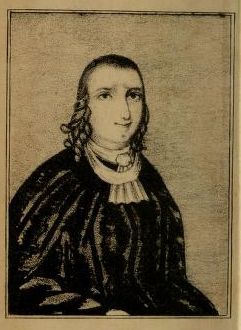
Image: Frontispiece portrait of The Public Universal Friend from David Hudson, Memoir of Jemima Wilkinson, a Preacheress of the Eighteenth Century (Bath, N.Y., 1844). Image courtesy of the Library of Congress.
The Friend claimed to be a genderless spirit sent from Heaven to preach before the endtimes. Jemima, the Friend claimed, had in fact died during her illness, allowing the Friend to occupy her old body. The Friend began preaching in Rhode Island and other New England states, amassing a small society that called themselves the Society of Universal Friends.
The Friend used no gendered pronouns, and would answer only to the name of The Friend, or The Universal Friend, or the All-Friend. Members of the Friend’s Society were diligent in respecting this identity, creating new ways of structuring their sentences to eliminate pronouns when referring to the Friend. Members of the general public were not so respectful, constantly referring to the Friend by the name of Jemima and she/her pronouns. As part of this genderless identity, the Friend also dressed in an androgynous manner, being noted during life for having a masculine appearance. Some outfits detailed by those who visited the Friend include the following, with pronouns omitted in favor of nongendered language:
“had on a white morning gown, and waistcoat, such as men wear, and a petticoat of the same colour. … wore a stock and white silk cravat, which was tied about [the] neck with affected negligence.”[i]
And:
“wore an under garment with long sleeves, wristbands and collar, and a large cravat about [the] neck–petticoat and slippers; a vest cut sloping to the right and left from the centre, a kind of coatee dress similar to a lady’s riding habit, the upper part buttoned, and cut sloping below, so as to show the edges of [the] vest, and over the whole a long robe of black silk or white sattin; and in public […] always appeared with a huge black beaver turned down at the sides and tied under [the] chin with a ribbon. […] wore no head dress, having […] fine black hair combed and dressed in several sets of curls and ringlets, which by frequent wetting and oiling were kept as smooth and glossy as a raven’s wing, so that with a fine complexion, a regular set of features, masculine countenance, a commanding air, and a liberal stock of assurance, […] had the appearance of a personage of no ordinary character.”[ii]
In 1782 the Friend made the first pilgrimage to Philadelphia with five followers. Accounts describe the Friend as a curiosity, drawing large crowds at each public speaking event. However, not many people were swayed to join this new religious sect. The Friend would spend a lot of time in the Philadelphia area, specifically in a town called Worcester in Montgomery County. The Friend returned to the area in the summer of 1784 for about a year and then again in the winter of 1787. The Friend left with the Society in 1789 to establish a new religious town in Upstate New York near the Finger Lakes, called Jerusalem.
The Friend preached mostly Quaker values, rejecting predestination in favor of a free will doctrine, advocating for anti-slavery, and for sexual abstinence. Perhaps most jarring to the social order, the Friend thought women should obey God, not men.
Clearly, some women were interested in this new idea. A 1791 list of the Friend’s followers, a remarkable manuscript given to the Library Company by Trustee Emeritus Michael Zinman in 2000, identifies 159 women members, but only 77 men.[iii]
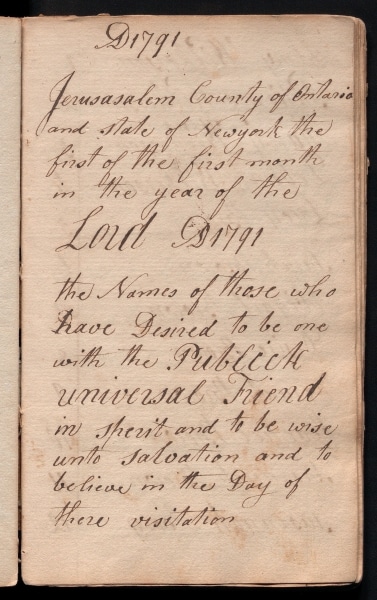
Image: First page to the list of members of the Society of Universal Friends, written in 1791. Society of Universal Friends member list and writings (MSS00301). Gift of Michael Zinman.
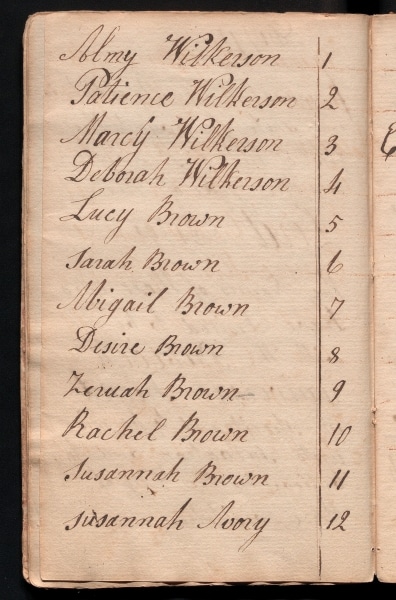
Image: List of women members of the Society. Four of Jemima Wilkinson’s sisters are listed first using their maiden names. They were all married in 1791 when the list was written.
Contemporary opposition further claimed that the Friend forbid followers from marrying and would split up already married couples. But this manuscript list sheds different light on this idea. Five siblings of Jemima Wilkinson appear in this list, including sisters Patience, Amy, Marcy, and Deborah, and brother Simon. All five siblings were married at the time this list was written, but all four sisters are listed under their maiden name, Wilkinson. Marcy and Deborah’s husbands also appear on the list of followers. The other siblings’ spouses were presumably not members of the Society.[iv]
Perhaps it is not surprising that the Friend’s critics would conclude that the prophet must obviously have been against the institution of marriage altogether if the Friend preached sexual abstinence, encouraged women to obey God over husbands, listed married female members by their maiden names, and did not require couples to both be members.
Certainly, not everyone agreed with the Friend’s preaching. There were many accusations of fraud levied against the Friend during life and even after death. Some claimed that the Friend stole from the members of the Society and from the Rhode Island treasury, that the Friend faked miracles and visions to dupe wealthy followers into giving money, and even that the Friend tried to kill a member of the Society. One account called the members of the Society “dissenters from other denominations, those who had been suspended or excluded from church membership for their disorderly conduct, a few unprincipled adventurers, and a still greater number of weak men and women, and inexperienced girls and children.”[v]
However, Society members continued to follow the Friend throughout the Friend’s life. Among other things, the Friend preached to the Society: holding sabbath on both Saturdays and Sundays, shunning the “wicked world,” keeping the body free of unholy liquor, and treating all people with respect and kindness.[vi]
The Friend died in 1819, and the Society died out shortly after, not able to sustain their community after the death of their spiritual leader.
The Friend stands out as a unique figure of ungendered identity. The Friend maintained until death this genderless state, and was lucky enough to have devout followers who respected it.
[i] Eccentric Biography, or, Memoirs of Remarkable Female Characters, Ancient and Modern (London: J. Cundee, 1803).
[ii] David Hudson, History of Jemima Wilkinson, (Geneva, NY: S.P. Hull, 1821). Library Company call number: Am 1821 Hud 11519.D.
[iii] Society of Universal Friends member list and writings (MSS00301), Library Company of Philadelphia.
[iv] In fact, both of Deborah’s husbands appear on the list. After the death of her first husband, Benajah Botsford, Deborah married Elijah Malin.
[v] Hudson, History of Jemima Wilkinson.
[vi] See Public Universal Friend, The Universal Friend’s Advice (Philadelphia: Francis Bailey, 1784), in Society of Universal Friends member list and writings (MSS00301), Library Company of Philadelphia.

