
In Celebration of Retiring Senior Curator of Graphic Arts Sarah J. Weatherwax
By Erika Piola, Curator of Graphic Arts and Director of the Visual Culture Program
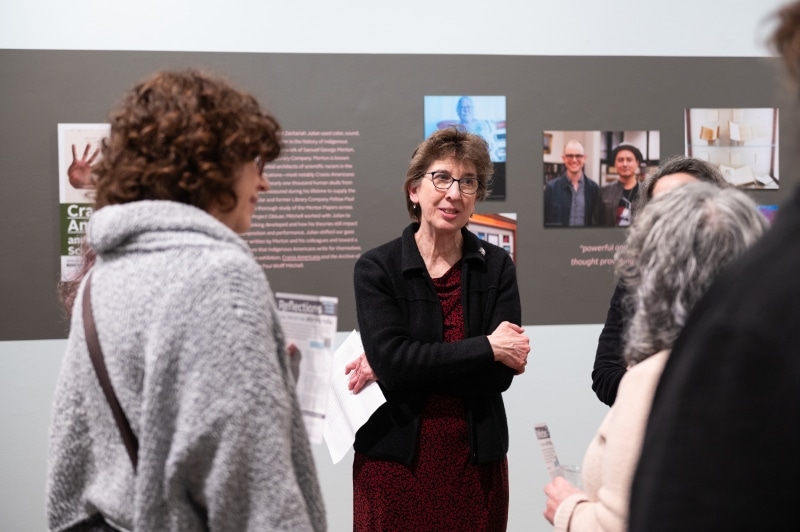
For over three decades, Sarah J. Weatherwax has advanced and led one of the most respected historical American graphics collections in the nation. With her retirement approaching on August 13, it is my privilege to be able to commemorate just a few of the highlights of Sarah’s illustrious career at the Library Company.
Sarah joined the staff at the Library Company in 1993 as the Curatorial Assistant for what was then called the Print Department. Just three years later, she assumed the position of Curator. In the years that followed, she oversaw the expansion of the graphic arts collection to twice its previous size. She curated and supported over two dozen major and smaller exhibitions. And, she became an authoritative voice on the history of Philadelphia photography, particularly relating to daguerreotypes and the photographer William H. Rau. She managed all of this while also being promoted to Senior Curator of Graphic Arts in 2020 and overseeing the work of more than a dozen staff, interns, and volunteers who have passed through the Department while she has been at the helm.
A diligent steward in the development of the collection and long-term supporter of the institution, Sarah forged relationships with a wide-ranging depth of Library Company
stakeholders, including trustees, donors, dealers, and patrons. Such connections produced a breadth of materials that have innumerably increased our holding strengths, especially for research of the visual history of the city.
Without Sarah, we would not have the Marriot C. Morris Collection of photographs and negatives documenting Germantown and Quaker life during the 19th century, nor the website that showcases them. The Raymond Holstein Stereograph Collection of over 2,000 stereographs showing prominent landmarks, popular sites, and the busy streets of Philadelphia also may never have found its way to our shelves. And in coming months, because of Sarah’s expertise and guidance, a collection of over 30,000 postcards will be arriving to further enhance the Library’s standing as a center for Philadelphia iconography. Sarah’s indelible nature and knowledge have also led to significantgifts from long-term donors such as David Doret, Ivan Jurin, Clarence Wolf, and Randy Plummer (to name a few). They have entrusted the Library with multiple donations of hundreds of prints, photographs, and drawings made by Philadelphians or that portray the built, social, and cultural environment of the city and that serve as testaments to Philadelphia’s role in the history and understanding of American popular art.
Hand in hand with developing our collections, Sarah has shared her scholarship through her curation of several Library exhibitions ranging in subject matter from the history of music in Philadelphia to the Philadelphia home front during the First World War. In more recent years, Sarah partnered in curating Imperfect History: Curating the Graphic Arts Collection at Benjamin Franklin’s Library. The multi-faceted project commemorated the fiftieth anniversary of the Graphic Arts Department in 2021 and included a publication that received the Ewell L. Newman Book Award for significant scholarly achievement in the field of American historical prints.
Over her tenure, Sarah raised awareness of our graphics holdings beyond our exhibition spaces. Her numerous presentations and outside publications, including with the Daguerrean Society, American Historical Print Collectors Society, Arcadia Publishing, and the Ephemera Society of America, allowed her to impart her research about early women and Philadelphia photographers, the Sesquicentennial Exposition, and the lithographer Matthias Weaver. Sarah’s talks and writings have also led us to become the largest repository of photographs by the aforementioned William Rau.
Relatedly, Sarah has served on the Boards of the Daguerreian Society and the American Historical Print Collectors Society, for which the latter she managed their most well-attended annual meeting in years held in Philadelphia in 2023. Undaunted, soon thereafter, Sarah directed the benchmark multi-exhibition and book project Beyond Glass Cases funded by The Pew Center for Arts and Heritage.
Not to rest on her laurels, Sarah’s many decades of dedicated work in special collections fostered her nomination and election to the Print Council of America, facilitated the implementation of our digital catalog which now holds over 100,000 images, and precipitated the inauguration of the Visual Culture Program which has supported multiple grant-funded initiatives since 2008.
In recent years, this dedication also led to the generous bequest to the Department by our late, treasured volunteer Louise Beardwood. Louise volunteered with the Department for over twenty-five years, completing multiple projects supervised by Sarah. Louise’s volunteer hours ended with conversations, smiles, and words of wisdom. Because of the friendship and mutual respect that grew between Sarah and Louise, Graphic Arts staff have and will continue to have for years to come professional development opportunities otherwise not possible.
On another personal note, my growth as a curator and program director benefited tremendously from Sarah. The visual culture projects pursued by the Department could not have succeeded without her encouragement. Among them is the exhibition and corresponding book Philadelphia on Stone (2012), in which the latter includes her chapter about pioneer lithographer Peter S. Duval, an essay that continues to serve as one of the most detailed accounts of his career.
Although Sarah will be leaving her role as the backbone of the Graphic Arts Department, her boundless belief in her colleagues, her untiring work ethic to strengthen access to the holdings, and her immeasurable knowledge of our graphics holdings will thankfully remain. As the Department evolves in the years to come, her legacy will continue through the people who worked with her, the collections acquired by her, and the memories of those who had the fortune to experience the presentations and publications authored by her.
The Library wishes Sarah a most well-deserved and happy retirement.

