• Link to Facebook
  • Link to Instagram
  • Link to Youtube
  • Link to Mail
  • Link to Rss this site
  • Shopping Cart Shopping Cart
    0Shopping Cart
The Library Company of Philadelphia
  • Home
  • Search Collections
    • Search Library Catalog
    • Search Manuscripts
    • Search Digital Collections
    • How to Search the Collections
      • Subject Guides
      • Access Terms used in our Catalogs
    • Potentially Harmful Materials and Descriptions Statement
  • Academic Programs
    • Overview
    • Fellowships
    • Awards
      • LCP First Book Award
      • Innovation Award
    • Program in African American History
    • Program in Early American Economy & Society
    • The Davida Tenenbaum Deutsch Program in Women’s History
    • Visual Culture Program
  • Research
    • Overview
    • Subject Guides
    • Finding Aids
    • Online Exhibitions
    • Online Resources
  • Using the Library
    • Overview
    • Hours, Access, & Location
    • Appointments
    • Rights & Reproductions
  • Events
    • Upcoming Events
    • Fireside Chats
    • LCP News
    • LCP Press Resources
  • Projects
    • Beyond Glass Cases
    • Library Company Papers Project
  • Join & Support
    • Overview
    • Donate Online!
    • Join & Renew Membership Online!
    • Support: Shareholding
    • Annual Dinner 2026
    • Lecture in Honor of John C. Van Horne
    • The Junto
    • Gifts in Kind
    • Membership Benefits
    • Planned Giving
  • About LCP
    • Annual Reports
    • Staff
    • Academic Program Directors
    • Board of Trustees
    • Library Company Ambassadors
    • Employment
    • Affiliations
    • LCP Blog
    • Press Resources
    • LCP Privacy Policy
    • Overview & History
    • LCP FAQ Sheet
  • Click to open the search input field Click to open the search input field Search
  • Menu Menu

Mellon Scholars Summer Program – Subject Guides

African American Missionaries from Independent Black Churches to the African Diaspora
Previous Previous Previous Next Next Next
12345
Open image in lightbox: alexandercrummell Open image in lightbox: alexandercrummell
Open image in lightbox: BishopsoftheAMEChurch Open image in lightbox: BishopsoftheAMEChurch
Open image in lightbox: DanielCokersLettertoHisBrethreninAmerica Open image in lightbox: DanielCokersLettertoHisBrethreninAmerica
Open image in lightbox: ThisCertifies Open image in lightbox: ThisCertifies
Open image in lightbox: ViewsofLiberia Open image in lightbox: ViewsofLiberia

Overview:

Throughout the late eighteenth and nineteenth centuries, African Americans formed new independent Black churches and denominations, often rejecting unfair racial hierarchies and segregation in White-led churches. Philadelphia is the birthplace of independent African American churches, as, in the late eighteenth century, minister Richard Allen founded Mother Bethel African Methodist Episcopal Church (and later the African Methodist Episcopal (AME) denomination) and Absalom Jones founded the African Episcopal Church of St. Thomas. Independent Black churches were spaces where Black communities could organize religiously, socially, and politically. In the early nineteenth century, for example, Black Philadelphians united at Mother Bethel AME to reject the American Colonization Society, an organization founded to resettle African Americans in West Africa.
Throughout the nineteenth century, independent Black churches became increasingly involved in missionary work, especially to Africa and African diasporic communities in the Americas. Though many Black Christians rejected forced African American emigration to West Africa or the Caribbean, many also believed that African-descended Christians had a unique ability and responsibility to Christianize Africa and Afro-diasporic communities. Though independent Black religious communities had rejected racial discrimination in White-led American churches, in their framing of the African and African diasporic mission field, African American missionaries adopted White Christians’ racist constructions and discourses about Black religiosity and civility. How did African American missionary work look similar to that of White missionaries? How did it look different? How did African American missionaries describe their imagined mission field? How have Black missionaries’ conceptions evolved over time?

About the Author:

Alison Fortenberry is an incoming PhD student in the Department of Religion at Princeton University, and she recently completed her BA in African American Studies at Princeton. Alison is working on a community archive project, cataloging and digitizing the historic records of a Philadelphia church. She is passionate about African American religious history, and in her free time she enjoys reading and doing jigsaw puzzles.

Keywords

Contributors:

  1. Coker, Daniel, 1780-1846
  2. Crummell, Alexander, 1819-1898
  3. Cornish, Samuel E. 1795?-1858
  4. American Colonization Society
  5. African Methodist Episcopal Church (Philadelphia, Pa.)
  6. Allen, Richard, 1760-1831
  7. Jones, Absalom, 1746-1818
  8. Forten, James, 1766-1842
  9. Carey, Lott, 1780-1828
  10. Holly, James Theodore, 1829-1911

Subject Headings:

  1. African American missionaries
  2. African Americans –Missions — Liberia
  3. African Americans – Missions — Haiti
  4. Missions — History
  5. African Americans — Relations with Africans
  6. African Americans — Colonization — Africa
  7. African Americans — Colonization — Africa, West
  8. African Americans — Colonization — Liberia
  9. American Colonization Society
  10. African American churches — Pennsylvania — Philadelphia
  11. African Methodist Episcopal Church — History
  12. St. Thomas’ Church (Philadelphia, Pa.)
  13. African Americans — Pennsylvania — Philadelphia
  14. Antislavery movements — Pennsylvania — History
  15. Free African Americans — Pennsylvania — History

Access Terms:

  1. Sermons
  2. Letters (Correspondence)
  3. Speeches
  4. Biographies
  5. Certificates
Annotated Bibliography

Resources at LCP:

Daniel Coker, “Daniel Coker’s Letter to His Brethren in America,” Washington Review and
Examiner (July 10, 1820).
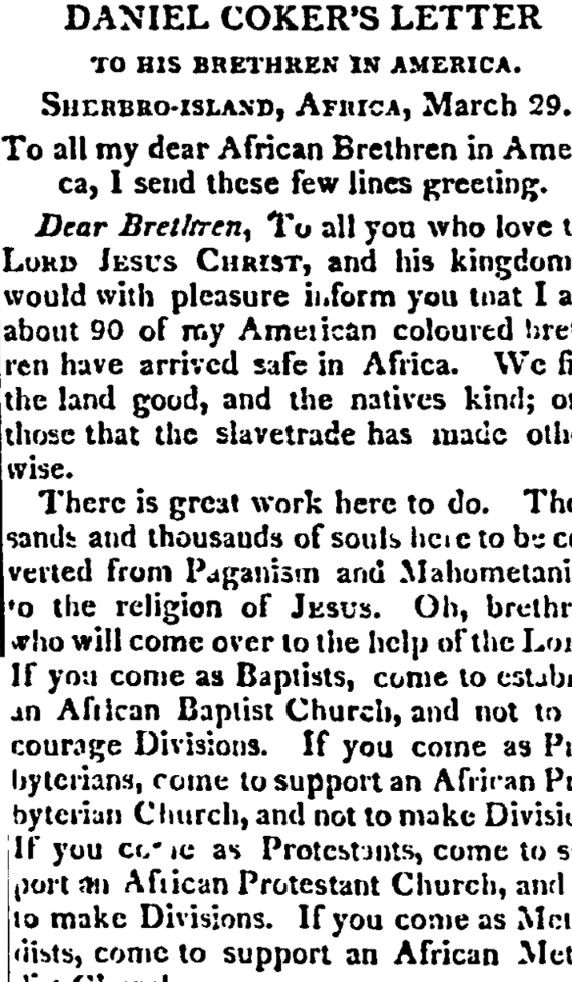
Daniel Coker is one of the founders of the AME Church who was sponsored by the American Colonization Society to work as a missionary in Liberia. In this letter, which was published in local presses, Coker encourages African American Christians to shed their sectarian divisions and come to Africa to help convert the “Heathens” from “Paganism and Mahometanism to the religion of Jesus.”

William Lloyd Garrison, Thoughts on African Colonization, or, An Impartial Exhibition of the Doctrines, Principles and Purposes of the American Colonization Society (Boston, 1832).

This refutation of African colonization, written by White abolitionist William Lloyd Garrison, contains a compendium of anti-colonization appeals by African Americans. Black Philadelphians, led in part by local Black religious leaders, met at Mother Bethel AME church to reject African colonization, staking a claim to American identity and arguing that, if African Americans were forcibly sent en masse “into the savage wilds of Africa” (9), many African Americans would lose their Christian faith. Though Black Philadelphians rejected African colonization, they accepted racially informed religious beliefs that cast Africa and African people as “savage,” “heathenistic,” and in need of Christianization.

James A. Thome, Samuel H. Cox, Samuel E. Cornish, and Henry B. Stanton, Debate at the Lane Seminary, Cincinnati: Speech of James A. Thome of Kentucky, Delivered at the Annual Meeting of the American Anti-Slavery Society, May 6, 1834. Letter of the Rev. Dr. Samuel H. Cox, Against the American Colonization Society (Boston, 1834).

Included in this pamphlet is a letter written by Samuel Eli Cornish, founder of the first Black Presbyterian church in New York City, in which Cornish argues against African colonization, citing the refutation produced by Philadelphia’s Black community.

Richard R. Wright, J. R. Hawkins, and Levi Jenkins Coppin, Centennial Encyclopaedia of the African Methodist Episcopal Church (Philadelphia, 1916).

Produced by the African Methodist Episcopal Church one hundred years after its founding, this encyclopedia gives an overview of key figures, departments, institutions, and missionary societies that contributed to the AME’s development. Though Black Philadelphians rejected African colonization, the AME names Daniel Coker, an AME founder and American Colonization Society missionary to Liberia, as one of its pioneering missionaries.

Bishops of the A.M.E. Church (Boston, 1876). Print.

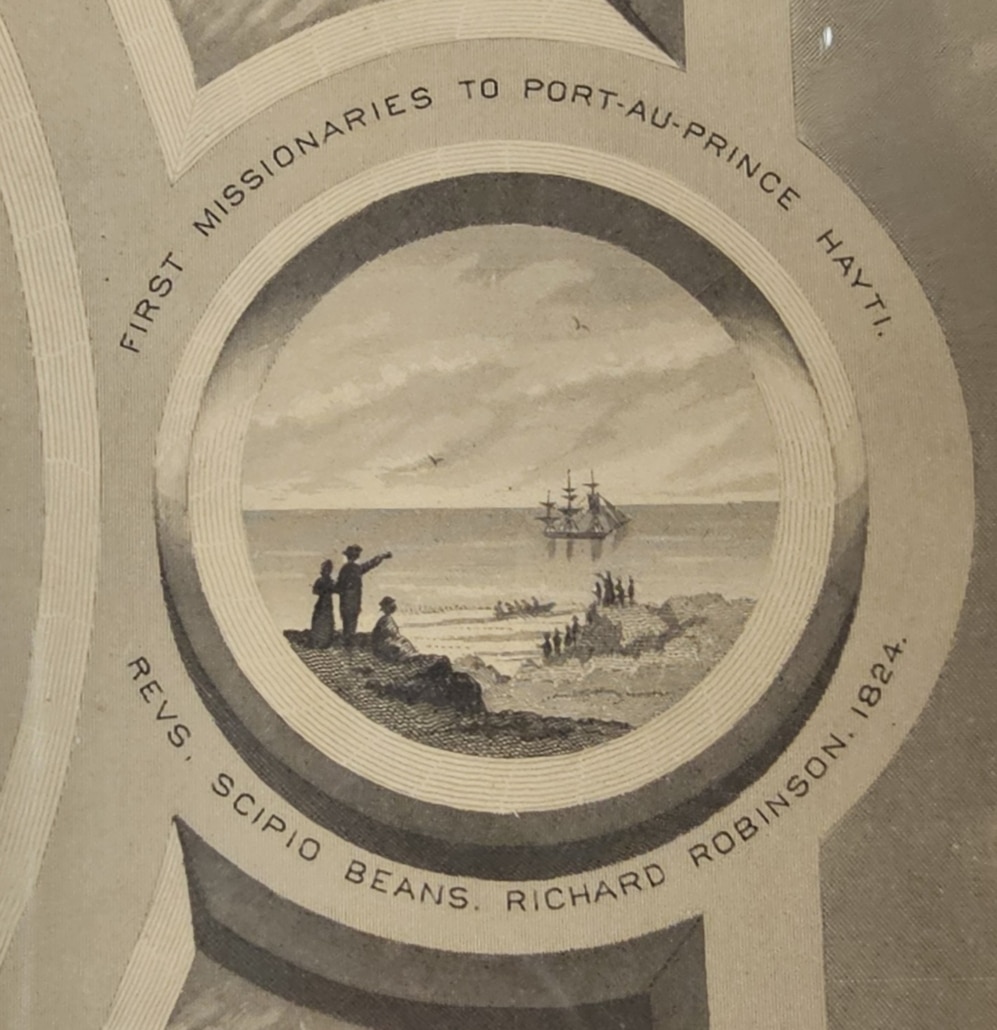
This commemorative AME print, which was commissioned on the denomination’s 160th anniversary, features a portrait of Richard Allen, the founder of Philadelphia’s Mother Bethel AME church, surrounded by portraits of other AME leaders and vignettes of significant moments in the denomination’s history. Among these is a vignette of the AME’s early missionary work, with text reading: “First Missionaries to Port-au-Prince Hayti, Revs. Scipio Beans. Richard Robinson. 1824,” and an illustration showing Black figures on a shore pointing at a ship on the water. Missions among Afro-diasporic people have been crucial to the AME’s work since its early history.

Alexander Crummel, Emigration, an Aid to the Evangelization of Africa: A Sermon, Preached in Trinity Church, Monrovia, Liberia, West Africa, to the Barbadian Emigrants, May 14, 1863, the Sunday After Their Arrival (Boston, 1865).

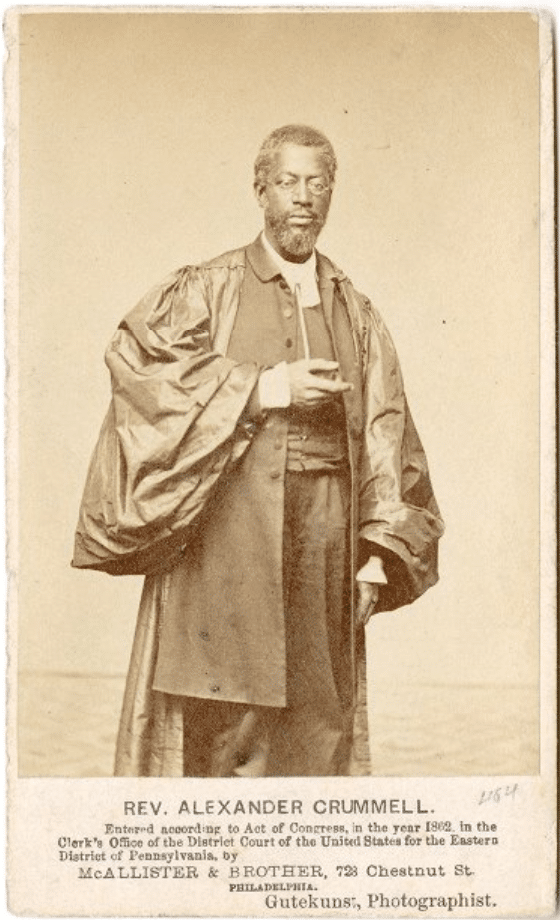
Alexander Crummell was an Episcopal priest and African American missionary to Liberia. Later in his life, he helped found the first independent Black Episcopal church in Washington D.C. In this sermon, delivered to Afro-Barbadian emigrants to Liberia, Crummell argued that African colonization was God’s divine will and that Afro-diasporic people had been “trained, civilized, and enlightened” in the Americas to convert their “heathen kin” in Africa (11).

Alexander Crummel, The Relations and Duties of Free Colored Men in America to Africa (Hartford, 1861).

In this letter, Crummell argues that African American and Afro-diasporic Christians have a responsibility to “live and labor for the evangelization of the land of their fathers” (37). In Crummell’s view, African Americans and Black diasporic people who had been converted to Christianity had a unique responsibility to bring the Christian message to Africa.

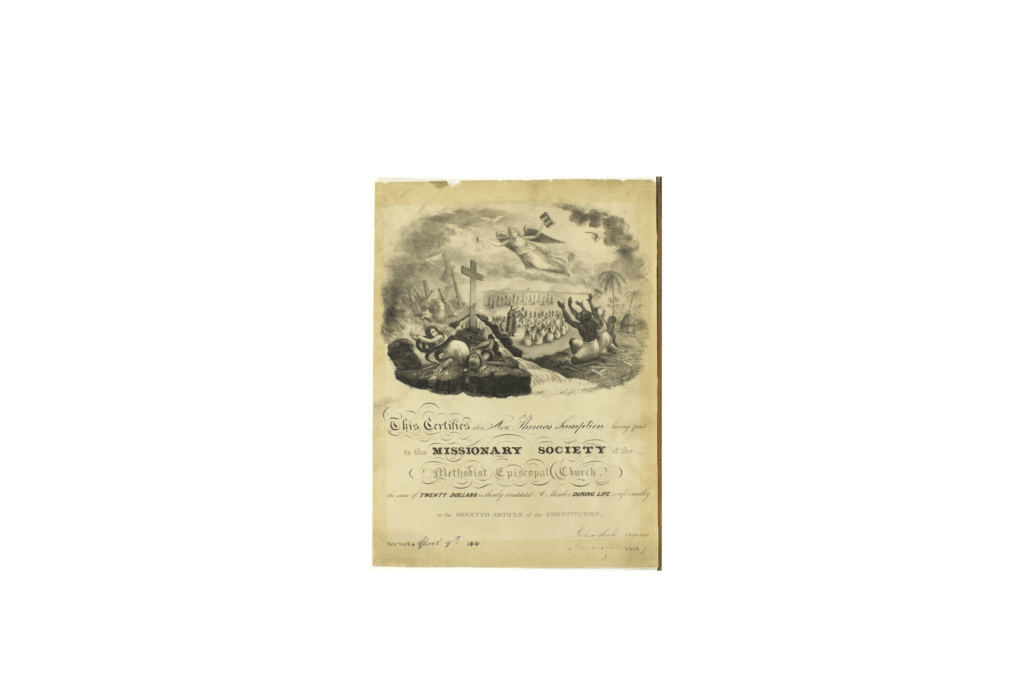
Nathaniel Currier, This Certifies that [Blank] Having Paid to the Missionary Society of the Methodist Episcopal Church the Sum of Twenty Dollars, is Hereby Constituted a Member During Life Conformably to the Seventh Article of the Constitution (New York, ca. 1835). Lithograph.

This certificate, produced by a White Methodist Episcopalian missionary society, features racist representations of Black and indigenous American peoples being Christianized by White missionaries. Three scantily clad African people in the foreground are shown bowing down in reverence of a White angel carrying a Bible, while religious objects from other traditions are blown away. As African American missionaries used language like “heathen,” “savage,” and “barbaric” to describe non-Christian Africans and Afro-diasporic people, they drew on racist discourses and representations like these.

Ralph Randolph Gurley, Life of Jehudi Ashmun, Late Colonial Agent in Liberia (Washington D.C., 1835).

This biography of Jehudi Ashmun, a White religious leader of the American Colonization Society, concludes with a brief biography of Rev. Lott Carey, one of the first African American missionaries to West Africa. Carey was a Baptist minister who had been born enslaved in Virginia. While Carey’s migration to Africa was driven in large part by a perceived religious duty to Christianize the “savage men, or more savage wild beasts on the Coast of Africa” (149), Carey also expressed a desire to “go to a country where I shall by estimated by merits, not by my complexion” (148). Though African Americans used similar religio-racial discourses as White colonists, their motives for migration often looked different than White missionaries’.

James Theodore Holly, A Vindication of the Capacity of the Negro Race for Self-Government, and Civilized Progress as Demonstrated by Historical Events of the Haytian Revolution; and the Subsequent Acts of that People Since Their National Independence (New Haven, 1857).

James Theodore Holly, African American missionary and emigrant to Haiti, gave this lecture about the Haitian Revolution and government to argue that Black people were capable of self-government and civilization. Among the examples Holly provided of Haiti’s civility was its openness to Christian missionaries and religious conversion.

Local Resources:

Muslim Charm (Fort Shirley, Huntingdon County, PA, c.a. 1760). Copper Charm. Museum of the American Revolution.

This charm, which may have belonged to an enslaved African American, is engraved with the Islamic symbol, the Shahada. Many enslaved Africans brought Islamic faith with them, though both White and Black Christian missionaries sought to convert them to Christianity.

Frederick H. Talbot, “Partners in Mission” (1974). Record Slipcover. Courtesy of the Richard Allen Museum.

This record was produced by the 16th District of the AME, which contains the Caribbean and South America. The slipcover calls the Afro-diasporic people of the 16th AME District “the sons and daughters of Richard Allen” and describes them as partners in mission. Missionary efforts in the AME led to large international branches of the independent Black denomination.

Ethel H. McNair, The Reflector: The First Episcopal District Women’s Missionary Society Newsletter (July 31, 1979). Courtesy of the Richard Allen Museum.

A local branch of the AME’s Women’s Missionary Society produced this newsletter in 1979, which outlined the AME Women’s Missionary Society’s present work and continued efforts in global missionary work. This document shows the enduring focus on international missionary work among independent Black churches.

Reference Books:

Lum, Kathryn Gin. Heathen: Religion and Race in American History. Cambridge, Harvard University Press, 2022.

In Heathen, religious historian Kathryn Gin Lum traces the concept of “heathen” from the colonial era to the present, arguing that racialization and religious othering are co-constitutive processes used in the construction of the “heathen.” Lum argues that White Americans constructed the “heathen” as a non-Protestant, generally non-White, recipient of White Christian evangelism and aid. Lum further explores how African American missionaries who had been converted to Christianity adopted similar rhetorics around heathenism, often describing Africa as a heathen continent in need of Christianization.

Andrews, Edward E. Native Apostles: Black and Indian Missionaries in the British Atlantic World. Cambridge, Harvard University Press, 2013.

*]:pointer-events-auto [content-visibility:auto] supports-[content-visibility:auto]:[contain-intrinsic-size:auto_100lvh] R6Vx5W_threadScrollVars scroll-mb-[calc(var(–scroll-root-safe-area-inset-bottom,0px)+var(–thread-response-height))] scroll-mt-[calc(var(–header-height)+min(200px,max(70px,20svh)))]” dir=”auto” data-turn-id=”request-WEB:21c3e0b2-4d6c-480f-b7e0-b3fdd3b2137a-0″ data-testid=”conversation-turn-2″ data-scroll-anchor=”false” data-turn=”assistant”>

Native Apostles explores the lives and work of African American and indigenous missionaries (often those affiliated with White-led denominations) to Afro-diasporic and indigenous communities. Andrews argues that White Christians often applied the same negative religio-racial stereotypes to Black missionaries as they did to non-Christian Black people, believing that African-descended Christians were uniquely physically and culturally equipped to minister to other Afro-diasporic people. Andrews further argues that African American missionaries related to Afro-diasporic communities differently than White missionaries did and that Black missionaries cannot be flattened into the simple “binary categories of compassionate martyr versus avaricious imperialist” (5). The book concludes with a helpful appendix of African American and indigenous
missionaries in the colonial period.

Additional Sources:

LCP SOURCES

Mathew B. Brady [photographer], John Chester Buttre [engraver], Middleton Strobridge and Co. [printer], Rev. Francis Burns: Missionary Bishop of the M.E. Church in Western Africa (Cincinnati, 1859. Engraving.

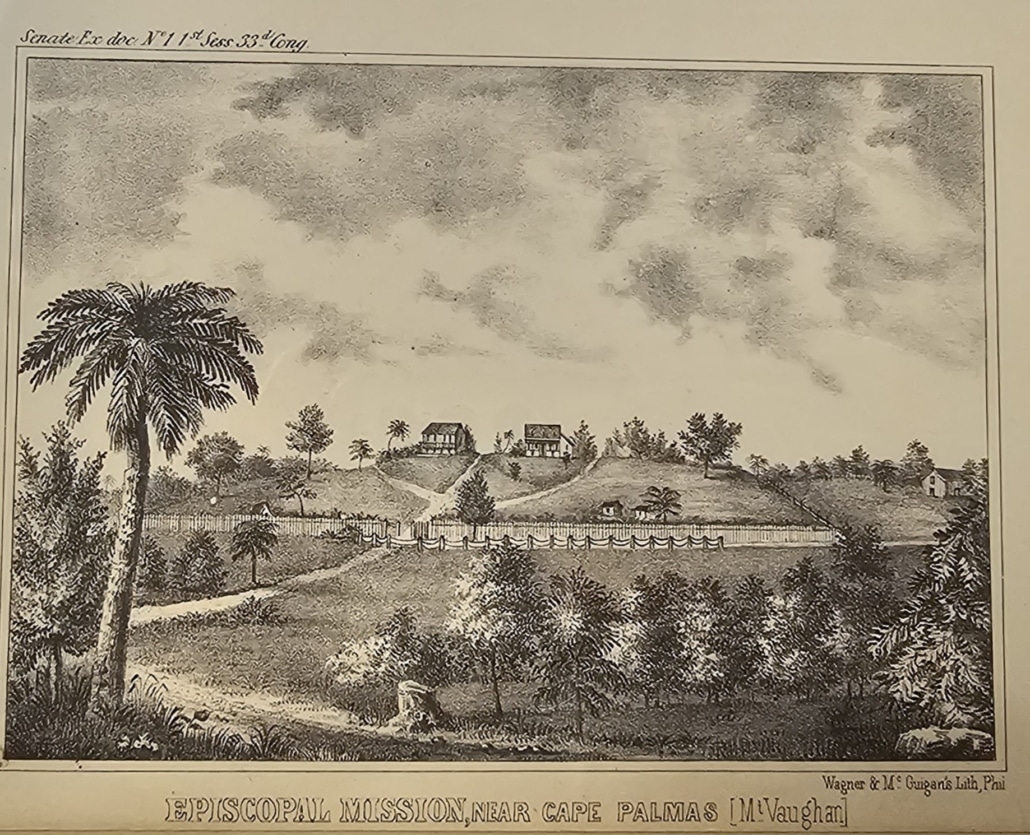
William L. Breton and Peter S. Duval, Mount Vaughan: Scite of Protestant Episcopal Mission, Cape Palmos, West Africa (Philadelphia, 1838). Lithograph.

Alexander Crummell, Africa and America: Addresses and Discourses by Alex Crummell, Rector of St. Luke’s Church, Washington D.C. (Springfield, MA, 1891).

Alexander Crummell, Civilization the Primal Need of the Race (Washington D.C., 1898).

Alexander Crummell, The Duty of a Rising Christian State to Contribute to the World’s Well-Being and Civilization, and the Means by Which it May Perform the Same (London and Boston, 1857).

Alexander Crummell, The Future of Africa: Being Addresses, Sermons, Etc. Delivered in the Republic of Liberia (New York, 1862).

The American Colonization Society and Daniel Coker, The Fourth Annual Report of the American Society for Colonizing the Free People of Colour of the United States (Washington D.C., 1821).

William Douglass, Annals of the First African Church, in the United States of America, Now Styled the African Episcopal Church of St. Thomas (Philadelphia, 1862).

Frederick Gutenkunst, Rev. Alexander Crummell (Philadelphia, 1862). Photograph.

Lambert Hollis [illustrator], John Chester Buttre [engraver], and George Edward Perine [printer], American Methodism (New York, 1872). Engraving.

William J. Keubler, Rev. C. M. Tanner, Philadelphia, PA, April 17, 1896 (Philadelphia, 1896). Photograph.

John H. B. Latrobe, William S. Seager, and Wagner and McGuigan [Wagner and McGuigan are lithographers], Views of Liberia from “W. F. Lynch Report of Mission to Africa” (Philadelphia, 1853). Lithograph.

John Marrant and William Aldridge, A Narrative of the Lord’s Wonderful Dealings with John Marrant, a Black: (Now Going to Preach the Gospel in Nova-Scotia) born in New-York, in North-America (London, 1785).

St. Mark’s Hospital (Harper, Liberia), Alexander Crummell, and Alexander Anderson, Laying of the Corner Stone, of St. Mark’s Hospital: Harper: Cape Palmas, Liberia, West Coast of Africa, 24th, April, 1859. With the Addresses and Speeches Delivered on the Occasion (New York, 1860).

Benjamin Tanner and William R. Jones, Revd. John Gloucester: Late Pastor of the First African Presbyterian Church in Philadelphia (Philadelphia, 1828). Engraving.

William Walker, The Missionary Pioneer, or, A Brief Memoir of the Life, Labours, and Death of John Stewart, (Man of Colour,) Founder, Under God of the Mission Among the Wyandotts of Upper Sandusky, Ohio (New York, 1827).

REFERENCE BOOKS

Tomek, Beverly C. Colonization and Its Discontents: Emancipation, Emigration, and Antislavery in Antebellum Pennsylvania. New York, New York University Press, 2011

Search

Search Search

Categories

  • All News (780)
  • Announcements (4)
  • Artist at LCP (13)
  • Beyond Glass Cases (4)
  • Beyond the Reading Room (325)
  • Bookbinding Research (16)
  • Curator's Favorites (29)
  • Current Exhibition (5)
  • Featured Collections (33)
  • Graphic Art Department News (87)
  • Imperfect History (24)
  • LCP in the Press (24)
  • LCP News (507)
  • Library Company Papers Project (47)
  • Marriott C. Morris Collection (14)
  • Mellon Scholars Program (46)
  • PAAH (40)
  • Pandemic Reading (8)
  • Podcasts (97)
  • Popular Medicine (1)
  • Program in Women's History (22)
  • Receipts from “The Larder Invaded” (43)
  • Redrawing History (17)
  • Seminars (4)
  • Shareholder Spotlight (57)
  • Talking in the Library Podcast (69)
  • The Living Book (3)
  • Uncategorized (8)
  • VCP News (44)

Archives

© Copyright 2024 - The Library Company of Philadelphia, 1314 Locust Street, Philadelphia, PA 19107. TEL (215) 546-3181
  • Link to Facebook
  • Link to Instagram
  • Link to Youtube
  • Link to Mail
  • Link to Rss this site
Link to: In Celebration of Retiring Senior Curator of Graphic Arts Sarah J. Weatherwax Link to: In Celebration of Retiring Senior Curator of Graphic Arts Sarah J. Weatherwax In Celebration of Retiring Senior Curator of Graphic Arts Sarah J. Weatherw... Link to: Shareholder Spotlight: Sarah Wistar Link to: Shareholder Spotlight: Sarah Wistar Photograph of page of Library Company share record bookShareholder Spotlight: Sarah Wistar Scroll to top Scroll to top Scroll to top

This site uses cookies. By continuing to browse the site, you are agreeing to our use of cookies.

OKLearn more

Cookie and Privacy Settings


How we use cookies

We may request cookies to be set on your device. We use cookies to let us know when you visit our websites, how you interact with us, to enrich your user experience, and to customize your relationship with our website.

Click on the different category headings to find out more. You can also change some of your preferences. Note that blocking some types of cookies may impact your experience on our websites and the services we are able to offer.

Essential Website Cookies

These cookies are strictly necessary to provide you with services available through our website and to use some of its features.

Because these cookies are strictly necessary to deliver the website, refusing them will have impact how our site functions. You always can block or delete cookies by changing your browser settings and force blocking all cookies on this website. But this will always prompt you to accept/refuse cookies when revisiting our site.

We fully respect if you want to refuse cookies but to avoid asking you again and again kindly allow us to store a cookie for that. You are free to opt out any time or opt in for other cookies to get a better experience. If you refuse cookies we will remove all set cookies in our domain.

We provide you with a list of stored cookies on your computer in our domain so you can check what we stored. Due to security reasons we are not able to show or modify cookies from other domains. You can check these in your browser security settings.

Google Analytics Cookies

These cookies collect information that is used either in aggregate form to help us understand how our website is being used or how effective our marketing campaigns are, or to help us customize our website and application for you in order to enhance your experience.

If you do not want that we track your visit to our site you can disable tracking in your browser here:

Other external services

We also use different external services like Google Webfonts, Google Maps, and external Video providers. Since these providers may collect personal data like your IP address we allow you to block them here. Please be aware that this might heavily reduce the functionality and appearance of our site. Changes will take effect once you reload the page.

Google Webfont Settings:

Google Map Settings:

Google reCaptcha Settings:

Vimeo and Youtube video embeds:

Other cookies

The following cookies are also needed - You can choose if you want to allow them:

Accept settingsHide notification only
X