
• Link to Facebook
  • Link to Instagram
  • Link to Youtube
  • Link to Mail
  • Link to Rss this site
  • Shopping Cart Shopping Cart
    0Shopping Cart
The Library Company of Philadelphia
  • Home
  • Search Collections
    • Search Library Catalog
    • Search Manuscripts
    • Search Digital Collections
    • How to Search the Collections
      • Subject Guides
      • Access Terms used in our Catalogs
    • Potentially Harmful Materials and Descriptions Statement
  • Academic Programs
    • Overview
    • Fellowships
    • Awards
      • LCP First Book Award
      • Innovation Award
    • Program in African American History
    • Program in Early American Economy & Society
    • The Davida Tenenbaum Deutsch Program in Women’s History
    • Visual Culture Program
  • Research
    • Overview
    • Subject Guides
    • Finding Aids
    • Online Exhibitions
    • Online Resources
  • Using the Library
    • Overview
    • Hours, Access, & Location
    • Appointments
    • Rights & Reproductions
  • Events
    • Upcoming Events
    • Fireside Chats
    • LCP News
    • LCP Press Resources
  • Projects
    • Beyond Glass Cases
    • Library Company Papers Project
  • Join & Support
    • Overview
    • Donate Online!
    • Join & Renew Membership Online!
    • Support: Shareholding
    • Annual Dinner 2026
    • Lecture in Honor of John C. Van Horne
    • The Junto
    • Gifts in Kind
    • Membership Benefits
    • Planned Giving
  • About LCP
    • Annual Reports
    • Staff
    • Academic Program Directors
    • Board of Trustees
    • Library Company Ambassadors
    • Employment
    • Affiliations
    • LCP Blog
    • Press Resources
    • LCP Privacy Policy
    • Overview & History
    • LCP FAQ Sheet
  • Click to open the search input field Click to open the search input field Search
  • Menu Menu

Fellow Highlight: American Literature’s Other Scripts
Author and Annual Dinner Speaker Stephen Fried

My essay “1833 – 1932: American Literature’s Other Scripts,” included in Cody Marrs and Christopher Hager’s edited volume Timelines of American Literature (Johns Hopkins UP), emerged out of my research on Helen Keller’s theory of embodied selfhood (“Stillness Is a Move: Helen Keller and the Kinaesthetics of Autobiography” in American Literary History, Fall 2013). Building on Marta Werner’s materialist recuperation of Keller’s writing practices as well as Mara Mill’s powerful work on the disability history of modern communications, I explored how Keller’s engagement with Braille troubles ocular-centric notions of subject and object, of self and other, of the real and the representational – and of authorship itself. This exploration was based on the assumption that Braille was the tactile print system in which Keller read and wrote.

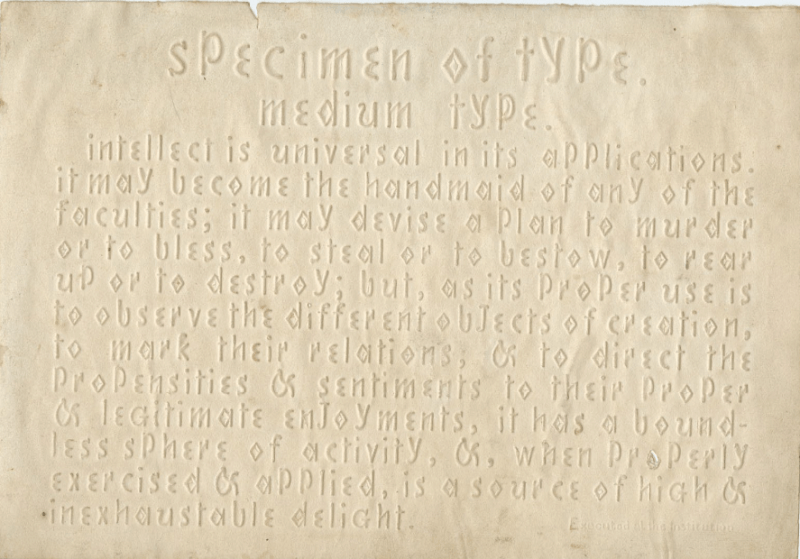
I was wrong. Unfolding in the decades prior to and during her first decade as a writer was a little-known but widespread public debate called “The War of the Dots.” Unlike most wars in the U.S., this was not a territorial but a typographical one. In 1786, French educator Valentine Haüy created raised, three-dimensional letters to be read with the fingers. Forty years later, the blind French educator Louis Braille published his raised print system, but replaced Haüy’s alphabetic characters with dots – each set representing an alphabetic letter – which he argued made reading easier and quicker for those with visual impairments. So began the war between “line type” (raised alphabetic characters) and “point type” (raised dots). The war spread to the United States in the 1830s, where social reformer Samuel Gridley Howe devised his own type (“Boston Line Letter”), as did Philadelphia printer Napoleon Kneass (“Philadelphia Line Letter”), among others. The proliferation of raised print systems – some line, some point – was burdensome for the people these institutions were professing to help. To read any given book required literacy in any number of print types. After almost a century of activism by blind students and their teachers, Braille finally “triumphed” – but that was far from a foregone conclusion when Louis Braille first invented it.

My essay explores the economic and ideological factors driving this war, but equally if not more important it recovers readers and writers who have been largely excised from book history and print culture. When in 1832 Philadelphian Jacob Snider printed the first embossed book in the U.S., The Gospel According to St. Mark, that event inaugurated not simply a debate between social reformers – over whether or not point type would undermine assimilation – but made possible an entirely new and highly decentralized reading public. As my essay argues, what emerged from the war was a literary “para-canon” altogether different from the one taught to sighted people as well as a mixed-media “sub-canon” in which blind writers repurposed inkprint literature. Within this framework, Keller’s authorship no longer seems exceptional but instead part of a larger and more dynamic literary culture. The goal, then, of my essay is not simply to treat tactile print (and its users) as an object of recovery but as an analytic. After all, what if we were to model our “timelines” of U.S. literature not on the straight-and-narrow path of ocular reading (left to right, left to right) but on the radial trajectory of the haptic, fingers moving both with and away from each other, looping back yet ever outward?

Dr. Erica Fretwell

(SUNY-Albany)

Former Andrew W. Mellon Short-Term Fellow

Search

Search Search

LCP News Home

Categories

  • All News
  • Announcements
  • Artist at LCP
  • Beyond Glass Cases
  • Beyond the Reading Room
  • Bookbinding Research
  • Curator's Favorites
  • Current Exhibition
  • Featured Collections
  • Graphic Art Department News
  • Imperfect History
  • LCP in the Press
  • LCP News
  • Library Company Papers Project
  • Marriott C. Morris Collection
  • Mellon Scholars Program
  • PAAH
  • Pandemic Reading
  • Podcasts
  • Popular Medicine
  • Program in Women's History
  • Receipts from “The Larder Invaded”
  • Redrawing History
  • Seminars
  • Shareholder Spotlight
  • Talking in the Library Podcast
  • The Living Book
  • Uncategorized
  • VCP News

Archive

© Copyright 2024 - The Library Company of Philadelphia, 1314 Locust Street, Philadelphia, PA 19107. TEL (215) 546-3181
  • Link to Facebook
  • Link to Instagram
  • Link to Youtube
  • Link to Mail
  • Link to Rss this site
Link to: Dissertation, Reimagined: Notes from the 2019 Modern Language Association Annual Convention Link to: Dissertation, Reimagined: Notes from the 2019 Modern Language Association Annual Convention Dissertation, Reimagined: Notes from the 2019 Modern Language Association Annual...Dr. William D. Fenton, Director of Scholarly Innovation Link to: The Past, Present and Future of Online Exhibitions Link to: The Past, Present and Future of Online Exhibitions The Past, Present and Future of Online Exhibitions
Scroll to top Scroll to top Scroll to top

This site uses cookies. By continuing to browse the site, you are agreeing to our use of cookies.

OKLearn more

Cookie and Privacy Settings


How we use cookies

We may request cookies to be set on your device. We use cookies to let us know when you visit our websites, how you interact with us, to enrich your user experience, and to customize your relationship with our website.

Click on the different category headings to find out more. You can also change some of your preferences. Note that blocking some types of cookies may impact your experience on our websites and the services we are able to offer.

Essential Website Cookies

These cookies are strictly necessary to provide you with services available through our website and to use some of its features.

Because these cookies are strictly necessary to deliver the website, refusing them will have impact how our site functions. You always can block or delete cookies by changing your browser settings and force blocking all cookies on this website. But this will always prompt you to accept/refuse cookies when revisiting our site.

We fully respect if you want to refuse cookies but to avoid asking you again and again kindly allow us to store a cookie for that. You are free to opt out any time or opt in for other cookies to get a better experience. If you refuse cookies we will remove all set cookies in our domain.

We provide you with a list of stored cookies on your computer in our domain so you can check what we stored. Due to security reasons we are not able to show or modify cookies from other domains. You can check these in your browser security settings.

Google Analytics Cookies

These cookies collect information that is used either in aggregate form to help us understand how our website is being used or how effective our marketing campaigns are, or to help us customize our website and application for you in order to enhance your experience.

If you do not want that we track your visit to our site you can disable tracking in your browser here:

Other external services

We also use different external services like Google Webfonts, Google Maps, and external Video providers. Since these providers may collect personal data like your IP address we allow you to block them here. Please be aware that this might heavily reduce the functionality and appearance of our site. Changes will take effect once you reload the page.

Google Webfont Settings:

Google Map Settings:

Google reCaptcha Settings:

Vimeo and Youtube video embeds:

Other cookies

The following cookies are also needed - You can choose if you want to allow them:

Accept settingsHide notification only
X