
• Link to Facebook
  • Link to Instagram
  • Link to Youtube
  • Link to Mail
  • Link to Rss this site
  • Shopping Cart Shopping Cart
    0Shopping Cart
The Library Company of Philadelphia
  • Home
  • Search Collections
    • Search Library Catalog
    • Search Manuscripts
    • Search Digital Collections
    • How to Search the Collections
      • Subject Guides
      • Access Terms used in our Catalogs
    • Potentially Harmful Materials and Descriptions Statement
  • Academic Programs
    • Overview
    • Fellowships
    • Awards
      • LCP First Book Award
      • Innovation Award
    • Program in African American History
    • Program in Early American Economy & Society
    • The Davida Tenenbaum Deutsch Program in Women’s History
    • Visual Culture Program
  • Research
    • Overview
    • Subject Guides
    • Finding Aids
    • Online Exhibitions
    • Online Resources
  • Using the Library
    • Overview
    • Hours, Access, & Location
    • Appointments
    • Rights & Reproductions
  • Events
    • Upcoming Events
    • Fireside Chats
    • LCP News
    • LCP Press Resources
  • Projects
    • Beyond Glass Cases
    • Library Company Papers Project
  • Join & Support
    • Overview
    • Donate Online!
    • Join & Renew Membership Online!
    • Support: Shareholding
    • Annual Dinner 2026
    • Lecture in Honor of John C. Van Horne
    • The Junto
    • Gifts in Kind
    • Membership Benefits
    • Planned Giving
  • About LCP
    • Annual Reports
    • Staff
    • Academic Program Directors
    • Board of Trustees
    • Library Company Ambassadors
    • Employment
    • Affiliations
    • LCP Blog
    • Press Resources
    • LCP Privacy Policy
    • Overview & History
    • LCP FAQ Sheet
  • Click to open the search input field Click to open the search input field Search
  • Menu Menu

The Captivating World of 19th-Century American Trade Cards

Miko Fleming, Haverford College ’24
Gladys Kreible Delmas Foundation Graphic Arts Department Summer Intern 2024
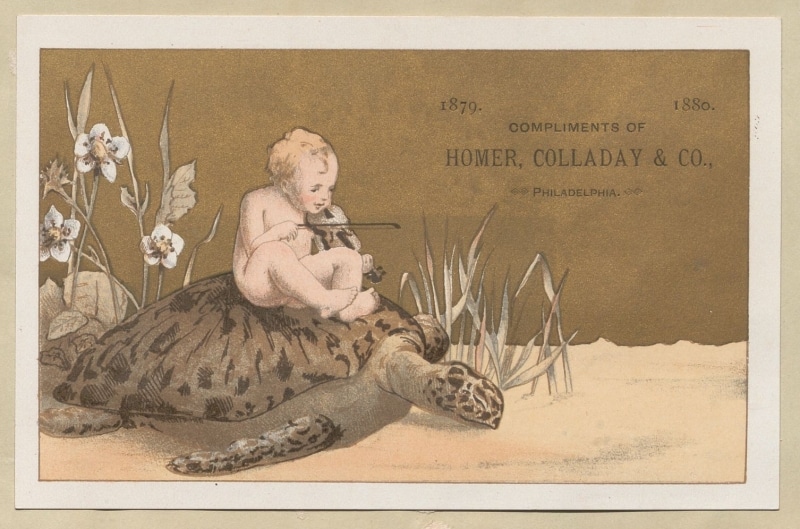
p.2014.14-p54 row2 boy on turtle_access2

Compliments of Homer, Colladay & Co. Philadelphia (Philadelphia, 1879). Chromolithograph trade card.

After finishing my project with the William T. McAllister Collection of Graphic Materials, I was thrilled by the opportunity to work with a scrapbook of 19th-century American trade cards acquired by the Library Company in 2021. Immediately upon opening the scrapbook, my eyes were met by an explosion of vibrant colors with each page packed with a rich selection of chromolithographic prints advertising various businesses from the later 19th to early 20th century. This volume reminded me of a cartes-de-visite album that I had previously worked on in the McAllister Collection, and much like that album, this scrapbook of trade cards is a rich resource for understanding the material, commercial, and visual culture of 19th-century America.
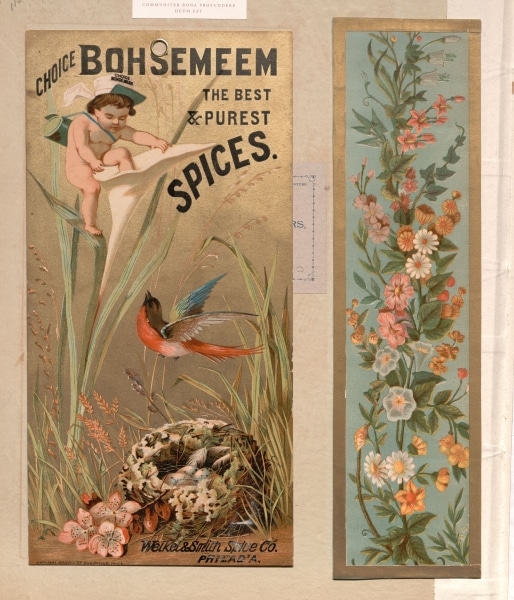
p.2014.14-p1 inside front cover cards in one image_access2

Large-format trade cards pasted on the inside front cover of the scrapbook.

The rise of trade cards in the United States occurred parallel to the Industrial Revolution. As populations grew larger and manufacturers developed ways to produce more products at cheaper prices, businesses also sought innovative ways to attract new customers. In addition, the new printing process of chromolithography facilitated printers’ abilities to create vivid and beautiful designs in multiple colors relatively cheaply. All of these factors caused the trade card to become the dominant form of advertisement during the late 19th century. At the height of their popularity between the Centennial Exhibition of 1876 and the early 1900s, trade cards were a popular and effective method for businesses to advertise their products. In addition, the large demand for multicolored trade cards led to an intense culture of competition between printers, in turn leading to the creation of even more captivating images. Color printing was still a novelty at the time, and trade cards became extremely popular collectible items. People began collecting cards in albums and scrapbooks and occasionally traded them to curate their perfect collection.
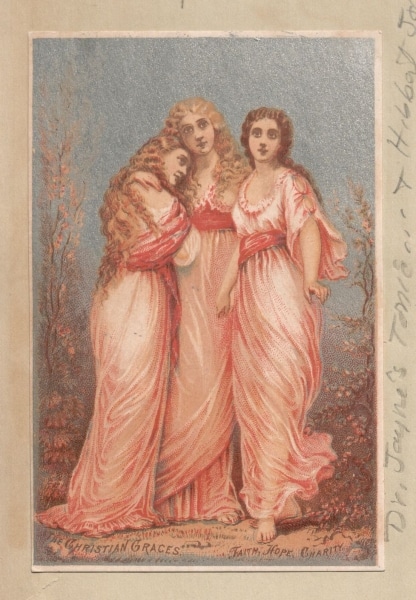
p.2014.14-p89 top row left - 3 women silver background_access2

Trade card for Dr. Jayne’s Tonic. Chromolithograph.

Trade cards displayed humorous cartoons, beautiful illustrations, or catchy sayings often unrelated to the product itself. In order to attract more customers, they would also utilize the likenesses of famous people or beautiful women, much like modern advertisers. By studying these cards, we can try to imagine the aesthetic tastes of the collector themselves, as well as the consumer and material cultures of the later 19th century that led to our own commercial language today.

Trade cards also reflect the common aesthetic and social attitudes of their time period, and imagery used in them can often be offensive to the modern eye. Though many cards display beautiful illustrations of flowers, children playing, or animals, many also feature caricatures of African American, Asian, Asian American, and Indigenous American people. Printers capitalized on such images  to appeal to their typically white, middle-class customer base. Though difficult to see, these cards are important sources for modern viewers to understand how harmful depictions of marginalized groups are intertwined with American media history. By studying them, we can further discern how these images evolved over time and continue to affect minority representation in modern-day media.
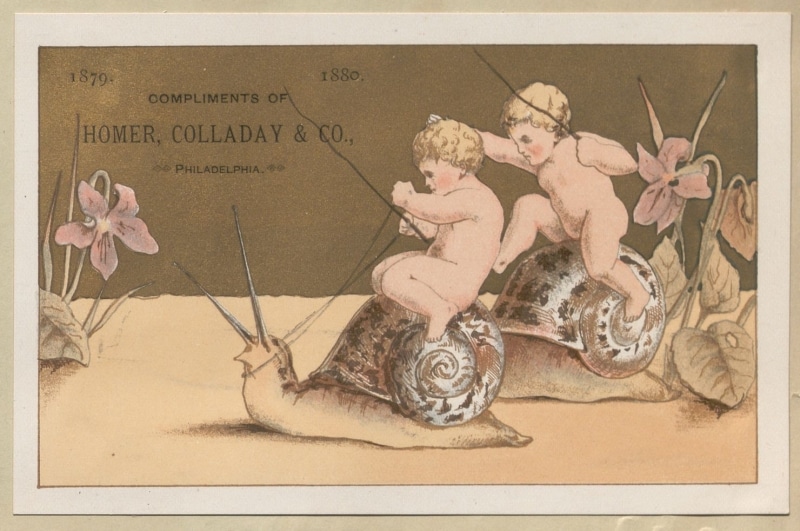
p.2014.14-p54 row2 boys on snails_access2

Compliments of Homer, Colladay & Co. Philadelphia (Philadelphia, 1879). Chromolithograph trade card.

Though trade cards were immensely popular between the 1870s and the early 20th century, they gradually lost their popularity once businesses started printing advertisements in magazines. Thankfully, due to the sheer volume of cards produced during the height of their popularity, many have survived in relatively good condition in 19th-century albums and scrapbooks such as the one at the Library. These cards enrich our knowledge about the aesthetic history of American commercial culture, as well as the social and economic factors that affect it.

Search

Search Search

Categories

  • All News (780)
  • Announcements (4)
  • Artist at LCP (13)
  • Beyond Glass Cases (4)
  • Beyond the Reading Room (325)
  • Bookbinding Research (16)
  • Curator's Favorites (29)
  • Current Exhibition (5)
  • Featured Collections (33)
  • Graphic Art Department News (87)
  • Imperfect History (24)
  • LCP in the Press (24)
  • LCP News (507)
  • Library Company Papers Project (47)
  • Marriott C. Morris Collection (14)
  • Mellon Scholars Program (46)
  • PAAH (40)
  • Pandemic Reading (8)
  • Podcasts (97)
  • Popular Medicine (1)
  • Program in Women's History (22)
  • Receipts from “The Larder Invaded” (43)
  • Redrawing History (17)
  • Seminars (4)
  • Shareholder Spotlight (57)
  • Talking in the Library Podcast (69)
  • The Living Book (3)
  • Uncategorized (8)
  • VCP News (44)

Archives

© Copyright 2024 - The Library Company of Philadelphia, 1314 Locust Street, Philadelphia, PA 19107. TEL (215) 546-3181
  • Link to Facebook
  • Link to Instagram
  • Link to Youtube
  • Link to Mail
  • Link to Rss this site
Link to: Leafing Through the Mid-19th Century with Cartes de Visite Link to: Leafing Through the Mid-19th Century with Cartes de Visite Leafing Through the Mid-19th Century with Cartes de Visite Link to: Shareholder Spotlight: Rees Lloyd (1709-1743) Link to: Shareholder Spotlight: Rees Lloyd (1709-1743) Photo of text in minute book about Rees Lloyd's widow wanting share to be held in trust by her brother for her childrenShareholder Spotlight: Rees Lloyd (1709-1743)
Scroll to top Scroll to top Scroll to top

This site uses cookies. By continuing to browse the site, you are agreeing to our use of cookies.

OKLearn more

Cookie and Privacy Settings


How we use cookies

We may request cookies to be set on your device. We use cookies to let us know when you visit our websites, how you interact with us, to enrich your user experience, and to customize your relationship with our website.

Click on the different category headings to find out more. You can also change some of your preferences. Note that blocking some types of cookies may impact your experience on our websites and the services we are able to offer.

Essential Website Cookies

These cookies are strictly necessary to provide you with services available through our website and to use some of its features.

Because these cookies are strictly necessary to deliver the website, refusing them will have impact how our site functions. You always can block or delete cookies by changing your browser settings and force blocking all cookies on this website. But this will always prompt you to accept/refuse cookies when revisiting our site.

We fully respect if you want to refuse cookies but to avoid asking you again and again kindly allow us to store a cookie for that. You are free to opt out any time or opt in for other cookies to get a better experience. If you refuse cookies we will remove all set cookies in our domain.

We provide you with a list of stored cookies on your computer in our domain so you can check what we stored. Due to security reasons we are not able to show or modify cookies from other domains. You can check these in your browser security settings.

Google Analytics Cookies

These cookies collect information that is used either in aggregate form to help us understand how our website is being used or how effective our marketing campaigns are, or to help us customize our website and application for you in order to enhance your experience.

If you do not want that we track your visit to our site you can disable tracking in your browser here:

Other external services

We also use different external services like Google Webfonts, Google Maps, and external Video providers. Since these providers may collect personal data like your IP address we allow you to block them here. Please be aware that this might heavily reduce the functionality and appearance of our site. Changes will take effect once you reload the page.

Google Webfont Settings:

Google Map Settings:

Google reCaptcha Settings:

Vimeo and Youtube video embeds:

Other cookies

The following cookies are also needed - You can choose if you want to allow them:

Accept settingsHide notification only
X