
• Link to Facebook
  • Link to Instagram
  • Link to Youtube
  • Link to Mail
  • Link to Rss this site
  • Shopping Cart Shopping Cart
    0Shopping Cart
The Library Company of Philadelphia
  • Home
  • Search Collections
    • Search Library Catalog
    • Search Manuscripts
    • Search Digital Collections
    • How to Search the Collections
      • Subject Guides
      • Access Terms used in our Catalogs
    • Potentially Harmful Materials and Descriptions Statement
  • Academic Programs
    • Overview
    • Fellowships
    • Awards
      • LCP First Book Award
      • Innovation Award
    • Program in African American History
    • Program in Early American Economy & Society
    • The Davida Tenenbaum Deutsch Program in Women’s History
    • Visual Culture Program
  • Research
    • Overview
    • Subject Guides
    • Finding Aids
    • Online Exhibitions
    • Online Resources
  • Using the Library
    • Overview
    • Hours, Access, & Location
    • Appointments
    • Rights & Reproductions
  • Events
    • Upcoming Events
    • Fireside Chats
    • LCP News
    • LCP Press Resources
  • Projects
    • Beyond Glass Cases
    • Library Company Papers Project
  • Join & Support
    • Overview
    • Donate Online!
    • Join & Renew Membership Online!
    • Support: Shareholding
    • Annual Dinner 2026
    • Lecture in Honor of John C. Van Horne
    • The Junto
    • Gifts in Kind
    • Membership Benefits
    • Planned Giving
  • About LCP
    • Annual Reports
    • Staff
    • Academic Program Directors
    • Board of Trustees
    • Library Company Ambassadors
    • Employment
    • Affiliations
    • LCP Blog
    • Press Resources
    • LCP Privacy Policy
    • Overview & History
    • LCP FAQ Sheet
  • Click to open the search input field Click to open the search input field Search
  • Menu Menu

Michael Zinman Collection of Early American Primers Now Available to Researchers

Amy Carson Collections Processor and Reference Assistant

It’s back to school season! While this time of year may make many of us nostalgic for crayons and yellow buses, for many early Americans, memories of childhood education would involve a type of book known as a primer. Currently, Library Company staff are finishing the processing and cataloging of the more than 200 examples of these tiny books that constitute the Michael Zinman Collection of Early American Primers. 
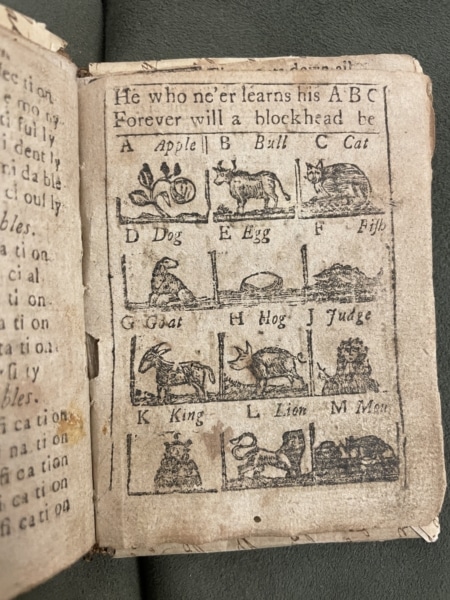
Am 1798 AM Primer 124860.D Alphabet

Image: Illustrated alphabet from the 1798 Medford printing of The American Primer Improved. Call number: Am 1798 Am Primer 124860.D (Zinman)

Primers were a genre of early schoolbooks intended to teach children to read. They typically included elements like woodcut illustrations, rhyming couplets, and lists of common words broken down by syllable. By far the most popular primer in America was The New England Primer, which print historians estimate had anywhere from three to eight million copies printed between its first publication around 1687-90 to the mid-1800s.[i] This imprecise estimate is due to a mix of factors. For one, these were books intended to be handled over and over by children while they learned to read. Many extant copies, including those at the Library Company, show evidence of extensive use and wear, such as tattered pages, broken bindings, and extensive repairs. 
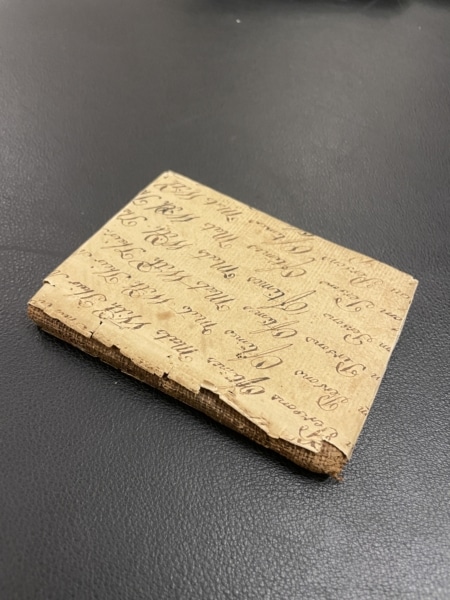
Am 1798 AM Primer 124860.D paper cover exterior

Image: The American Primer Improved, 1798 Medford, MA imprint by Nathaniel Coverly. Exterior with vernacular protective covering made from scrap paper previously used for a penmanship exercise. Call number: Am 1798 Am Primer 124860.D (Zinman)
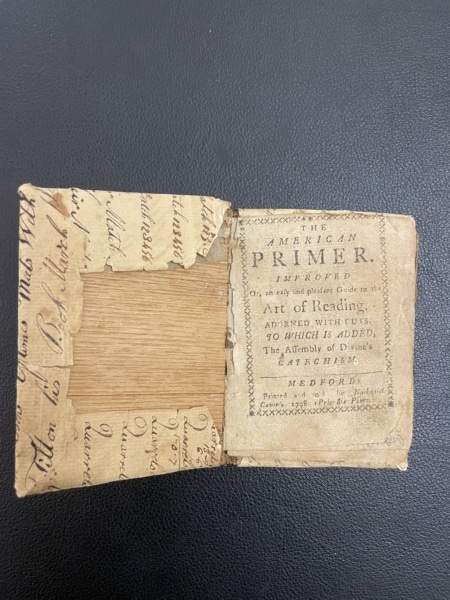
Am 1798 Am Primer 124860.D paper cover interior with title pg

Image: The American Primer Improved, 1798 Medford, MA imprint by Nathaniel Coverly. interior of front board, which shows that this paper covering is constructed very similarly to the classic paper bag textbook covers many of us remember making in grade school.
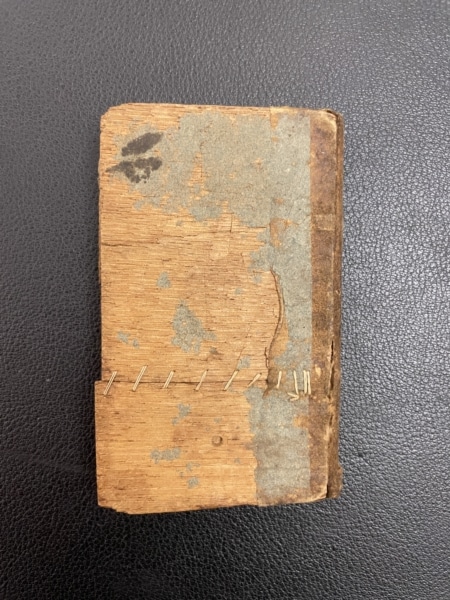
Am 1819 NE Primer 124916.D repair exterior

Image: The New England Primer, 1819 Haverhill, MA printing by Nathan Burrill. The back board has a vernacular sewn repair, where the wood in the scaleboard binding had split. Call number: Am 1819 NE Primer 124916.D (Zinman)
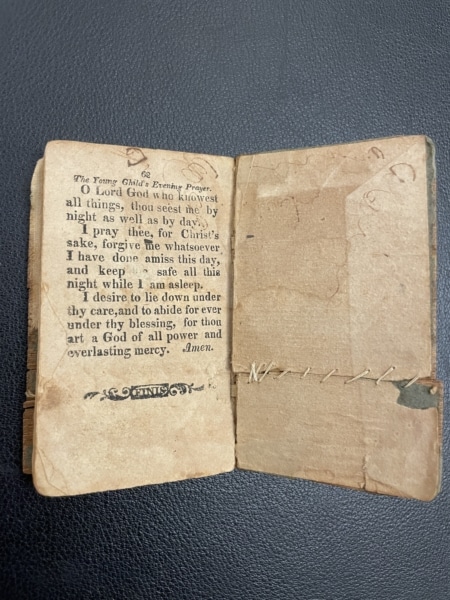
Am 1819 NE Primer 124916.D repair interior

Image: Interior of sewn vernacular repair on back board of 1819 Watts imprint. Near the top of both the final page and the pastedown, you can see various scribbles in early 19th century ink.

As primers were quick to print, cheap to produce, and certain to sell, printers all across colonial and early America happily met the demand, making primers staples of print shops across the early nation.[ii]

While these primers were extremely common at the time of their printing, their extensive use makes surviving copies rare today. For example, bibliographic evidence indicates that the New England Primer was first printed by Benjamin Harris (1673-1716) sometime around 1690. However, the earliest known copies that still exist today date to 1727. [iii] The earliest copy held by the Library Company is a 1754 printing from Germantown, which came to us as part of the Zinman donation.
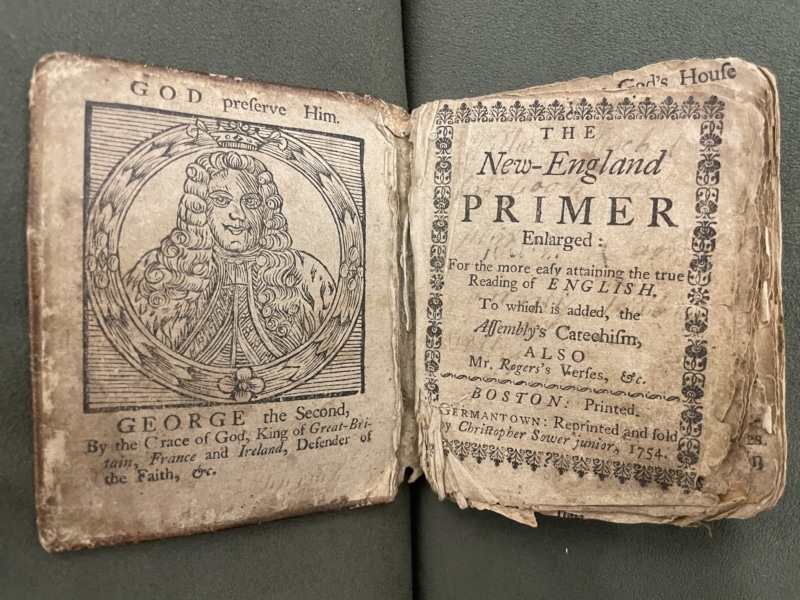
Am 1754 NE Primer 124842.D Title and Fronticpiece

Image:The New England Primer, 1754 Germantown imprint by Christopher Sower, title page and frontispiece. Call number: Am 1754 NE Primer 124842.D

While primarily intended to teach one to read, the New England Primer was also an explicitly religious text.[iv] Written in the wake of the British Reformation, the little book sought to provide a Protestant moral education through the inclusion of short prayers and hymns, a question-and-answer-style catechism, and–most shocking to modern audiences–an illustration of Protestant martyr John Roger being burned at the stake.
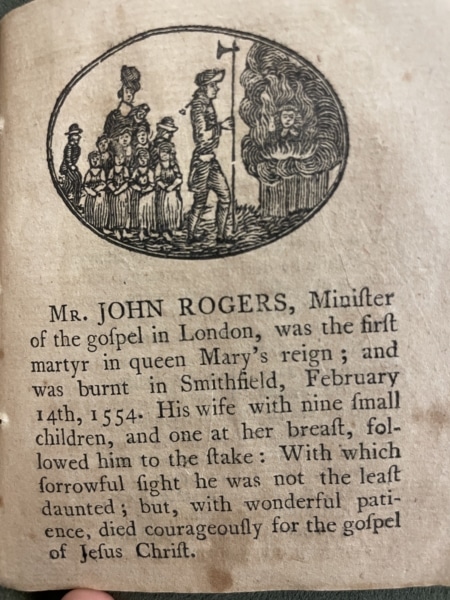
Am 1797 NE Primer 124857.D John Rogers

Image: The New England Primer, 1797 Philadelphia imprint by Thomas Dobson.  Illustration of Protestant martyr John Rogers being burned at the stake, a common feature of early New England Primers. Call number: Am 1797 NE Primer 124857.D

The New England Primer’s long printing history and focus on children’s moral education offer historians a unique insight into cultural shifts from the Colonial to Early Republic periods. Through gradual changes in the text, one can see how children went from being educated within a colonial cultural identity to a distinctively American one. For example, the Revolutionary War led some printers to make changes in the content of its iconic (and explicitly pro-British) rhyming pictorial alphabet section. In the 1790s, Philadelphia printer Thomas Dobson (1751–1823 ) changed the entry for K, “Our KING the good / No man of blood” to “”The British King / Lost States Thirteen”.[v] By the early 1800s, some printers completely replaced K’s references to a king with a Biblical reference to Korah’s rebellion, as found in an 1824 Newark printing from the Zinman collection.
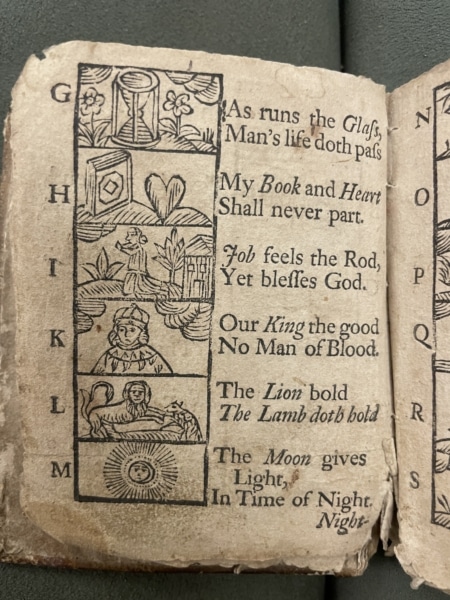

Image: K entry from Am 1754 NE Primer 124842.D, which espouses a positive sentiment about the King of England.
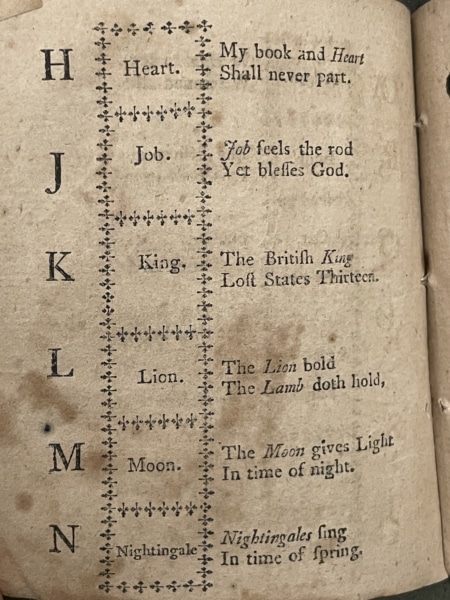
Am 1797 NE Primer 124857.D K

Image: K entry from Am 1797 NE Primer 124857.D (Zinman), where printer Thomas Dobson changed the rhyme to be critical of the King
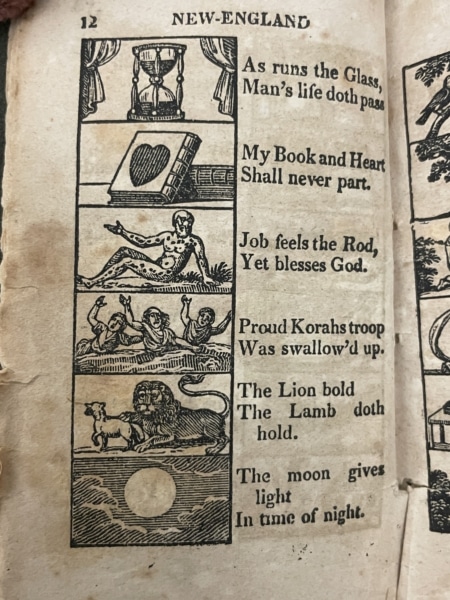
Am 1824 NE Primer 124926.D K

Image: K entry from Am 1824 NE Primer 124926.D, where the rhyme no longer references a King at all, but is replaced by the story of Korah from the Bible.

If you wish to come and explore all the various ways these little books changed over the years for yourself, feel free to schedule an appointment in the Scheide Reading Room to view them. All of the primers that are part of the Zinman collection can be found and requested here in the Library Company’s online catalog. 

—–

[i] Roberts, Kyle B. “Rethinking The New-England Primer.” The Papers of the Bibliographical Society of America 104, no. 4 (2010): 492. https://doi.org/10.1086/680973.

[ii] Beales, Ross W. and Monaghan, E. Jennifer. Chapter 11: Practices of Reading, Part 1 . Literacy and Schoolbooks.in A History of the Book in America Vol. 1 The Colonial Book in the Atlantic World. (Chapel Hill, NC: University of North Carolina Press, 2007).

[iii] Roberts, 497.

[iv] Smith, S.J. “The New-England Primer.” Encyclopedia Britannica, March 4, 2019. https://www.britannica.com/topic/The-New-England-Primer.

[v] Spero, Patrick. “The Revolution in Popular Publications: The Almanac and New England Primer, 1750—1800.” Early American Studies 8, no. 1 (2010): 71. http://www.jstor.org/stable/23546600.

Search

Search Search

Categories

  • All News (780)
  • Announcements (4)
  • Artist at LCP (13)
  • Beyond Glass Cases (4)
  • Beyond the Reading Room (325)
  • Bookbinding Research (16)
  • Curator's Favorites (29)
  • Current Exhibition (5)
  • Featured Collections (33)
  • Graphic Art Department News (87)
  • Imperfect History (24)
  • LCP in the Press (24)
  • LCP News (507)
  • Library Company Papers Project (47)
  • Marriott C. Morris Collection (14)
  • Mellon Scholars Program (46)
  • PAAH (40)
  • Pandemic Reading (8)
  • Podcasts (97)
  • Popular Medicine (1)
  • Program in Women's History (22)
  • Receipts from “The Larder Invaded” (43)
  • Redrawing History (17)
  • Seminars (4)
  • Shareholder Spotlight (57)
  • Talking in the Library Podcast (69)
  • The Living Book (3)
  • Uncategorized (8)
  • VCP News (44)

Archives

© Copyright 2024 - The Library Company of Philadelphia, 1314 Locust Street, Philadelphia, PA 19107. TEL (215) 546-3181
  • Link to Facebook
  • Link to Instagram
  • Link to Youtube
  • Link to Mail
  • Link to Rss this site
Link to: From the New Director to Library Company Shareholders Link to: From the New Director to Library Company Shareholders From the New Director to Library Company Shareholders Link to: New Hours for Researching at the Library Company Link to: New Hours for Researching at the Library Company New Hours for Researching at the Library Company
Scroll to top Scroll to top Scroll to top

This site uses cookies. By continuing to browse the site, you are agreeing to our use of cookies.

OKLearn more

Cookie and Privacy Settings


How we use cookies

We may request cookies to be set on your device. We use cookies to let us know when you visit our websites, how you interact with us, to enrich your user experience, and to customize your relationship with our website.

Click on the different category headings to find out more. You can also change some of your preferences. Note that blocking some types of cookies may impact your experience on our websites and the services we are able to offer.

Essential Website Cookies

These cookies are strictly necessary to provide you with services available through our website and to use some of its features.

Because these cookies are strictly necessary to deliver the website, refusing them will have impact how our site functions. You always can block or delete cookies by changing your browser settings and force blocking all cookies on this website. But this will always prompt you to accept/refuse cookies when revisiting our site.

We fully respect if you want to refuse cookies but to avoid asking you again and again kindly allow us to store a cookie for that. You are free to opt out any time or opt in for other cookies to get a better experience. If you refuse cookies we will remove all set cookies in our domain.

We provide you with a list of stored cookies on your computer in our domain so you can check what we stored. Due to security reasons we are not able to show or modify cookies from other domains. You can check these in your browser security settings.

Google Analytics Cookies

These cookies collect information that is used either in aggregate form to help us understand how our website is being used or how effective our marketing campaigns are, or to help us customize our website and application for you in order to enhance your experience.

If you do not want that we track your visit to our site you can disable tracking in your browser here:

Other external services

We also use different external services like Google Webfonts, Google Maps, and external Video providers. Since these providers may collect personal data like your IP address we allow you to block them here. Please be aware that this might heavily reduce the functionality and appearance of our site. Changes will take effect once you reload the page.

Google Webfont Settings:

Google Map Settings:

Google reCaptcha Settings:

Vimeo and Youtube video embeds:

Other cookies

The following cookies are also needed - You can choose if you want to allow them:

Accept settingsHide notification only
X