
Looking Back at the Loganian Library
Dana Dorman, Archivist, Library Company Papers Project
With this month marking the 350th anniversary of the birth of James Logan (1674-1751), I wanted to take a moment to review the Library Company’s long relationship with the Loganian Library.
Unlike the other 18th century libraries that merged into the Library Company, the Loganian Library began as one person’s private collection.
Logan was a politician, merchant, trader, scientist, and scholar. He served as Provincial Secretary to the Penn family, Mayor of Philadelphia, and Chief Justice of Pennsylvania, among other roles. He was also an enslaver, and he played a key role in the “Walking Purchase” that unfairly forced Lenape off their homeland.[i]
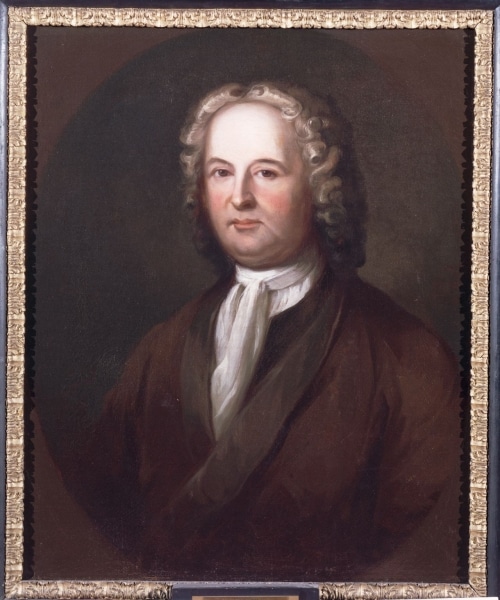
Image: The Directors of the Library Company commissioned this portrait of James Logan in 1831 to replace a painting destroyed in a fire at the Loganian Library on January 6 of that year. Artist Thomas Sully (1783-1872) copied a Logan portrait by Gustavus Hesselius (1682-1755) that was in the possession of “Mrs. D. Logan” of Stenton. Thomas Sully, James Logan (Philadelphia, 1831). Oil on canvas.
Logan’s personal wealth allowed him to feed his wide-ranging scholarly interests with an impressive book collection. One biographer observed, “It is not too much to say that James Logan was the greatest bookman of colonial America.”[ii]
Logan did not become a Library Company shareholder, but he was given special borrowing permission nevertheless. He helped the Library Company compile its first order of books in 1732, with the Directors noting that he was “a Gentleman of universal Learning, and the best Judge of Books in these Parts.”[iii]
By the time of his death, Logan had built a substantial personal library of almost 2,600 books. His collection included works of mathematics, science, history, geography, and much more, primarily in Latin and Greek but also in English, Italian, Spanish, French, and other languages.
Logan had taken steps in 1745 to turn his library into a public resource, motivated “by the patriotic desire of extending the benefits of learning among his fellow citizens,” but he had not yet finished the legal steps required when he died in 1751.[iv]
Logan’s heirs followed through on his wishes and created the Loganian Library.
The library’s building was located on 6th Street between Walnut and Chestnut Streets, and by 1760, it was open to the public on Saturday afternoons.[v]
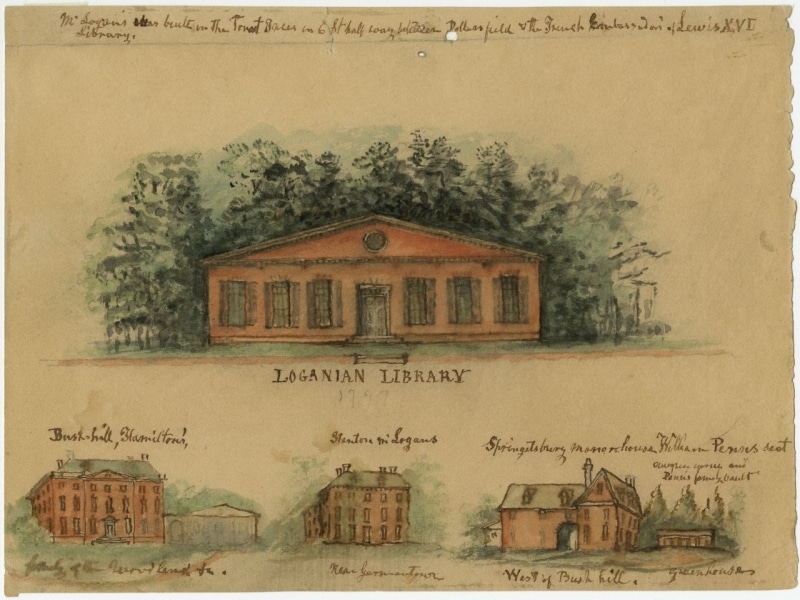
Image: Loganian Library ([1797?]. Ink and wash drawing.
The library published a catalog of its holdings in 1760, the Catalogus Bibliothecae Loganianae, so we know that it offered numerous erudite works in Latin, Greek, and other languages.
The library operated independently for the next 30 years, but in 1792, Logan’s last surviving heir proposed to transfer the Loganian Library to the Library Company upon “certain conditions.” The Library Company’s Directors appointed a committee to look into the specifics, but they clearly approved of the conditions. Governor Thomas Mifflin (1744-1800) approved a state law to unite the two libraries just six weeks after the idea was first mentioned in the Directors’ minutes.[vi]
Of course, the Legislature would have been very well informed of Philadelphia’s library landscape at that time. The Legislature met in what is today known as Independence Hall, just across the street from the Library Company’s then-new building at 5th and Chestnut. The Speaker of the Pennsylvania House in 1792 was Library Company shareholder and benefactor William Bingham (1752-1804); the Speaker of the Senate was Library Company shareholder Samuel Powel (1738-1793).
The Directors quickly addressed the conditions of the transfer of the Loganian Library’s assets. For instance, the law specified that the Loganian Library’s books and other property “be kept separate and apart from the books belonging to the Library Company.”[vii] To accomplish this, the Library Company constructed an addition to its brand-new building and connected it to the existing library room.
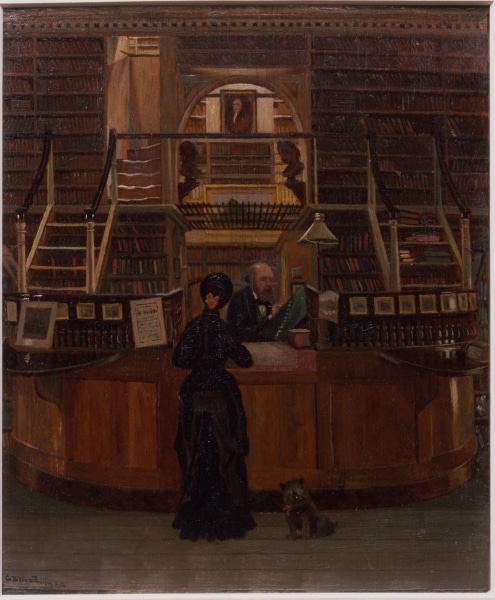
Image: The Loganian Library space is visible through the arched doorway in the center of this view of the Library Company’s interior. George Bacon Wood, Library Building on 5th Street (Philadelphia, 1880). Oil on wood. Gift of Dr. William Pepper, 1893.
The operations of the Loganian Library were also managed separately, no doubt in part because it had its own source of income. The Loganian Library had been funded by ground rents paid on Logan-owned land in Bucks County, a system that continued at least into the late 19th century.[viii]
The Loganian Library’s financial records, Trustee minutes, collection records, and more are now arranged and described as part of the Library Company’s institutional archives, and are in the process of being digitized and uploaded to the Internet Archive and our Digital Library thanks to the Library Company Papers Project.
To learn more about the Loganian Library before and after it was united with the Library Company, check out recordings of this two-part program that was hosted by the Library Company and Stenton, Logan’s country home and plantation in the Germantown section of Philadelphia:
“Books Are My Disease” Part One: The Loganian Library at Stenton
“Books Are My Disease” Part Two: The Loganian Library at the Library Company of Philadelphia

Any views, findings, conclusions, or recommendations expressed in this blog post do not necessarily represent those of the National Endowment for the Humanities.
[i] For more on the Walking Purchase and Logan’s involvement, see “The Walking Purchase – August 25, 1737,” Pennsylvania Historical & Museum Commission, https://www.phmc.state.pa.us/portal/communities/documents/1681-1776/walking-purchase.html (accessed September 27, 2024).
[ii] Edwin Wolf 2nd, “James Logan, Bookman Extraordinary,” Proceedings of the Massachusetts Historical Society, 1967, Third Series, Vol. 79 (1967), 34.
[iii] The Directors minutes in early 1732 repeatedly mention “William Logan,” but this is certainly an error. Library Company Secretary Thomas Hopkinson copied loose minutes into a bound volume 27 years after the events recorded, and he would have known Logan’s son William. This quote about Logan is from March 29, 1732 minutes, Directors Minutes Volume 1, volume 163, Library Company of Philadelphia records (MSS00270). Logan’s exception to the borrowing rule is listed in the November 14, 1732 agreement for Louis Timothee to serve as librarian, available at the New York Public Library. A photostat and photocopies of the document are available in Box 10, Folder 10, Library Company of Philadelphia records (MSS00270).
[iv] Dorothy Fea Grimm, “A History of the Library Company of Philadelphia, 1731-1835,” (PhD dissertation, University of Pennsylvania, 1955), 120.
[v] “Notice is hereby given . . .”, Pennsylvania Gazette, October 16, 1760.
[vi] See February 18, 1792 minutes, Directors Minutes Volume 3, volume 165, Library Company of Philadelphia records (MSS00270). The full text of the Act of Annexation, dated March 31, 1792, was included in the Catalogue of the Books Belonging to the Loganian Library (Philadelphia, 1795), and is also available in Appendix VI of Grimm, 291-294.
[vii] Grimm, 293.
[viii] The LCP Papers Project focuses on the Library Company’s history only through 1881, so some records related to the Loganian Library’s operations are no doubt still waiting among the unprocessed portion of our institutional records.

