
Mellon Scholars Summer Program – Subject Guides
Reading Between the Lines: Queering Black American Fem(me) Intimacy


Overview:
Reading Between the Lines: Queering Black American Fem(me) Intimacy offers a counter-reading of (primarily) 19th and early 20th century effects of Black women, located in the United States and the Caribbean. This counter-reading acknowledges the conservative social-norms present during this period, particularly for Black women while fabulating the potential queerness hidden in plain sight. Working within the constraints of 19th and 20th century respectability politics in an anti-Black misogynist society, Black women archived their identities through creative methods. Friendship albums, poetry, and photos are just three forms that allowed for a reclamation of agency and self-identification.
This kind of affective archiving was often cataloged as a form of sentimentalism that allowed for the curation of a new emotion-oriented feminine aesthetic. For Black women, this femininity was inseparable from their desire for equitable freedom. Black women explored and cultivated racialized forms of womanhood and fluid intimacy within their personal effects. This queer(ed) intimacy is performed and preserved within the archive, beyond what is immediately legible. Rather than projecting the contemporary subject position of queerness onto historical subjects, this guide explores non-normative possibilities of discovering what was not always visible but is made clear through a Black feminist diasporic approach.
About the Author:
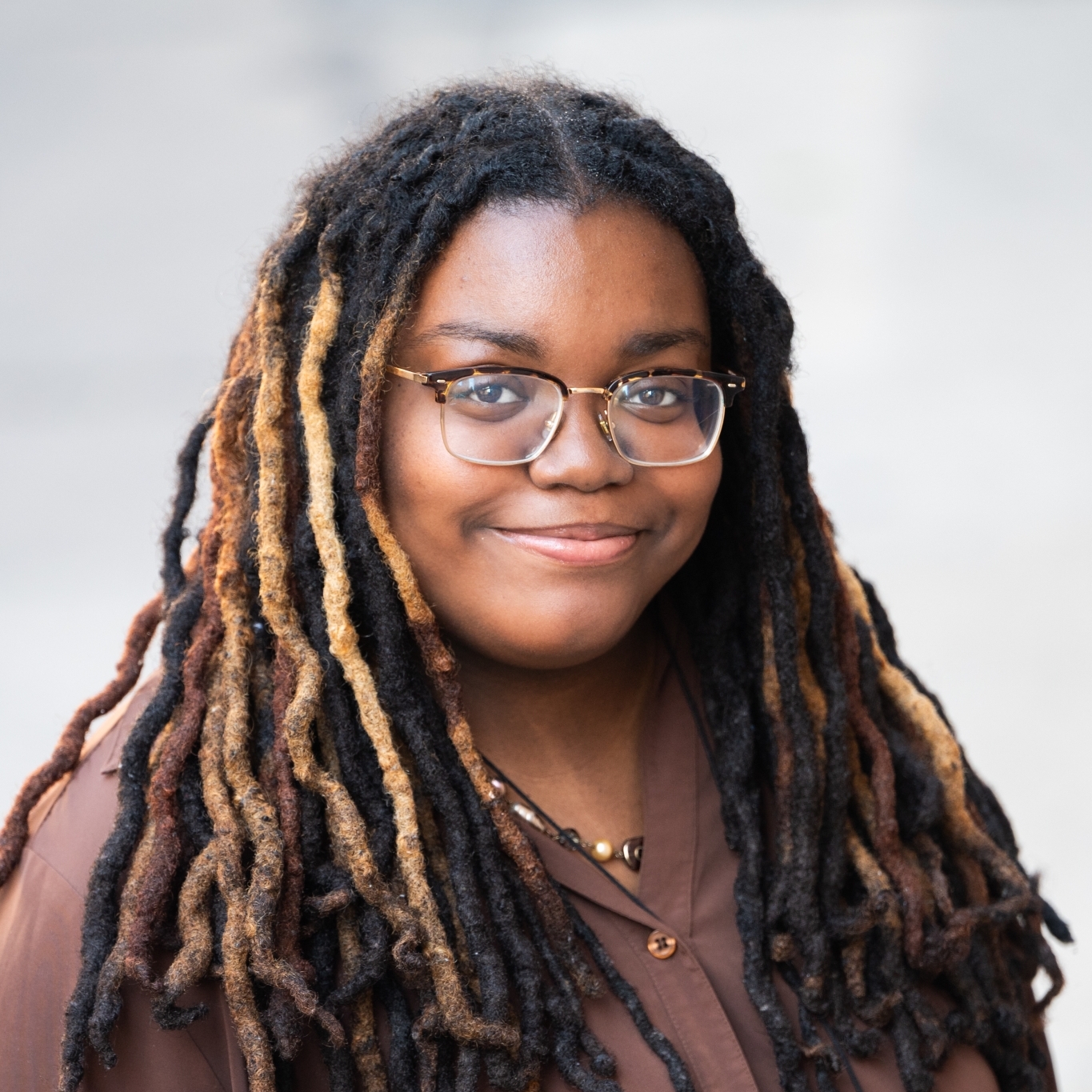
This subject guide was assembled by Caden Daubon, who received their B.A. in African and African American Studies and Sociology at Brandeis University. Caden manages the social media accounts of KyKy archives, a Black queer digital archive.
Keywords
Contributors:
- Amy Matilda Cassey
- Martina Dickerson
- Mary Ann Dickerson
- Alice Ruth Moore
- Mrs. N.F. Mossell
Subject Headings:
- Free African Americans – History – 19th century
- American poetry – African American authors
- African American women – Clothing & dress – United States
- African Americans – Intellectual life — Pennsylvania – Philadelphia
- African American women artists – Pennsylvania – Philadelphia
- Afro-American writers
- African Americans – Social conditions – History
- African American women – United States
- African Americans – Social life – Pennsylvania – Philadelphia
- African Americans – Portraits
Access Terms:
- Albums
- Portrait photographs — 1910-1920.
- Poems
- Letters (Correspondence)
- Essays
- Anthology
Annotated Bibliography
Resources at LCP:
Amy Matilda Cassey Album
This friendship album belonged to Amy Matilda Cassey, who was a middle-class African American woman active in the anti-slavery movement among others. This album was carefully curated to store items such as paintings, poetry, and letters that held emotional significance. Page 5 contains a painting by Sarah M. Douglass with the words, “a token of love from me, to thee.” As Cassey and Douglass’s relationship was amorphous, this love could be read expansively.
[Georgine E. Upshur Willis collection] [graphic]
The Georgine E. Upshur Willis collection is primarily composed of 20th century ephemera and photographs related to African-American middle class life. Item 55 is a photograph of Charlotte & Mike Holloman, Ann DeRamus, and Dr. Sam Bullock at a formal social event, in which Ann gazes directly at Charlotte, rather than the camera, with a loving smile on her face.
Martina Dickerson Album
This friendship album belonged to Martina Dickerson, a middle-class African American woman who created this album as an educational tool. This album contains poems and essays on topics such as love and friendship. Page 62 features a transcription of a poem titled “Remember Me.” The transcriber remained semi anonymous, for reasons unknown but perhaps inferable.
Other Archival Resources:
Stephan Loewentheil photograph collection, #8043. Division of Rare and Manuscript Collections, Cornell University Library.
This is a full length casual portrait of two African American women, later identified as Annie Bell and Sammie Pratt, standing together under a tree. Their body language, arms around each other and Pratt leaning her head on Bell’s shoulder, suggests an intimate relationship of sorts.
Young women, three-quarter length portrait, from The Exhibit of American Negroes, 1899.
This is a three-quarter length studio portrait, in which one Black woman sits on the other’s lap. They hold hands, as the woman on the right smiles up at the woman on the left. They seem to share an intimate relationship, one that may not be legible but is still archived through this portrait.
Two Women, C. 1903-1905. KyKy Archives.
This is a portrait of two African American women, who haven’t been identified. The woman on the left is dressed more traditionally feminine with a black collar, a sexually stigmatized accessory. The one on the right is dressed more masculinely than what would’ve been the norm of early 20th Century Black women. The woman on the left has her arm around the other woman, and is standing slightly behind the masculine woman.
Modern Reference Books:
Hartman, Saidiya. Wayward Lives, Beautiful Experiments: Intimate Histories of Social Upheaval. S.L., W W Norton, 2019.
Wayward Lives, Beautiful Experiments is a long-form application of critical fabulation in which Hartman uses archival material to reimagine the lives Black women living in Philadelphia and New York during the early 20th century. This is a labor of love, dedicated to illuminating the lives of wayward Black women whose disobedience was a direct response to the afterlives of slavery while capturing the fullness of Black social life.
Tinsley, Omise’eke Natasha. Thiefing Sugar. Duke University Press, 18 Aug. 2010.
In Thiefing Sugar, Tinsley offers a counter-reading of Caribbean Femme creative pieces, including performance poetry and novels, that acknowledges the erotic same-sex bonds that were often rendered illegible. This work connects an epistemology of queer(ed) Afro-Caribbean radical cultural and intellectual production with modern discourse regarding queer theory.
Additional Sources:
Hartman, Saidiya. “Venus in Two Acts.” Small Axe, vol. 12 no. 2, 2008, p. 1-14. Project MUSE, https://muse.jhu.edu/article/241115.
Ntozake Shange. For Colored Girls Who Have Considered Suicide When the Rainbow Is Enuf. S.L., Weidenfeld & Nicolson, 2021.
Rusert, Britt. “Disappointment in the Archives of Black Freedom.” Social Text, vol. 33, no. 4 125, Dec. 2015, pp. 19–33, https://doi.org/10.1215/01642472-3315874. Accessed 11 May 2020.
Tinsley, Omise’eke Natasha. “Black Atlantic, Queer Atlantic: Queer Imaginings of the Middle Passage.” GLQ: A Journal of Lesbian and Gay Studies, vol. 14, no. 2-3, 1 Jan. 2008, pp. 191–215, https://doi.org/10.1215/10642684-2007-030.
Two Women, circa 1940s — KyKy Archives
Photobooth Couple — KyKy Archive

