
Shareholder Spotlight: Aaron Levy (1742-1815) and Hyman Gratz (1776-1857)
Dana Dorman, Archivist
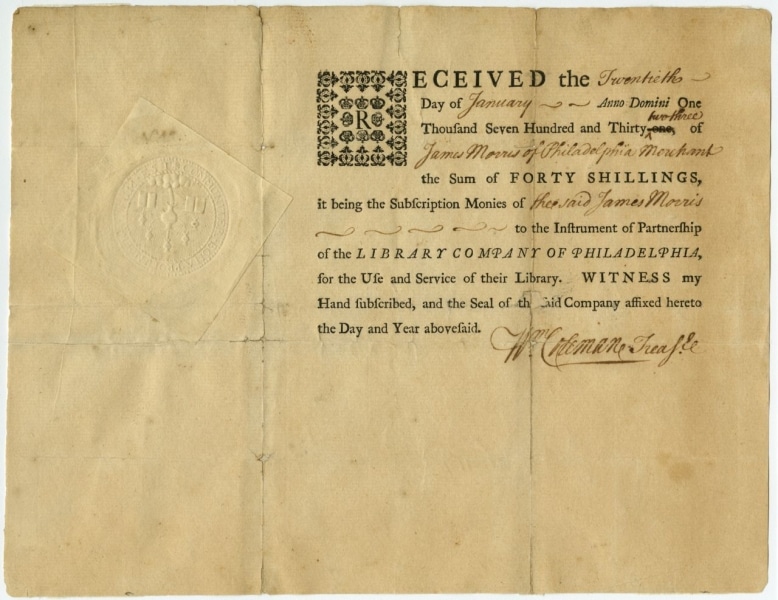
Image: Receipt for a Library Company share, 1733.
We continue our monthly “Shareholder Spotlight” series by taking a closer look at Share #666 and its third and fourth owners, Aaron Levy (1742-1815) and Hyman Gratz (1776-1857).
Shareholders have always been the backbone of the Library Company of Philadelphia. Starting with the first group of fifty tradesmen who formed the library in 1731, shareholders have provided crucial financial support each year for our mission to “pour forth benefits for the common good.”
We keep careful track of who has owned each historic share, and our list of 9,800+ shareholders includes signers of the Declaration and Constitution, merchants, doctors, soldiers, scientists, artists, philanthropists, politicians, and much more.
Share #666
This share was first issued to John Allen on January 25, 1791. Allen became a new shareholder the same month that the Library Company opened its new building at 5th and Chestnut Street. The Library Company had begun issuing new shares two years earlier to help raise funds for that new building.[i]
Allen maintained share #666 for two years.[ii] He sold it to John Greiner on March 20, 1793, and Greiner too maintained his Library Company share for two years.
On April 11, 1795, Greiner sold the share to Aaron Levy (1742-1815). Levy was a prominent Jewish merchant and land speculator who worked closely with another Library Company shareholder, Robert Morris (1734-1806; owner of Library Company share #418).
Levy had served as agent for Morris’s land dealings in Northampton County, where Levy lived at the time, and he also lent significant amounts of money to the Continental Congress for the Revolutionary War that was not fully repaid to him. In 1786, Levy laid out Aaronsburg in today’s Centre County, intending for it to serve as the capital of Pennsylvania.[iii]
Levy moved to Philadelphia in retirement in the 1790s.
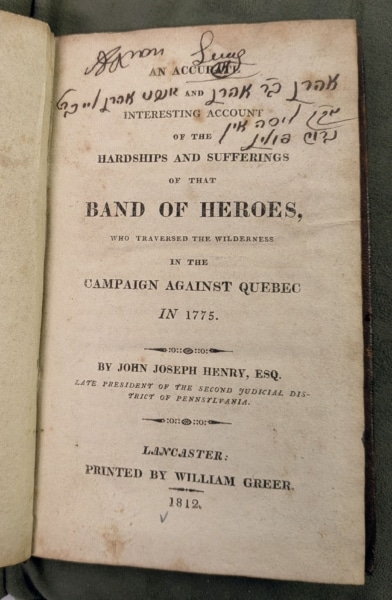
Image: Levy inscribed his name in this copy of John Joseph Henry’s account of the Revolutionary War’s Battle of Quebec that is now part of the Library Company’s collection. Levy and Henry both lived in Lancaster during the war, so they may have known each other. John Joseph Henry, An Accurate and Interesting Account of the Hardships and Sufferings of that Band of Heroes, Who Traversed the Wilderness in the Campaign Against Quebec in 1775 (Lancaster, 1775).
Although he had significant land holdings, Levy eventually ran into liquidity problems with his wealth. One story recounted that Levy made a deal with Philadelphian Simon Gratz (1773-1839) whereby he turned over his land holdings to Simon in return for an annuity for Levy and his wife Rachel.[iv]
Levy was certainly close to the prominent Gratz family. Levy sold his Library Company share to Simon’s brother Hyman Gratz (1776-1857) in May 1802, and Levy called Simon his “adopted son” in his June 1802 will.[v]
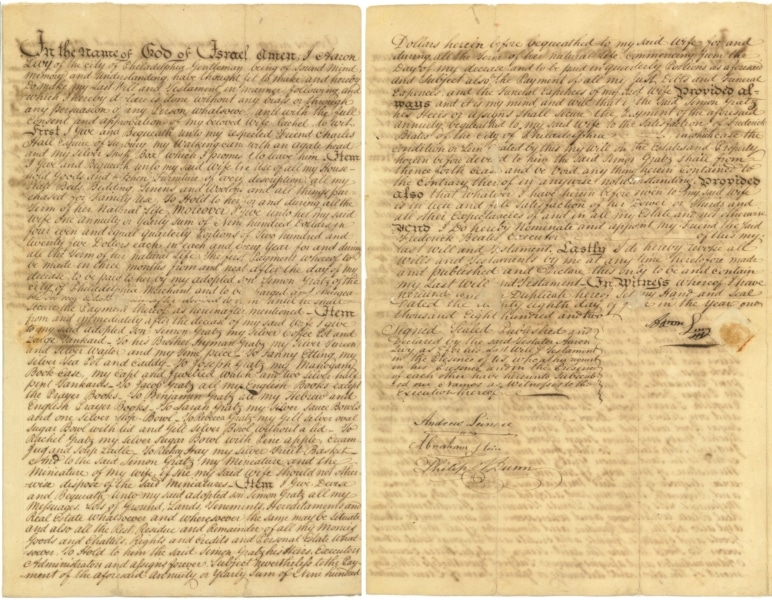
Image: In addition to naming Simon Gratz as his “adopted son,” Levy named multiple bequests to other Gratz family members in his 1802 will. Aaron Levy will, Box 3, Folder 3.24, Edwin Wolf 2nd collection of early American Jewish historical documents (MSS00231), Library Company of Philadelphia.
Hyman owned Library Company share #666 for the rest of his life. He never married, and lived with his sister Rebecca Gratz (1781-1869) and three other siblings.[vi]
Hyman eventually became president of the Pennsylvania Company for Insurance on Lives and Granting Annuities, served on the board of the Pennsylvania Academy of the Fine Arts, and served as treasurer of Congregation Mikveh Israel.[vii]
After his death, Hyman left a bequest in support of Jewish education. His trust eventually supported the founding of Gratz College.[viii]
As for his Library Company share, his estate continued to maintain the share for another seventeen years after Hyman’s death. Finally, in 1874, “Horace Moses, Residuary Legatee of Hyman Gratz, Deceased,” sold the share to “Horace Moses, Trustee.”
The share was owned by at least one more Gratz family member before it passed out of the family. The share has had a total of fourteen owners in its history.
Not yet a shareholder?
Share #666 is currently available. We work hard to match potential shareholders with historic shares that match their interests, and we would love to match you with Aaron Levy and Hyman Gratz’s share or another option.
You can become a Library Company shareholder with an initial gift of $500. To learn more, visit our website or reach out to our Development Office at [email protected].
—–
[i] With 499 shares already issued, the Library Company sold its 500th share in February 1789 and issued at least 249 more shares over the next four years to help pay for the expense of the new building. See June 1, 1789 minutes, Directors Minutes Volume 3, volume 165, Library Company of Philadelphia records (MSS00270), Library Company of Philadelphia.
[ii] Although the New Testament’s Book of Revelation identifies the number 666 as a number of the “beast,” with more modern cultural associations linking it to Satan himself, there is no indication that shareholder John Allen had any idea which number share he owned. Library Company share certificates issued in the 1790s did not list numbers. In fact, into the late 19th century, share transfer records listed only names of the previous and new owners, not share numbers.
[iii] Cyrus Adler, A. S. W. Rosenbach, “Levy, Aaron,” The Jewish Encyclopedia, https://www.jewishencyclopedia.com/articles/9869-levy-aaron (accessed August 11, 2026).
[iv] Edwin Wolf 2nd and Maxwell Whiteman, The History of the Jews of Philadelphia from Colonial Times to the Age of Jackson (Philadelphia, 1956), p. 183
[v] See Aaron Levy will, Box 3, Folder 3.24, Edwin Wolf 2nd collection of early American Jewish historical documents (MSS00231), Library Company of Philadelphia.
[vi] Dianne Ashton, “Rebecca Gratz,” The Shalvi/Hyman Encyclopedia of Jewish Women, https://jwa.org/encyclopedia/article/gratz-rebecca (accessed August 18, 2026).
[vii] “Hyman Gratz,” John J. Loeb, Jr. Database of Early American Jewish Portraits, https://loebjewishportraits.com/biography/hyman-gratz/ (accessed August 18, 2026). Hyman Gratz also co-owned what is today Mammoth Cave National Park in Kentucky; the property operated as a saltpeter mine until 1815.
[viii] “Mission & History,” Gratz College, https://www.gratz.edu/about/mission-and-history (accessed August 18, 2026).

