• Link to Facebook
  • Link to Instagram
  • Link to Youtube
  • Link to Mail
  • Link to Rss this site
  • Shopping Cart Shopping Cart
    0Shopping Cart
The Library Company of Philadelphia
  • Home
  • Search Collections
    • Search Library Catalog
    • Search Manuscripts
    • Search Digital Collections
    • How to Search the Collections
      • Subject Guides
      • Access Terms used in our Catalogs
    • Potentially Harmful Materials and Descriptions Statement
  • Academic Programs
    • Overview
    • Fellowships
    • Awards
      • LCP First Book Award
      • Innovation Award
    • Program in African American History
    • Program in Early American Economy & Society
    • The Davida Tenenbaum Deutsch Program in Women’s History
    • Visual Culture Program
  • Research
    • Overview
    • Subject Guides
    • Finding Aids
    • Online Exhibitions
    • Online Resources
  • Using the Library
    • Overview
    • Hours, Access, & Location
    • Appointments
    • Rights & Reproductions
  • Events
    • Upcoming Events
    • Fireside Chats
    • LCP News
    • LCP Press Resources
  • Projects
    • Beyond Glass Cases
    • Library Company Papers Project
  • Join & Support
    • Overview
    • Donate Online!
    • Join & Renew Membership Online!
    • Support: Shareholding
    • Annual Dinner 2026
    • Lecture in Honor of John C. Van Horne
    • The Junto
    • Gifts in Kind
    • Membership Benefits
    • Planned Giving
  • About LCP
    • Annual Reports
    • Staff
    • Academic Program Directors
    • Board of Trustees
    • Library Company Ambassadors
    • Employment
    • Affiliations
    • LCP Blog
    • Press Resources
    • LCP Privacy Policy
    • Overview & History
    • LCP FAQ Sheet
  • Click to open the search input field Click to open the search input field Search
  • Menu Menu

Mellon Scholars Summer Program – Subject Guides

Moving Against the Boundaries: Black Travel and Agency in the 19th Century
Previous Previous Previous Next Next Next
12345
Open image in lightbox: Screenshot 2026-07-29 155646 Open image in lightbox: Screenshot 2026-07-29 155646
Open image in lightbox: Screenshot 2026-07-29 155606 Open image in lightbox: Screenshot 2026-07-29 155606
Open image in lightbox: Screenshot 2026-07-29 155625 Open image in lightbox: Screenshot 2026-07-29 155625
Open image in lightbox: Screenshot 2026-07-29 155636 Open image in lightbox: Screenshot 2026-07-29 155636
Open image in lightbox: Screenshot 2026-07-29 155655 Open image in lightbox: Screenshot 2026-07-29 155655

Overview:

In the 19th century, travel was vastly different from how we understand it now. We take it for granted that movement is now readily available with various transportation methods anyone can use. However, for 19th Century African Americans traveling was rarely just leisurely movement. For Black figures in the 19th century, travel was an important way to inquire about the world, dedicate time to work, spread ideas, build faith, and claim agency.
This subject guide focuses on 19th Century Black Travelers Nancy Prince and William Wells Brown. These Black travelers’ narratives show how movement shaped their lives and their work. Nancy Prince used travel to spread education and religion in Russia and Jamaica. She was also a working class woman who used her work to support herself and her endeavors. William Wells Brown’s travel began with forced movement under slavery but later it also became his path to freedom and his platform for abolition work in Europe.
My main project will use the experiences from Nancy Prince and William Wells Brown to analyze Black Travel and how they promoted Agency in the 19th Century.

About the Author:

Aniyah Farrow Williams is a junior History major at Temple University, where she has developed a deep passion for African American history and the preservation of Black stories that have too often been overlooked. Through her academic work, she is committed to learning from archival sources, engaging with historical memory, and understanding how the past continues to shape communities today.

Keywords

Contributors 

  • Nancy Prince
  • William Wells Brown
  • Elizabeth Stordeur Pryor
  • The West End Museum 

Subject Headings

  • African Americans, Travel, 19th century 
  • Fugitive slaves
  • Slave narratives 
  • Freemen Travel 
  • Citizenship
  • Abolition, (or Abolitionist) 
  • Slavery, United States 
  • Black women travelers 
  • Missionaries, Jamaica 
  • Russia, Description and travel 
  • Great Britain, Description and travel 
  • France, Description and travel 
  • African American agency 
  • Antislavery movements 

Access Terms

  • Genre Terms: Slave narratives 
  • Genre Terms: Black Travel writing 
  • Genre Terms: Autobiographies 
  • Genre Terms: Black Travel Narratives 
  • Provenance Evidence: former owner (George F. Young, Charles L. Blockson)
Annotated Bibliography

Resources at LCP:

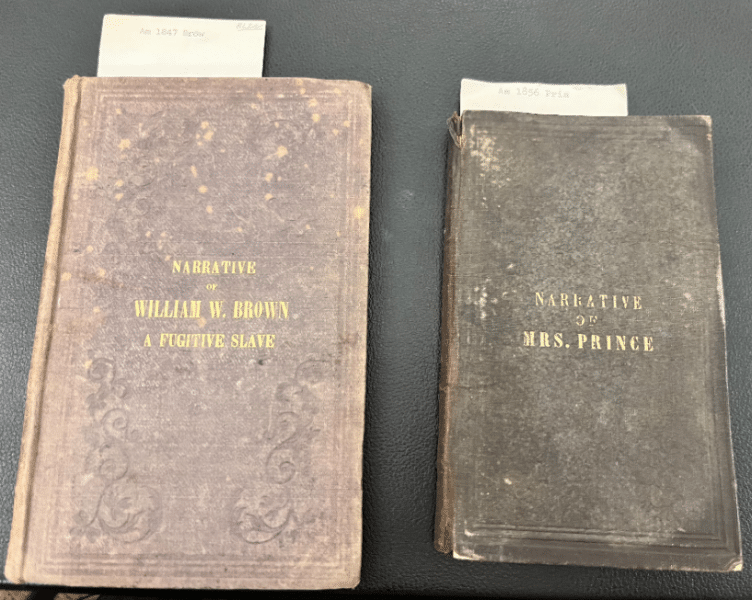
Nancy Prince, Narrative of the Life and Travels of Mrs. Nancy Prince (Boston, 1853). 

This narrative is Nancy Prince’s travel writing/autobiography. Prince describes her early life, her family background, her travels and work life in Russia, and her later mission work in Jamaica. This source helps show how travel gave Prince a way to build independence. She found agency in spreading her faith abroad and supporting newly freed people after emancipation. It is one of the main sources for understanding how travel worked for Black women in the 19th century and specifically how Nancy travel promoted agency within her own life.

Wells Brown, Narrative of William W. Brown, a Fugitive Slave (Boston, 1848). George F. Young, former owner. 

This narrative explains William Wells Brown’s early life under slavery and how he used travel to escape to freedom. Brown describes being moved around by enslavers and witnessing the cruelty of the slavery. His escape near Cincinnati shows how travel became a path toward self-definition. This source is useful because Brown’s experiences show how travel worked under slavery and also how travel/movement was used to escape the horrors of slavery. 

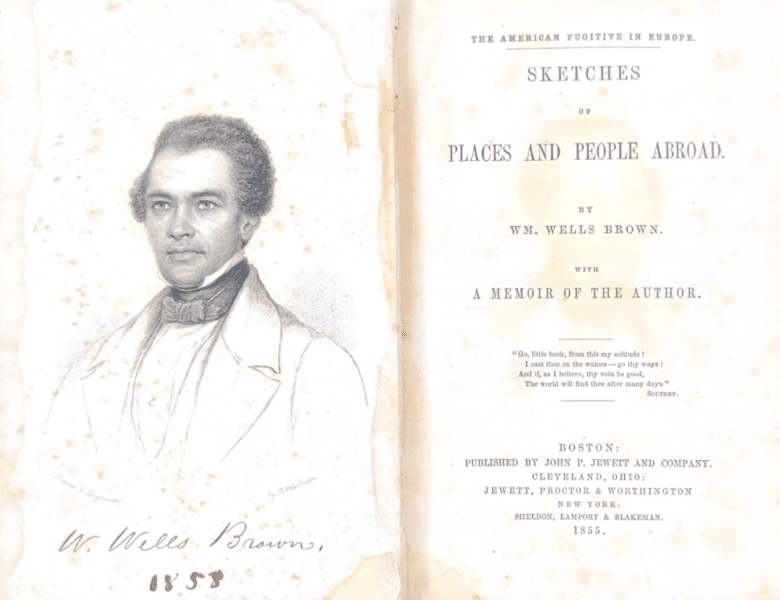
Wells Brown, Three Years in Europe, or, Places I Have Seen and People I Have Met (London, 1852). Charles L. Blockson, former owner. 

This source follows William Wells Brown’s travels through Europe after he escaped slavery. Brown writes about Liverpool, Dublin, London, Paris, and Scotland. His travel gave him a larger audience for his abolition work and allowed him to speak about American slavery outside of the United States. This source helps show how Brown used international travel to build influence and support himself through lectures and writing. This challenged American slavery from abroad. 

Resources at Local Museums:

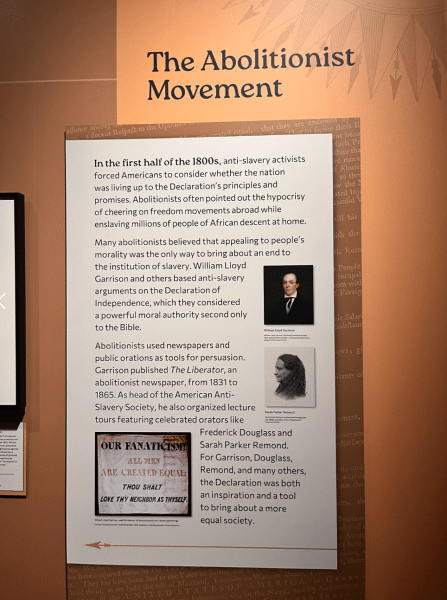
“The Abolitionist Movement.” (Philadelphia, 2026). Exhibition panel. Museum of the American Revolution. 

This exhibition panel connects abolitionist activism to American ideas of freedom and equality. It explains how abolitionists used newspapers, speeches, and public arguments to point out the hypocrisy of supporting freedom abroad while allowing slavery at home. This source helps support my project because it gives background on the abolitionist world that William Wells Brown entered after escaping slavery. 

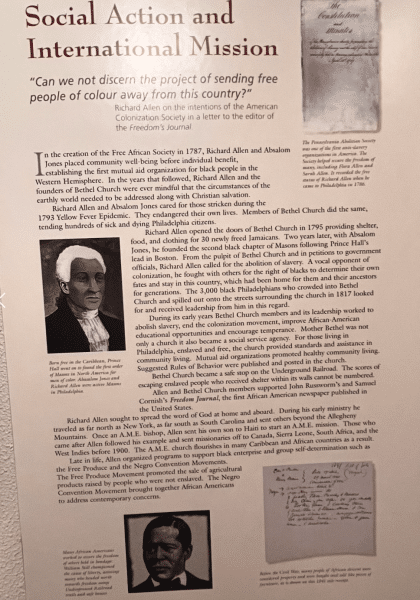
“Social Action and International Mission” (Philadelphia, 2026). Exhibition panel. Mother Bethel African Methodist Episcopal Church. 

This exhibition panel focuses on Richard Allen and the role of Black religious communities in social action. It explains how Bethel Church supported abolition, education, community care, and international missions. This source connects to my project because it shows how Black travel and mobility could be tied to faith and community building. Allen wanting the AME church in other countries to teach his religious messages shows that Nancy Prince’s mission work abroad was a power concept that many other abolitionists also followed.

Other Resources:

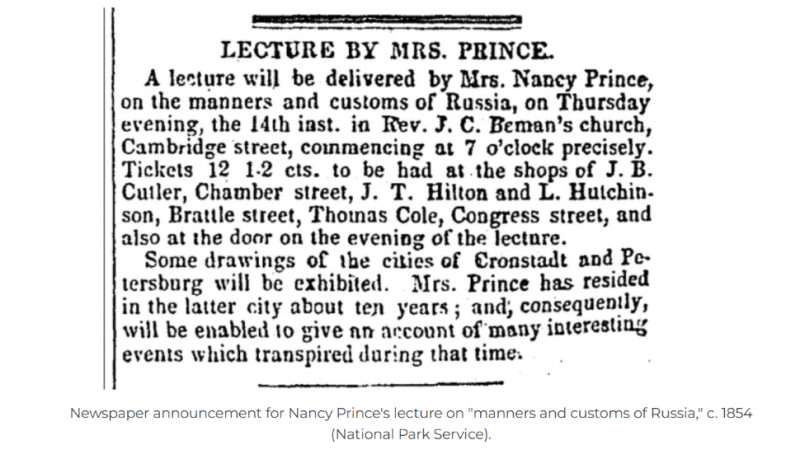
Newspaper announcement for Nancy Prince’s lecture on “manners and customs of Russia.” (ca. 1854). National Park Service.
This newspaper announcement shows Nancy Prince using her travel experience in Russia as a public lecture topic. It advertised her lecture on the “manners and customs of Russia”. This source shows her public work had reached a widespread audience.

Reference Books:

Fish, Cheryl J. Black and White Women’s Travel Narratives: Antebellum Explorations. University Press of Florida, 2004.
Fish’s book helps support my project because it looks at travel writing, race, gender, and mobility in the antebellum period. This source is especially useful for Nancy Prince because Fish discusses how Black women travelers used movement and writing to speak with authority.

Pryor, Elizabeth Stordeur. Colored Travelers: Mobility and the Fight for Citizenship before the Civil War. University of North Carolina Press, 2016.
Pryor’s book helps explain the larger argument behind this project. She shows that Black travel in the 19th century was connected to citizenship and freedom. This source is useful because it gives historical context for Nancy Prince and William Wells Brown’s individual narratives. It also supports the idea that Black movement was not ordinary travel. Black travel had to be planned and was calculated because of Criminalization of Black Mobility. Despite this, Black Travel in the 19th century showed agency because of the way travelers worked around racism and spread their works and ideas anyways.

Program in African American History

  • Home
  • News
  • Fellows
  • Fellowships
  • Past Events
  • Mellon Scholars Summer Program
© Copyright 2024 - The Library Company of Philadelphia, 1314 Locust Street, Philadelphia, PA 19107. TEL (215) 546-3181
  • Link to Facebook
  • Link to Instagram
  • Link to Youtube
  • Link to Mail
  • Link to Rss this site
Link to: Mellon Scholars 2026: Amirah Lockett Link to: Mellon Scholars 2026: Amirah Lockett Mellon Scholars 2026: Amirah Lockett Link to: Mellon Scholars 2026: Aselah Davy Link to: Mellon Scholars 2026: Aselah Davy Mellon Scholars 2026: Aselah Davy Scroll to top Scroll to top Scroll to top

This site uses cookies. By continuing to browse the site, you are agreeing to our use of cookies.

OKLearn more

Cookie and Privacy Settings


How we use cookies

We may request cookies to be set on your device. We use cookies to let us know when you visit our websites, how you interact with us, to enrich your user experience, and to customize your relationship with our website.

Click on the different category headings to find out more. You can also change some of your preferences. Note that blocking some types of cookies may impact your experience on our websites and the services we are able to offer.

Essential Website Cookies

These cookies are strictly necessary to provide you with services available through our website and to use some of its features.

Because these cookies are strictly necessary to deliver the website, refusing them will have impact how our site functions. You always can block or delete cookies by changing your browser settings and force blocking all cookies on this website. But this will always prompt you to accept/refuse cookies when revisiting our site.

We fully respect if you want to refuse cookies but to avoid asking you again and again kindly allow us to store a cookie for that. You are free to opt out any time or opt in for other cookies to get a better experience. If you refuse cookies we will remove all set cookies in our domain.

We provide you with a list of stored cookies on your computer in our domain so you can check what we stored. Due to security reasons we are not able to show or modify cookies from other domains. You can check these in your browser security settings.

Google Analytics Cookies

These cookies collect information that is used either in aggregate form to help us understand how our website is being used or how effective our marketing campaigns are, or to help us customize our website and application for you in order to enhance your experience.

If you do not want that we track your visit to our site you can disable tracking in your browser here:

Other external services

We also use different external services like Google Webfonts, Google Maps, and external Video providers. Since these providers may collect personal data like your IP address we allow you to block them here. Please be aware that this might heavily reduce the functionality and appearance of our site. Changes will take effect once you reload the page.

Google Webfont Settings:

Google Map Settings:

Google reCaptcha Settings:

Vimeo and Youtube video embeds:

Other cookies

The following cookies are also needed - You can choose if you want to allow them:

Accept settingsHide notification only
X