
• Link to Facebook
  • Link to Instagram
  • Link to Youtube
  • Link to Mail
  • Link to Rss this site
  • Shopping Cart Shopping Cart
    0Shopping Cart
The Library Company of Philadelphia
  • Home
  • Search Collections
    • Search Library Catalog
    • Search Manuscripts
    • Search Digital Collections
    • How to Search the Collections
      • Subject Guides
      • Access Terms used in our Catalogs
    • Potentially Harmful Materials and Descriptions Statement
  • Academic Programs
    • Overview
    • Fellowships
    • Awards
      • LCP First Book Award
      • Innovation Award
    • Program in African American History
    • Program in Early American Economy & Society
    • The Davida Tenenbaum Deutsch Program in Women’s History
    • Visual Culture Program
  • Research
    • Overview
    • Subject Guides
    • Finding Aids
    • Online Exhibitions
    • Online Resources
  • Using the Library
    • Overview
    • Hours, Access, & Location
    • Appointments
    • Rights & Reproductions
  • Events
    • Upcoming Events
    • Fireside Chats
    • LCP News
    • LCP Press Resources
  • Projects
    • Beyond Glass Cases
    • Library Company Papers Project
  • Support the Library
    • Overview
    • Donate Online!
    • Join & Renew Membership Online!
    • Support: Shareholding
    • Annual Dinner 2026
    • Lecture in Honor of John C. Van Horne
    • The Junto
    • Gifts in Kind
    • Membership Benefits
    • Planned Giving
  • About LCP
    • Annual Reports
    • Staff
    • Academic Program Directors
    • Board of Trustees
    • Library Company Ambassadors
    • Employment
    • Affiliations
    • LCP Blog
    • Press Resources
    • LCP Privacy Policy
    • Overview & History
    • LCP FAQ Sheet
  • Click to open the search input field Click to open the search input field Search
  • Menu Menu

The following post was authored by Imperfect History Digital Catalog guest cataloger Joy O. Ude about her experience writing for the platform. The Imperfect History Digital Catalog creatively engages with the Imperfect History exhibition themes of (un)conscious bias and multiple viewpoints. Four guest catalogers from the curatorial, art history, and studio art fields authored concise descriptions of the same visual material, from their individual perspective as affected by their discipline. A traditionally standardized, “objective” process was made pro-actively subjective and diverse.
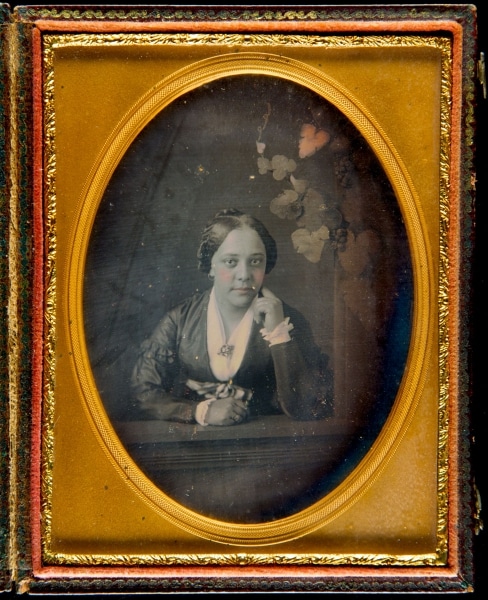
Samuel Broadbent, Portrait of an Unidentified African American Woman (Philadelphia, ca. 1850). Daguerreotype.

Samuel Broadbent, Portrait of an Unidentified African American Woman (Philadelphia, ca. 1850). Daguerreotype.

History and Representation

I’m not a writer. I know that I’m capable of writing well, especially when the subject interests me, but that doesn’t necessarily make me an adept writer. So, it was with both interest and an underlying sense of anxiousness that I accepted the invitation to participate in writing descriptions for the Imperfect History digital catalog. Even after reading the project prospectus and understanding that my task as a guest cataloger was to write authentically as I observed the visual materials, it took me some time to draft my descriptions. As a studio artist, educator, and member of an artist-run gallery, it was difficult not to slip into using the didactic language typical of curated shows as I began to write.

Not long after receiving the Imperfect History prospectus, the early impact of the pandemic began to ripple through the city of Philadelphia. Initially, I worked from home; I was furloughed soon after. In the middle of a burst of creativity—writing, curating, and producing various works—I had to stop and assess whether remaining in Philadelphia was the best decision for my family, livelihood, and career. I made the decision to move back to Texas, to be closer to family and become a certified elementary art teacher. Between studying for certification exams, interviewing for teaching positions, and packing my apartment and studio, my creative projects ground to a halt. When I’d finally settled somewhat into my new district and teaching position, I also received the disappointing news that my husband’s visa petition might be delayed because  of changes to U.S. immigration laws. We’d been separated for nearly a year, and the news was a crushing blow to the hopes that we might be reunited by the beginning of 2021.

Why have I chosen to divulge so much personal information in a post meant to reflect on my experience writing descriptions for Imperfect History? All this serves to provide some context for the lens through which I reviewed and weighed the works for the catalog. Though much of my personal work considers identity, several personal and national events from the previous year tempered my commentary on some of the visual materials. What does identity, real or assumed, mean now in the U.S.? Can people’s implicit biases be unlearned?

These were the questions I asked myself repeatedly as I looked over Portrait of an Unidentified African American Woman. The daguerreotype reminded me so much of the popular, stylized West African portraits that I’d seen my grandmothers, aunts, and mother featured in—the direct gaze into the camera, fixed posture, and with an air of confidence. While the black and white images may share some visual similarities, the individual stories of these women couldn’t be more different. Those  matriarchal family portraits were taken long before my mother immigrated to the U.S. from Nigeria in the 1980s. Decades before she knew anything of abject racism and how the painful history of slavery in this country would shape her experience, both as a student and eventual U.S. citizen. I couldn’t help but wonder about the life and story of the unidentified woman in the daguerreotype. Her photo was taken in Philadelphia, about a decade prior to the end of slavery. In comparing her portrait to my mother’s, it felt almost as though she could serve as a visual harbinger. Like a confirmation of ingrained dignity that refuses to be diminished, no matter the various indignities one may have suffered.

This dignity that was ingrained despite living in a time when a whole race of people were subjected to grotesque caricatures that depicted and reflected that they were seen not as human, but as cartoons. This dignity that was ingrained despite the racist tropes that perpetuated false narratives of the ignorance and moral depravity of Black Americans. I thought about the fact that an image like Unidentified Woman is  a rarity in elementary and secondary history books and that I wanted to know more about this woman’s experience. In this country, which stories deserve to be told? If they don’t reinforce long-held assumptions, are they simply ignored? More than anything, the daguerreotype makes me wonder what representation of Black Americans in the U.S. will look like ten, twenty, and fifty years into the future. I hope that dignity will remain intact.

Joy O. Ude, Art Teacher, Howry STEAM Academy

Imperfect History is supported by the Henry Luce Foundation, Walter J. Miller Trust, Center for American Art, Philadelphia Museum of Art, Jay Robert Stiefel and Terra Foundation for American Art.

Henry Luce Foundation Logo

Imperfect History

  • Overview
  • Exhibition
  • Publication
  • SYMPOSIUM
    • Overview
    • Keynote Address
    • Panelists
    • Program
    • Registration
  • Digital Catalog
  • Blog
  • Social Media
  • Press Release
  • Project Team
  • Graphic Arts Department
  • VISUAL LITERACY WORKSHOP
    • Overview
    • About the Workshop
    • How to Apply
    • Travel & Accommodations
    • Instructors
    • Program
    • Pre-Readings
© Copyright 2024 - The Library Company of Philadelphia, 1314 Locust Street, Philadelphia, PA 19107. TEL (215) 546-3181
  • Link to Facebook
  • Link to Instagram
  • Link to Youtube
  • Link to Mail
  • Link to Rss this site
Link to: Fireside Chat: Creative Confluence in a Peak Poetry World (Orchid Tierney, Jena Osman, Andrea Krupp) Link to: Fireside Chat: Creative Confluence in a Peak Poetry World (Orchid Tierney, Jena Osman, Andrea Krupp) Fireside Chat: Creative Confluence in a Peak Poetry World (Orchid Tierney, Jena...LCP Fireside Chats Logo Link to: Fireside Chat: British Military Rule & the Everyday Experience of Revolution (Donald Johnson) Link to: Fireside Chat: British Military Rule & the Everyday Experience of Revolution (Donald Johnson) LCP Fireside Chats LogoFireside Chat: British Military Rule & the Everyday Experience of Revolution...
Scroll to top Scroll to top Scroll to top

This site uses cookies. By continuing to browse the site, you are agreeing to our use of cookies.

OKLearn more

Cookie and Privacy Settings


How we use cookies

We may request cookies to be set on your device. We use cookies to let us know when you visit our websites, how you interact with us, to enrich your user experience, and to customize your relationship with our website.

Click on the different category headings to find out more. You can also change some of your preferences. Note that blocking some types of cookies may impact your experience on our websites and the services we are able to offer.

Essential Website Cookies

These cookies are strictly necessary to provide you with services available through our website and to use some of its features.

Because these cookies are strictly necessary to deliver the website, refusing them will have impact how our site functions. You always can block or delete cookies by changing your browser settings and force blocking all cookies on this website. But this will always prompt you to accept/refuse cookies when revisiting our site.

We fully respect if you want to refuse cookies but to avoid asking you again and again kindly allow us to store a cookie for that. You are free to opt out any time or opt in for other cookies to get a better experience. If you refuse cookies we will remove all set cookies in our domain.

We provide you with a list of stored cookies on your computer in our domain so you can check what we stored. Due to security reasons we are not able to show or modify cookies from other domains. You can check these in your browser security settings.

Google Analytics Cookies

These cookies collect information that is used either in aggregate form to help us understand how our website is being used or how effective our marketing campaigns are, or to help us customize our website and application for you in order to enhance your experience.

If you do not want that we track your visit to our site you can disable tracking in your browser here:

Other external services

We also use different external services like Google Webfonts, Google Maps, and external Video providers. Since these providers may collect personal data like your IP address we allow you to block them here. Please be aware that this might heavily reduce the functionality and appearance of our site. Changes will take effect once you reload the page.

Google Webfont Settings:

Google Map Settings:

Google reCaptcha Settings:

Vimeo and Youtube video embeds:

Other cookies

The following cookies are also needed - You can choose if you want to allow them:

Accept settingsHide notification only
X