• Link to Facebook
  • Link to Instagram
  • Link to Youtube
  • Link to Mail
  • Link to Rss this site
  • Shopping Cart Shopping Cart
    0Shopping Cart
The Library Company of Philadelphia
  • Home
  • Search Collections
    • Search Library Catalog
    • Search Manuscripts
    • Search Digital Collections
    • How to Search the Collections
      • Subject Guides
      • Access Terms used in our Catalogs
    • Potentially Harmful Materials and Descriptions Statement
  • Academic Programs
    • Overview
    • Fellowships
    • Awards
      • LCP First Book Award
      • Innovation Award
    • Program in African American History
    • Program in Early American Economy & Society
    • The Davida Tenenbaum Deutsch Program in Women’s History
    • Visual Culture Program
  • Research
    • Overview
    • Subject Guides
    • Finding Aids
    • Online Exhibitions
    • Online Resources
  • Using the Library
    • Overview
    • Hours, Access, & Location
    • Appointments
    • Rights & Reproductions
  • Events
    • Upcoming Events
    • Fireside Chats
    • LCP News
    • LCP Press Resources
  • Projects
    • Beyond Glass Cases
    • Library Company Papers Project
  • Join & Support
    • Overview
    • Donate Online!
    • Join & Renew Membership Online!
    • Support: Shareholding
    • Annual Dinner 2026
    • Lecture in Honor of John C. Van Horne
    • The Junto
    • Gifts in Kind
    • Membership Benefits
    • Planned Giving
  • About LCP
    • Annual Reports
    • Staff
    • Academic Program Directors
    • Board of Trustees
    • Library Company Ambassadors
    • Employment
    • Affiliations
    • LCP Blog
    • Press Resources
    • LCP Privacy Policy
    • Overview & History
    • LCP FAQ Sheet
  • Click to open the search input field Click to open the search input field Search
  • Menu Menu

Period Politics: The 19th-Century Debate over Menstruation

Cornelia King, Chief of Reference and Curator of Women’s History
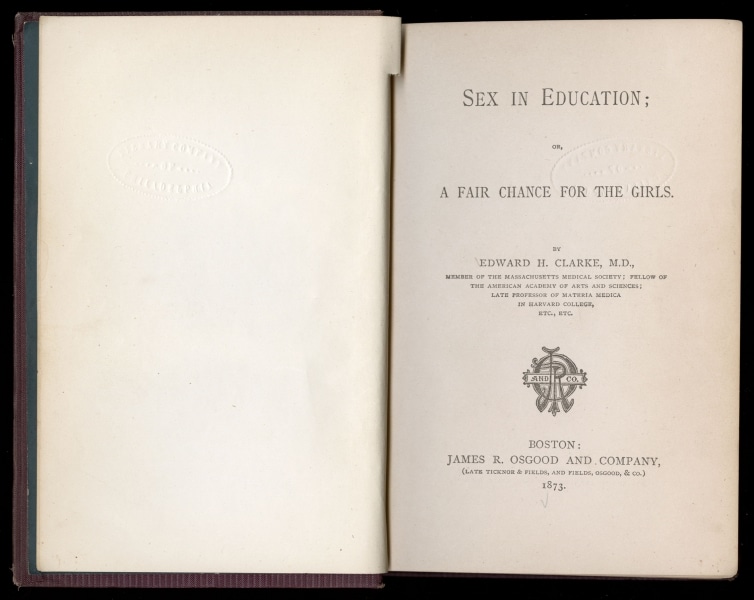
Title page from Sex in Education
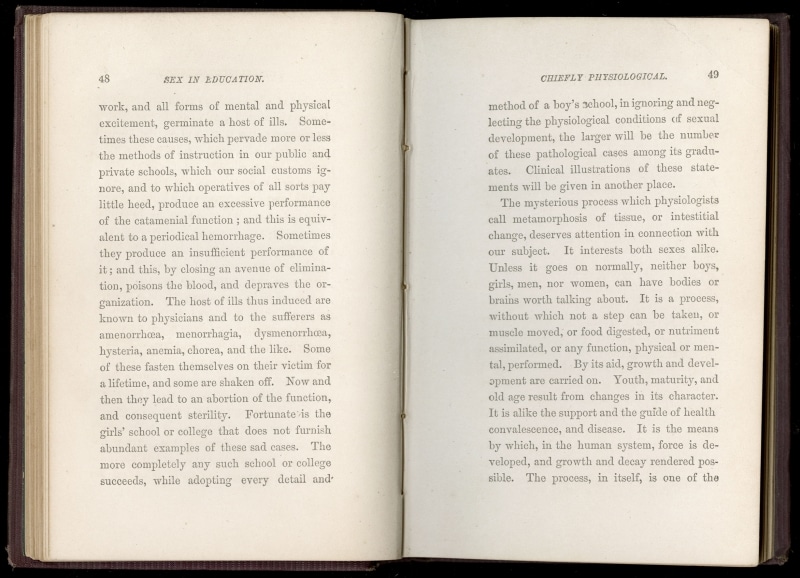
Excerpt from Sex in Education

In 1873, retired Harvard professor Edward H. Clarke’s Sex in Education, or, A Fair Chance for the Girls provoked controversy. In the book, Clarke states unequivocally that girls’ physiology requires that they not be educated in the same manner as boys. In particular, if they perform labor—including academic study—during their “periodical hemorrhage,” it can result in amenorrhoea (absence of a menstrual period), anemia, chorea (involuntary jerky movements), hysteria, and even sterility.

Not surprisingly, supporters of gender equality found fault with Clarke’s book. In Woman’s Education, and Woman’s Health (Syracuse, 1874), husband-and-wife team George and Anna Comfort state that Clarke’s argument is “utterly wrong in all its essential features.” George Comfort was a professor at Syracuse University and Anna Comfort was a practicing physician, having graduated from New York Medical College for Women.

In her No Sex in Education (Philadelphia, 1874), Eliza B. Duffey characterizes Clarke’s book as a “covert blow against the desires and ambitions of woman in every direction except a strictly domestic one.” In Sex and Education (Boston, 1874), Julia Ward Howe asserts that Clarke was primarily motivated by his antipathy toward the women who organized an 1872 campaign to raise money and petition Harvard to admit women. (Their efforts failed, despite raising $75,000.)

Another book that came out in 1874 in response to Clarke’s Sex in Education (1873) was The Education of American Girls (New York, 1874), which was edited by Anna C. Brackett (whose Brackett School for Girls in New York City prepared girls for college, and especially for Vassar, which admitted Brackett graduates without any entrance examination). The volume includes a chapter by Mary Putnam Jacobi, in which Jacobi rebuts Clarke’s claims using the methodology and language of science. Jacobi links menstruation with health and vitality, not frailty. She concludes that rest during the “menstrual week” would be ineffectual if the regime in the other three weeks was not healthful. [Editorial aside: Not all healthy women can say that they have never been at all incapacitated during menstruation. In this matter, Jacobi’s own social values and experience may have influenced her.]

Jacobi’s essay brought her to the attention of someone on the committee that awarded Harvard’s Boylston Medical Prize, many of whom regarded Clarke’s views on menstruation as unscientific. Apparently, that member passed word to Jacobi through a mutual friend that she should submit an essay for their consideration in 1876, the year the subject of rest during menstruation was a proposed topic. Significantly, at a time when Harvard faculty refused to admit women to either Harvard College or Harvard Medical School, they did award the Boylston Prize to Jacobi for her essay “The Question of Rest for Women during Menstruation,” with its tables of measurements and test results from her study of women over the course of a month.
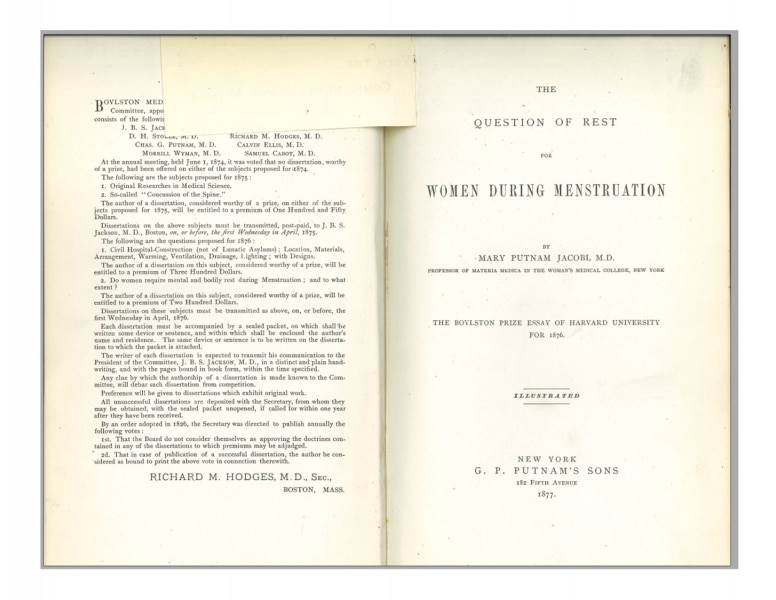
Title page from The Question of Rest for Women during Mensturation

As a winner of the Boylston Prize, Jacobi received a great deal of attention, and her family’s firm G.P. Putnam’s Sons published an extended version of the essay in 1877. Notably, our copy is an ex-library copy, which Jacobi herself sent to Dr. Henry J. Bigelow. We cannot say this with certainty, but Dr. Bigelow may have been the member of the Boylston Committee who encouraged Jacobi to submit her essay for consideration.

In the aftermath of the controversy over Clarke’s book, Jacobi continued her career in medicine, as a medical practitioner and as a member of the teaching faculty at Woman’s Medical College of the New York Infirmary—and also as a medical researcher, publishing over 120 articles in medical journals. For example, she wrote on women’s hysteria being a result of society’s failure to produce gender equality. As a professional woman, wife, and mother, Jacobi represented her core belief in gender equality, and the importance of women utilizing medical science to revise the cultural understanding of women’s potential.

For more on Jacobi and her contemporaries:

Bittel, Carla Jean. Mary Putnam Jacobi & the Politics of Medicine in Nineteenth-Century America (Chapel Hill: University of North Carolina Press, 2009).

Johnson, Joan Marie. Funding Feminism: Monied Women, Philanthropy, and the Women’s Movement, 1870-1967 (Chapel Hill: University of North Carolina Press, 2017).

Search

Search Search

Categories

  • All News (780)
  • Announcements (4)
  • Artist at LCP (13)
  • Beyond Glass Cases (4)
  • Beyond the Reading Room (325)
  • Bookbinding Research (16)
  • Curator's Favorites (29)
  • Current Exhibition (5)
  • Featured Collections (33)
  • Graphic Art Department News (87)
  • Imperfect History (24)
  • LCP in the Press (24)
  • LCP News (507)
  • Library Company Papers Project (47)
  • Marriott C. Morris Collection (14)
  • Mellon Scholars Program (46)
  • PAAH (40)
  • Pandemic Reading (8)
  • Podcasts (97)
  • Popular Medicine (1)
  • Program in Women's History (22)
  • Receipts from “The Larder Invaded” (43)
  • Redrawing History (17)
  • Seminars (4)
  • Shareholder Spotlight (57)
  • Talking in the Library Podcast (69)
  • The Living Book (3)
  • Uncategorized (8)
  • VCP News (44)

Archives

© Copyright 2024 - The Library Company of Philadelphia, 1314 Locust Street, Philadelphia, PA 19107. TEL (215) 546-3181
  • Link to Facebook
  • Link to Instagram
  • Link to Youtube
  • Link to Mail
  • Link to Rss this site
Link to: Virtual Close Looking: The Library Company’s First Visual Literacy Workshop Link to: Virtual Close Looking: The Library Company’s First Visual Literacy Workshop Virtual Close Looking: The Library Company’s First Visual Literacy Worksh...LCP's first online visual literacy workshop Link to: Dandelion and Scallion Salad with Dressing Link to: Dandelion and Scallion Salad with Dressing Ingredients for dandelion salad with scallion dressingDandelion and Scallion Salad with Dressing
Scroll to top Scroll to top Scroll to top

This site uses cookies. By continuing to browse the site, you are agreeing to our use of cookies.

OKLearn more

Cookie and Privacy Settings


How we use cookies

We may request cookies to be set on your device. We use cookies to let us know when you visit our websites, how you interact with us, to enrich your user experience, and to customize your relationship with our website.

Click on the different category headings to find out more. You can also change some of your preferences. Note that blocking some types of cookies may impact your experience on our websites and the services we are able to offer.

Essential Website Cookies

These cookies are strictly necessary to provide you with services available through our website and to use some of its features.

Because these cookies are strictly necessary to deliver the website, refusing them will have impact how our site functions. You always can block or delete cookies by changing your browser settings and force blocking all cookies on this website. But this will always prompt you to accept/refuse cookies when revisiting our site.

We fully respect if you want to refuse cookies but to avoid asking you again and again kindly allow us to store a cookie for that. You are free to opt out any time or opt in for other cookies to get a better experience. If you refuse cookies we will remove all set cookies in our domain.

We provide you with a list of stored cookies on your computer in our domain so you can check what we stored. Due to security reasons we are not able to show or modify cookies from other domains. You can check these in your browser security settings.

Google Analytics Cookies

These cookies collect information that is used either in aggregate form to help us understand how our website is being used or how effective our marketing campaigns are, or to help us customize our website and application for you in order to enhance your experience.

If you do not want that we track your visit to our site you can disable tracking in your browser here:

Other external services

We also use different external services like Google Webfonts, Google Maps, and external Video providers. Since these providers may collect personal data like your IP address we allow you to block them here. Please be aware that this might heavily reduce the functionality and appearance of our site. Changes will take effect once you reload the page.

Google Webfont Settings:

Google Map Settings:

Google reCaptcha Settings:

Vimeo and Youtube video embeds:

Other cookies

The following cookies are also needed - You can choose if you want to allow them:

Accept settingsHide notification only
X