Library Company Announces Plans for Semiquincentennial
The Library Company of Philadelphia, founded in 1731 by Benjamin Franklin, opened its collections to the delegates to the First Continental Congress in September 1774. At the time, its collections held virtually every significant work of political theory, history, law, and statecraft to be found in the American colonies. That privilege was extended to delegates to subsequent Congresses, the Constitutional Convention, and the early Federal Congresses while Philadelphia was the national capital until 1800. This heritage as the first, though unofficial, Library of Congress places the Library Company in a unique position to shed light on the Revolutionary era. Plans for the Semiquincentennial center on two exhibitions.
Fair Winds and Following Seas: Peacetime Naval Operations to 1939 (October 2025 to April 2026). During their 250-year existence, the United States Navy (USN) and Marine Corps (USMC) have participated in vital operations outside the scope of war. Maritime actions that supported the development and success of the United States was, and is, within the scope of these two conjoined branches of the military. This exhibition will highlight some of those actions of the USN and USMC, up to 1939. These actions include exploration, rescues, humanitarian missions, diplomacy, slave trade interdiction, and protection of commerce. While at times requiring combat, the primary goal of these operations was not the defeat of an identified foe in a declared war. Rather, they represent the historical understanding that a nation’s strength lies not only in its ability to defeat its enemies through military action, but also through its ability to protect its interests, grow and understand its dominion, and build strategic partnerships. Fair Winds and Following Seas will feature books, graphics, and ephemera that describe this peacetime, but not always peaceful, life on the high seas. There will be an open house welcome for visiting Marines and their families on their birthday, November 10.
Philadelphia’s Radical Revolution
Philadelphia’s Radical Revolution, A Semisesquicentennial Exhibition at The Library Company of Philadelphia (May through October 2026) In Philadelphia, artisans and tradesmen drove the Revolution more forcefully than in any other colony. Early in the Revolution, the city’s Quaker elite, many of whom eschewed the spirit of rebellion, had been pushed aside by working men who seized political power, wrote a radically democratic state constitution and reshaped Pennsylvania’s wartime government.
These ardent patriots, backed by the militia, demanded absolute loyalty to the American cause. During and after the occupation of Philadelphia by the British army in 1777-1778, citizens were forced to choose: swear an oath of allegiance to Pennsylvania or risk imprisonment, confiscation of property, or even death.
By the early 1780s, in the wake of victories by American armies and their French allies, Philadelphia’s long tradition of political moderation began to re-emerge. Many now feared that revolutionary excess could be as dangerous as elite rule. This spirit of moderation prevailed in 1787, when framers of the new Federal Constitution met in Philadelphia to design a government that balanced popular power with checks and restraints.
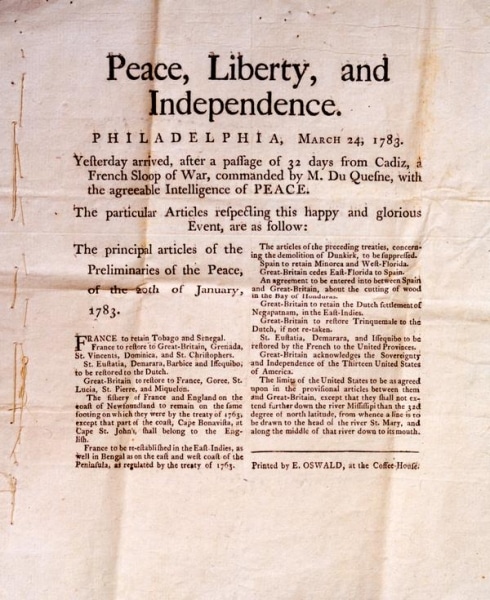
This exhibition explores the dramatic shifts Philadelphians endured—from disaffection, to radicalism, to moderation—through broadsides, pamphlets, newspapers, and prints collected during the Revolution itself. The collections of Swiss antiquarian Pierre Eugène Du Simitière and the papers of John Dickinson, the famously moderate “penman of the Revolution,” together preserve one of the richest records of Philadelphia’s radical experiment in democracy.
Funding has been generously provided by the Philadelphia Funder Collaborative for the Semiquincentennial