
Shareholder Spotlight: Connections to the U.S. Navy and U.S. Marine Corps
Dana Dorman, Archivist
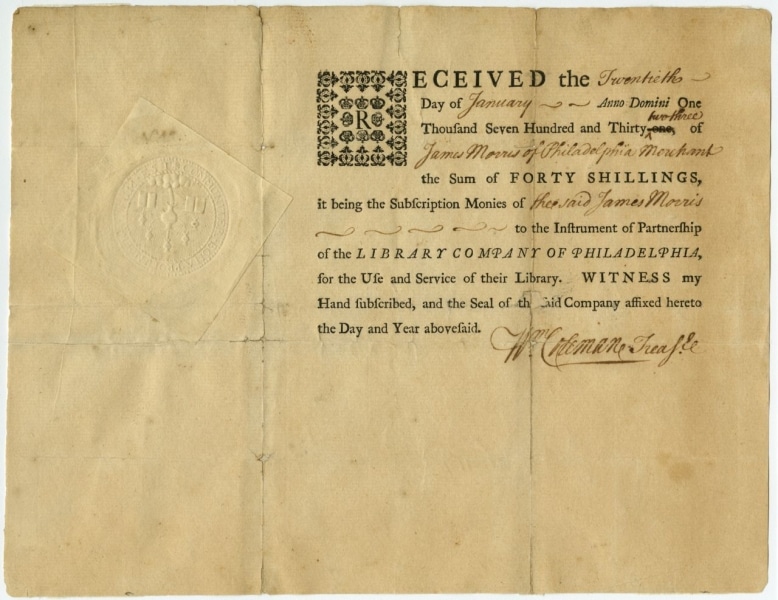
Image: Receipt for a Library Company share, 1733.
We’re doing something different for this month’s “shareholder spotlight” series by taking a closer look at past shareholders connected to the U.S. Navy and U.S. Marine Corps in honor of their 250th anniversaries. (These anniversaries are also marked in the Library Company’s latest exhibition, Fair Winds and Following Seas: Peacetime Naval Operations to 1939, on view until April 2026.)
Shareholders have always been the backbone of the Library Company of Philadelphia. Starting with the first group of fifty tradesmen who formed the library in 1731, shareholders have provided crucial financial support each year for our mission to “pour forth benefits for the common good.”
We keep careful track of who has owned each historic share, and our list of 9,800+ shareholders includes signers of the Declaration and Constitution, merchants, doctors, soldiers, scientists, artists, philanthropists, politicians, and much more.
Connections to the U.S. Navy and U.S. Marine Corps
The Second Continental Congress created the Navy on October 13, 1775, commissioning its first officers and commissioning its first ship. Less than a month later, on November 10, 1775, they founded the Marines to serve as naval infantry.[i]
Of course, given the importance of Philadelphia during this period (and after), some of the figures important in the early history of both the Navy and the Marines were also Library Company shareholders. Here are just a few examples:
Samuel Nicholas (1744-1790) – Share #6
This Library Company share was first issued to Anthony Nicholas (d. 1751) on November 10, 1731. He was a prosperous blacksmith in Philadelphia, and he was obviously acquainted with Benjamin Franklin (1706-1790) and his fellow Junto members. Nicholas signed the “Articles of Agreement” drawn up by that group on July 1, 1731 to found a library. He was among the first group of eleven shares issued four months later, and also served on the Library Company’s board of directors in 1731 and in 1732, when the Library Company hired its first librarian.[ii]
After his death, the share eventually passed to his son Samuel Nicholas (1744-1790). Samuel is best known as being the first Commandant of the Marine Corps.
In 1775, Samuel was the first officer commissioned for the two Marine battalions that had been authorized by the Continental Congress in November of that year. He recruited sixty-two men to serve as Marines about the gun frigate Alfred, ignored orders to attack Lord Dunmore’s ships in the Chesapeake, and led an attack on forts in Nassau instead. When he returned to Philadelphia in 1776, he was promoted from Captain to Major, but he never returned to sea. Instead, he “was ‘drafted’ by Washington, along with his eighty-man battalion, to take the place of artillerymen when enlistments expired.”[iii]
After the war, he worked as an innkeeper at the Sign of the Conestoga Wagon tavern, owned by his mother-in-law and located on today’s Market Street. He also fought a long battle for the naval “pay and emoluments” he felt due. He joined the Society of the Cincinnati of Pennsylvania in 1783, and served on its Standing Committee from 1785 to 1788. He died from yellow fever in 1790.[iv]
After Samuel’s death, the share eventually passed to his son, also named Samuel Nicholas. The share has been owned by nine people in its history. (This share is not currently available.)
James Read – Share #350
James Read (1743-1822) acquired Library Company share #350 on April 6, 1769. Like a number of previously profiled shares, that puts him among the shareholders of the Union Library Company, which merged into the Library Company on this date.
Read served in a variety of roles for the U.S. Navy. He served as paymaster for the first ships; clerk and paymaster of the Marine Committee of the Navy Board at Philadelphia; and eventually served as principal assistant to Robert Morris who was Superintendent of Finance and Naval Agent.[v]
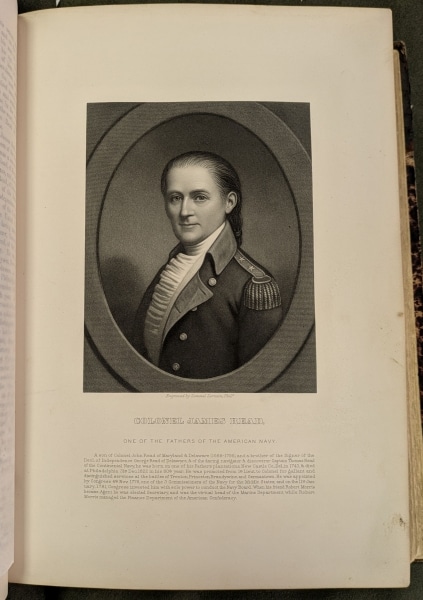
Image: Samuel Sartain, Colonel James Read, One of the Fathers of the American Navy (Philadelphia, circa 1888). Engraving published in J. Thomas Scharf, History of Delaware 1609-1888 (Philadelphia 1888).
Read maintained his Library Company share for the rest of his life, and his estate maintained the share for eight years after his death. The share was eventually transferred from James Read, “acting executor of James Read dec’d,” to “James Read in trust.”[vi] This is almost certainly the first shareholder’s son, also named James Read (1783-1853).[vii]
After the death of the younger James Read, the share next passed to his sister Susan Read Eckard (1776-1861) on November 14, 1853, and remained with the Eckard family until the early 20th century.
The share has been owned by ten people in its history, and is currently available.
Joshua Humphreys (1751-1838) – Share #663
Joshua Humphreys (1751-1838) acquired Library Company share #663 on March 11, 1791, just two months after it was first issued to Jacob Hergesheimer.
Humphreys was a master shipbuilder, and helped create the plans for the frigate Randolph, which is regarded as the first true warship of the new country.[viii]
He was appointed the first Chief Naval Constructor of the United States in 1794, and he was the principal architect of the Navy’s original six frigates. His shipyard on the Delaware River constructed the USS United States in 1797, and he apparently led a personal tour of the ship for President George Washington (1732-1799) and First Lady Martha Washington (1731-1802) during its construction.[ix]
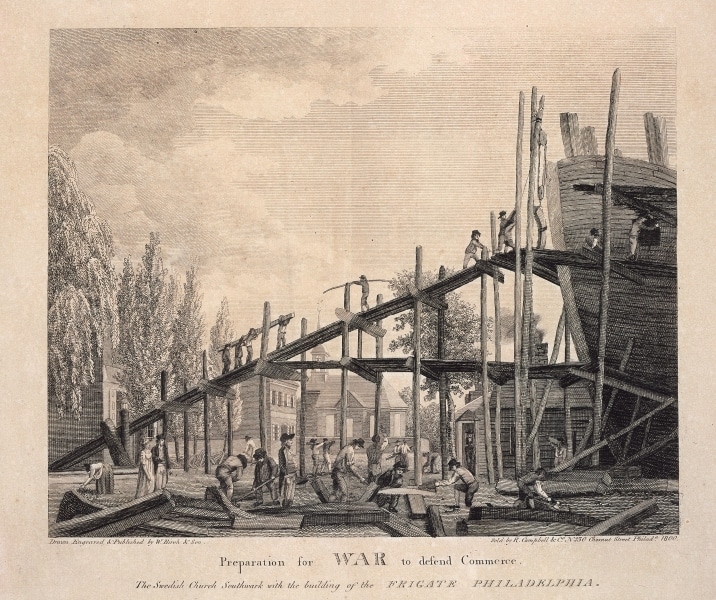
Image: This image shows the construction of the U.S. Navy warship Philadelphia at shareholder Joshua Humphreys’ shipyard. W. Birch & Son, Preparation for War to Defend Commerce (Philadelphia, 1800). Engraving.
The U.S. Navy purchased his shipyard soon after, and the Southwark Yard between Federal and Reed Streets was active from 1801 to 1876.[x]
Humphreys owned his Library Company share for the rest of his life, and it remained associated with his estate until his grandson Andrew Atkinson Humphreys (1810-1883) purchased the share on November 2, 1866.
The share remained in the Humphreys family until the mid-20th century, and has been owned by eight people total in its history. (The share is not currently available.)
Not yet a shareholder?
Share #350 is currently available. We work hard to match potential shareholders with historic shares that match their interests, and we would love to match you with James Read’s share or another option.
You can become a Library Company shareholder with an initial gift of $500. To learn more, visit our website or reach out to our Development Office at [email protected].
—–
[i] “Birth of the Navy,” Homecoming 250, https://www.homecoming250.org/birthplace-of-the-navy-marine-corps/the-birth-of-the-navy/ (accessed November 20, 2025). Philip Gold, “United States Marine Corps,” EBSCO, https://www.ebsco.com/research-starters/history/united-states-marine-corps (accessed November 20, 2025).
[ii] “At the Instance of Benjamin Franklin”: A Brief History of the Library Company of Philadelphia (Philadelphia, 2015), 5. You can see the Library Company’s contract with its first librarian Louis Timothée at Founders Online, “Agreement between Louis Timothée and Directors of Library Company,” https://founders.archives.gov/documents/Franklin/01-01-02-0085 (accessed November 20, 2025).
[iii] The State Society of the Cincinnati of Pennsylvania, “Maj. Samuel Nicholas,” The State Society of the Cincinnati of Pennsylvania, https://pasocietyofthecincinnati.org/gallery_post/maj-samuel-nicholas/ (accessed November 20, 2025).
[iv] Ibid. University of Pennsylvania, “The Un-Quaker Commandant,” The Pennsylvania Gazette, https://thepenngazette.com/the-un-quaker-commandant/ (accessed November 20, 2025).
[v] William H. J. Manthorpe, Jr., “Thomas Read of Delaware, Part 1: The Creation of the Continental Navy,” Journal of the American Revolution blog, https://allthingsliberty.com/2021/03/captain-thomas-read-of-delaware-part-i-the-creation-of-the-continental-navy/ (accessed November 20, 2025).
[vi] Share Record Book C, volume 173, Library Company of Philadelphia records (MSS00270), p. 298.
[vii] Interestingly, the same year that James Read died (1822), his son James Read, Jr. acquired a different Library Company share: #930. The younger Read owned that share until his death; his executor and nephew Frederick S. Eckard sold the share to himself on November 12, 1853. It is unclear why the younger James Read was associated with both shares, but he may have held share #350 “in trust” for the benefit of other family members, and used share #930 for himself.
[viii] Harry Kyriakodis, “Shaping Up and Shipping Out at Philadelphia’s First Navy Yard,” Hidden City, July 18, 2017, https://hiddencityphila.org/2017/07/shaping-up-and-shipping-out-at-philadelphias-first-navy-yard/ (accessed November 20, 2025).
[ix] Kyriakodis, “Shaping Up and Shipping Out at Philadelphia’s First Navy Yard.” Margherita Desy, “Humphreys’ Marvel,” USS Constitution Museum blog, September 21, 2016, https://ussconstitutionmuseum.org/2016/09/21/humphreys/ (accessed November 20, 2025).
[x] “History,” Navy Yard Philadelphia, https://navyyard.org/about/history/ (accessed November 20, 2025).

