
Shareholder Spotlight: Thomas Ash
Dana Dorman, Archivist
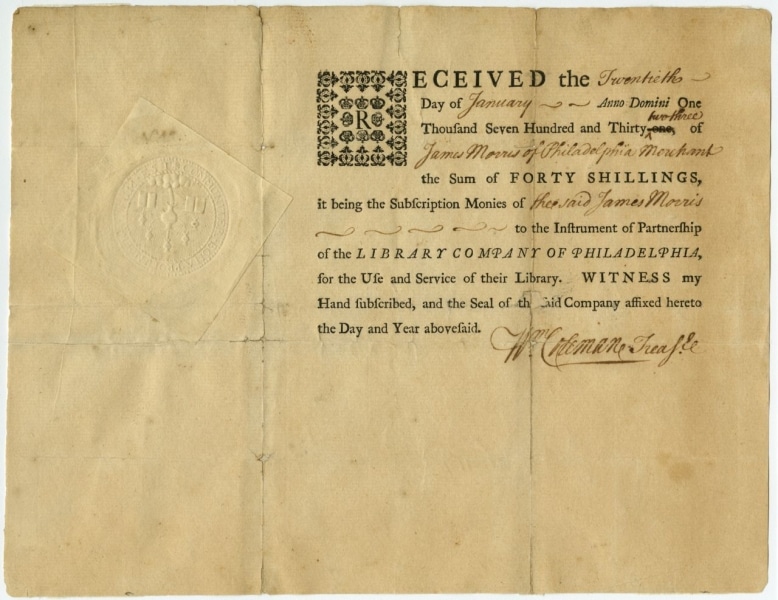
Image: Receipt for a Library Company share, 1733.
We continue our monthly “Shareholder Spotlight” series by taking a closer look at Share #274 and its first owner, Thomas Ash.
Shareholders have always been the backbone of the Library Company of Philadelphia. Starting with the first group of fifty tradesmen who formed the library in 1731, shareholders have provided crucial financial support each year for our mission to “pour forth benefits for the common good.”
We keep careful track of who has owned each historic share, and our list of 9,800+ shareholders includes signers of the Declaration and Constitution, merchants, doctors, soldiers, scientists, artists, philanthropists, politicians, and much more.
Share #274
This share was first issued to William Lownes on April 6, 1769. Like a number of previously profiled shares, that puts him among the shareholders of the Union Library Company, which merged into the Library Company on this date.
A master builder, Lownes was a member of the Carpenters’ Company by the time he acquired this Library Company share.[i] He continued as a Library Company shareholder for the rest of his life. His executors Robert Knowles and Thomas Betts sold the share to Thomas Ash on January 7, 1820.
Ash was a merchant in Philadelphia. The 1820 Philadelphia directory lists a T. Ash, “stave merchant,” based at the Christian Street wharf and with a home on South 3rd Street. The 1825 Philadelphia directory lists Thomas Ash as simply “merchant,” also based on South 3rd Street.[ii]
African American businessman and reformer James Forten (1766-1842) described Ash as “a merchant I work for” and “a very greate friend of mine” in an April 1817 letter to African American merchant Paul Cuffe. Ash himself wrote to Cuffe a couple weeks later to ask for advice on whether “Ebony wood can at this time be procured in the river Gaboon” in western Africa, as well as “the Kind of goods most suitable for the trade.”[iii]
It is unclear whether Cuffe answered Ash’s questions, or whether Ash pursued this potential source for Ebony wood.
Two years later, and just two months before Ash acquired his Library Company share, his business suffered a fire on Christian Street Wharf. Describing Ash’s business as a “Bark Manufactory,” one newspaper article noted that his factory and a “considerable quantity of tar” were lost.[iv]
However, Ash and other business owners paid for a newspaper advertisement to thank the “different Fire and Hose Companies of the City and County of Philadelphia, to Major Gamble of the Marine Corps, and to the Citizens generally” for helping to save some of their property from destruction.[v]
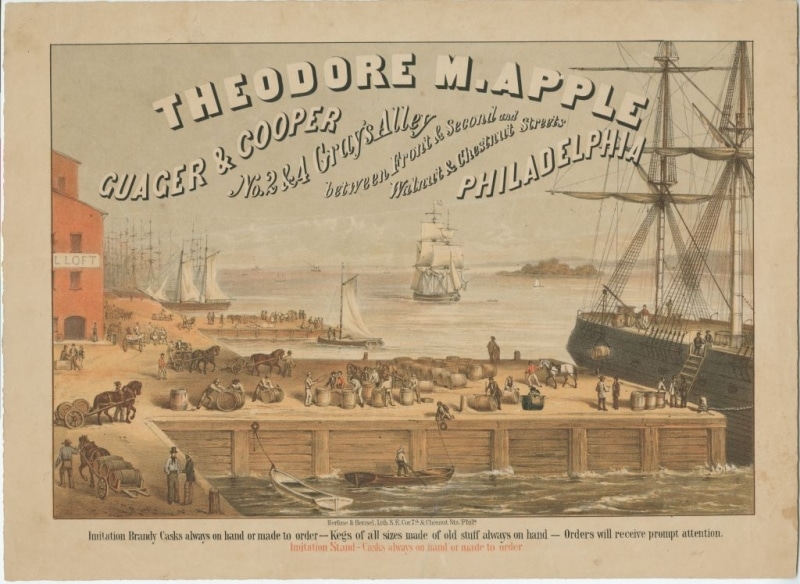
Image: This advertisement dates to roughly forty years after Thomas Ash’s fire at Christian Street Wharf, but it provides a snapshot of a busy wharf scene a few blocks north with sailing vessels, a sail loft, and assorted men conducting business. Herline & Hensel, printer, Theodore M. Apple, guager & cooper, no. 2 & 4 Gray’s Alley between Front & Second and Walnut & Chestnut Streets, Philadelphia [graphic] (Philadelphia, 1858). Chromolithograph.
Library Company records provide no further detail about Ash’s involvement with the library during his time as a shareholder, but he maintained his share for only five years.
Ash sold the share to merchant Comegys Paul (1785-1851) on November 7, 1825.
The share has been owned by seven people total in its history.
Not yet a shareholder?
Share #274 is currently available. We work hard to match potential shareholders with historic shares that match their interests, and we would love to match you with Thomas Ash’s share or another option.
You can become a Library Company shareholder with an initial gift of $500. To learn more, visit our website or reach out to our Development Office at [email protected].
—–
[i] ““Lownes, William,” Carpenters’ Company Digital Archive & Museum, https://archive.carpentershall.org/items/show/25853 (accessed February 23, 2026).
[ii] A stave is “any of the narrow strips of wood or narrow iron plates placed edge to edge to form the sides, covering, or lining of a vessel (such as a barrel) or structure.” “Stave,” Merriam-Webster Dictionary, https://www.merriam-webster.com/dictionary/stave (accessed February 23, 2026).
[iii] Ash may have been referring to the Ogooué River in Gabon. For a brief mention of James Forten and his connection to Thomas Ash, see Julie Winch, “’A Person of Good Character and Considerable Property’: James Forten and the Issue of Race in Philadelphia’s Antebellum Business Community,” The Business History Review, Vol. 75, no. 2 (Summer 2001), 261-296. Digitized copies of Forten and Ash’s April 1817 letters to Paul Cuffe can be viewed at https://paulcuffe.org/primary-documents/personal-and-family-papers/ (accessed February 23, 2026); the original letters are held at New Bedford Free Public Library in New Bedford, MA.
[iv] “Fire!,” Franklin Gazette, November 27, 1819.
[v] Advertisement, Poulson’s American Daily Advertiser, November 29, 1819.

