
Mellon Scholars Summer Program – Subject Guides
Philadelphia’s Black Founders: The Free Black Community in the Early Republic
Overview:
Black Founders: The Free Black Community in the Early Republic examines the activities of newly-freed African Americans in the North as they struggled to forge organizations and institutions to promote their burgeoning communities and to attain equal rights in the face of slavery and racism. Leaders emerged—many of them former slaves—who worked to organize independent churches, schools, and fraternal and educational associations, and to champion blacks’ inclusion as equal citizens in the American landscape. Deeply spiritual people, they held close the tenets of egalitarian Christianity and the affirmation in the Declaration of Independence of the unalienable right to liberty. They were the most consistent voices for multiracial democracy in the new republic, and their words and deeds helped inspire a vigorous American antislavery movement.
The subject guide ranges in time from the years after the Revolution up to 1830, when the first national convention of African Americans brought together Black people from all over the North to consider a national program to advance their rights and sharpen their campaign against slavery. Although the exhibition includes African Americans from all over the United States, our primary focus is on the Philadelphia black community, the largest of the northern free black communities during this period.
About the Author:
This subject guide was assembled by Fred D., is a Ph.D Candidate at Lincoln University pursuing a dual degree in computer science and history. Fred works as a graduate assistant in the university archives, assisting with the digitization of local history collections.
Keywords
Contributors:
- Forten, James
- Jones, Absalom
- Allen, Richard
- African Methodist Episcopal Church — Pennsylvania
- Pennsylvania Society for Promoting the Abolition of Slavery
Subject Headings:
- African American churches — Pennsylvania — Philadelphia
- Slaves — Emancipation — Pennsylvania
- Abolitionists — Pennsylvania — Societies, etc
- Antislavery movements — Pennsylvania
- African Americans — Education — Pennsylvania — Philadelphia
- African Americans — Pennsylvania — Philadelphia — Social conditions
- African Americans — Congresses — Pennsylvania
- Yellow fever — Pennsylvania — Philadelphia — African Americans
- African Americans — Suffrage — Pennsylvania
- Afro-American writers — Philadelphia
Genre Terms:
Annotated Bibliography
Resources at LCP:
A Narrative of the Proceedings of the Black People during the Late Awful Calamity in Philadelphia in the Year 1793: And a Refutation of Some Censures, Thrown upon Them in Some Late Publications (Philadelphia, 1794).
During the 1793 yellow fever epidemic, Richard Allen and Absalom Jones organized free Black Philadelphians to nurse the sick and bury the dead. Their Narrative defends these efforts against the racist criticisms of Matthew Carey, documenting Black mutual aid as essential to the city’s survival during crisis.
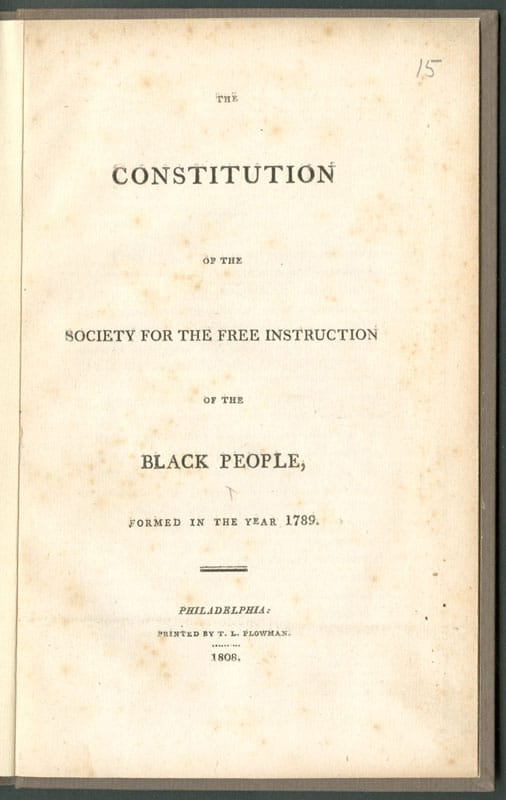
The Constitution of the Society for the Free Instruction of the Black People, Formed in the Year 1789 (Philadelphia, 1808).
This constitution reflects early Black educational organizing in Philadelphia, where limited formal schooling prompted both white-led and Black-led initiatives. Institutions like Anthony Benezet’s school and grassroots efforts by Black educators supported literacy, while churches and mutual aid networks fostered “each one teach one” models of communal learning.
Russell Parrott, An Oration on the Abolition of the Slave Trade, Delivered on the First of January, 1812, at the African Church of St. Thomas (Philadelphia, 1812).
In this 1812 Abolition Day address, Russell Parrott honors transatlantic abolitionists and situates their work within a broader moral struggle. A protégé of James Forten and Absalom Jones, Parrott underscores collective activism against the slave trade and celebrates its abolition as a moral triumph.
“A Voice from Philadelphia. Philadelphia, January, 1817,” in William Lloyd Garrison, Thoughts on African Colonization: Or an Impartial Exhibition of the Doctrines, Principles and Purposes of the American Colonization Society (Boston, 1831).
At a mass meeting of 3,000 Black men at Bethel Church, Philadelphians rejected the American Colonization Society’s plans. Published in Thoughts on African Colonization, this declaration asserts Black Americans’ rights to the nation and solidarity with enslaved people, refusing emigration and condemning racist assumptions.
Minutes and Proceedings of the First Annual Convention of the People of Colour. Held by Adjournments in the City of Philadelphia, from the Sixth to the Eleventh of June, Inclusive, 1831 (Philadelphia, 1831).
These proceedings document early national Black organizing led by Richard Allen. Addressing racist laws like Ohio’s Black codes, delegates supported migration to Canada and institution-building. These efforts contributed to transnational Black networks and, later, to communities central to the Underground Railroad.
Robert Purvis, Appeal of Forty Thousand Citizens, Threatened with Disfranchisement, to the People of Pennsylvania (Philadelphia, 1838).
In response to Pennsylvania’s 1838 constitution, Robert Purvis condemns Black disfranchisement and asserts political rights. A leading abolitionist and Underground Railroad organizer, Purvis connects voting rights to broader struggles for racial and gender justice, challenging white supremacist governance in the state.
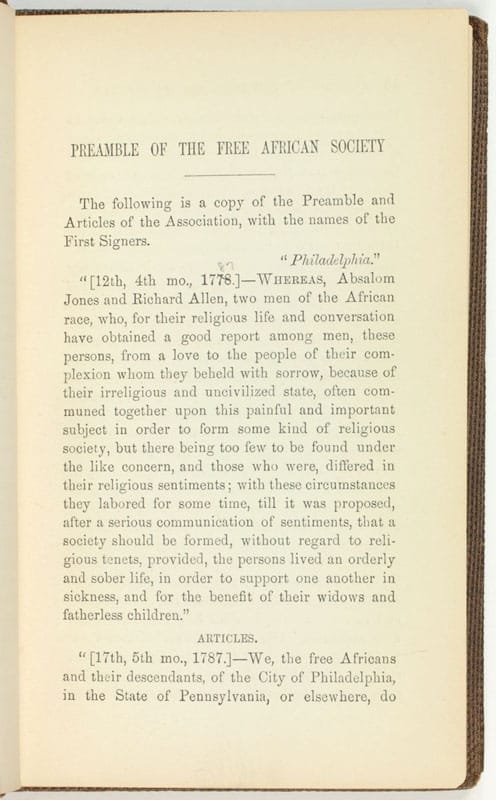
“Preamble of the Free African Society,” in William Douglass, Annals of the First African Church, in the United States of America, Now Styled the African Episcopal Church of St. Thomas, in Philadelphia (Philadelphia, 1862).
Local Resources:
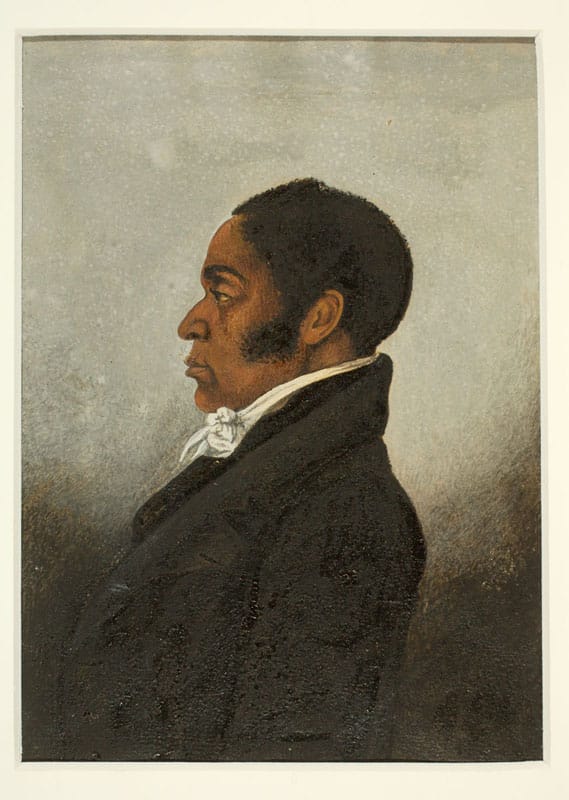
Portrait identified as James Forten, oil on paper probably by the African American artist Robert Douglass, Jr., ca. 1834. Courtesy of the Historical Society of Pennsylvania.
James Forten, a successful Philadelphia sailmaker, was among the wealthiest African Americans of his time. He funded schools, Black organizations, and antislavery efforts. Connected to figures like Paul Cuffe and William Lloyd Garrison, Forten shaped Black activism and reform networks locally and nationally in the early nineteenth century.
Frank Johnson. Lithograph by Alfred Hoffy, from a daguerreotype by Robert Douglass, Jr. (Philadelphia, 1846). Courtesy of the Historical Society of Pennsylvania.
Francis Johnson, a pioneering Black composer and bandleader, gained international acclaim performing for diverse audiences, including for abolitionists at the Library Company and at Queen Victoria’s coronation. Active from 1818 to 1844, he advanced popular band music and influenced generations. His legacy endured through successor bands that spread his model across the United States.
Reference Books:
Newman, Richard S and James Mueller. Antislavery and abolition in Philadelphia: Emancipation and the Long Struggle for Racial Justice in the City of Brotherly Love. Louisiana State University Press, 2011.
Antislavery and Abolition in Philadelphia explores the cultural, political, and religious forces shaping the city’s long struggle against racial injustice. Through nine scholarly essays, it traces the movement’s evolution from marginalization in the colonial era to prominence during the Civil War, highlighting Philadelphia’s central role in antislavery activism.
Newman, Richard S. Freedom’s Prophet: Bishop Richard Allen, the AME Church, and the Black Founding Fathers. New York University Press, 2008.

