
Philadelphia’s Radical Revolution: From the Stamp Act to the Federal Constitution
Free Exhibition | May 18th – October 9th
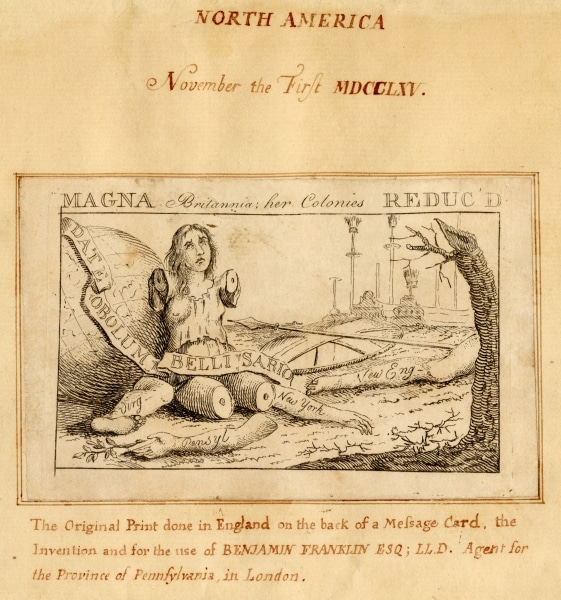
IN PHILADELPHIA, artisans and tradesmen drove the Revolution more forcefully than in any other colony. Early in the Revolution, the city’s political and economic elites, many of whom rejected the spirit of rebellion, had been pushed aside by working men who seized political power, reshaped Pennsylvania’s wartime government, and wrote a new state constitution that proved to be the most radically democratic constitution of the entire Revolution.
These ardent patriots, backed by the militia, demanded absolute loyalty to the American cause. Before and after the occupation of Philadelphia by the British army in 1777-1778, they forced citizens to choose: swear an oath of allegiance to Pennsylvania or risk imprisonment, confiscation of property, or even death.
After the war was won, the radicals retained much of their power, but in the early 1780s, Philadelphia’s long tradition of political excess could be as dangerous as elite rule had been before. When the Constitutional Convention met in Philadelphia in 1786, the city’s delegates brought this spirit of moderation to its deliberations and were influential in designing a federal government that balanced popular power with checks and restraints.
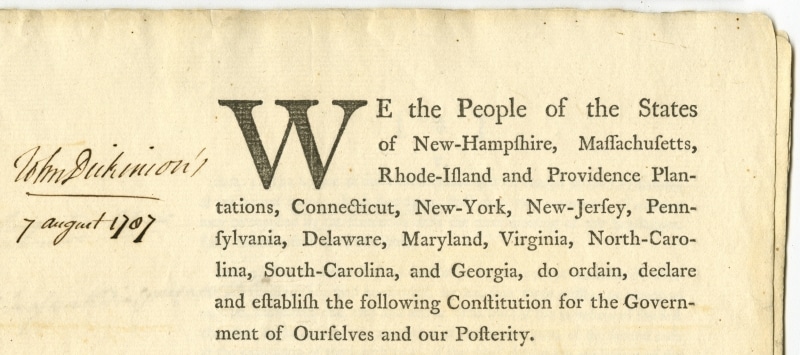
This exhibition does not attempt to tell the whole story of the Revolution. It focuses on what happened in Philadelphia and the dramatic shifts its citizens endured– from disaffection, to radicalism, to moderation–through broadsides, pamphlets, newspapers, and prints collected in the city during the Revolution itself. It is shaped by the unique perspectives of two avid contemporaries: the Swiss emigrant, Pierre Eugène Du Simitière, who collected and preserved many items that others disregarded, and John Dickenson, the famously moderate “penman of the Revolution” at the center of Revolutionary Politics. Together, they preserve one of the richest records of Philadelphia’s Radical experiment in democracy.
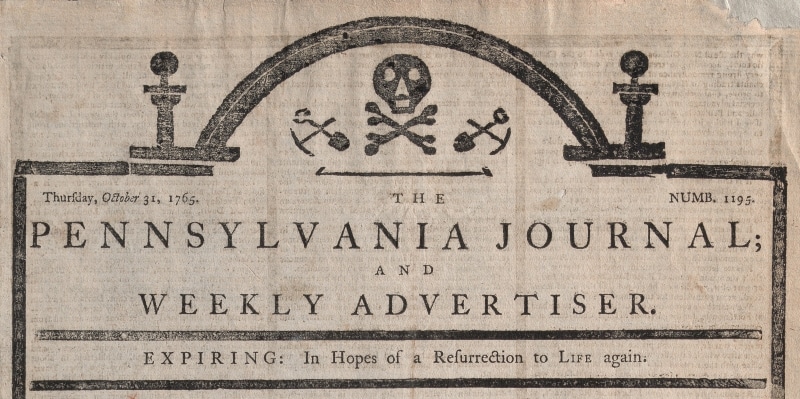
The Stamp Act and the Beginning of Resistance, 1765-1774
The end of the Seven Years War in 1763 left Britain victorious but financially strained. Defending its newly expanded empire was costly, and Parliament wanted American colonists to bear the expense of their own defence. The Stamp Act of 1765 was a direct result. The measure provoked widespread opposition across the colonies. Pierre Eugène Du Simitière — Later a self-appointed archivist of the Revolution — quickly began collecting printed reactions from colonial newspapers and pamphlets documenting the growing resistance.

From Resistance to Independence, 1774-1776
In response to the Boston Tea Party, the British blockaded Boston Harbor, dissolved the colony’s government, and imposed military rule. The other colonies rallied to Boston’s defense and called for a Continental Congress to meet in Philadelphia to coordinate a collective response to these threats to their rights and liberties as British subjects. Philadelphia thus became, in effect, the capital of the United Colonies, and a city long known for moderation and tolerance emerged as a center of radical political thought.
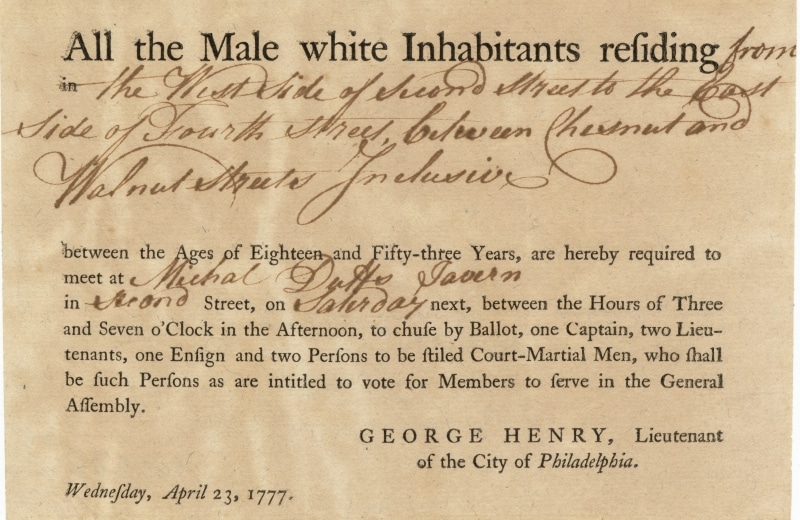
The Pennsylvania Constitution and Radical Government, 1776-1777
The Pennsylvania Constitution of 1776 was the most radical and democratic of the state constitutions adopted that year. It established a single-chamber legislative assembly with proceedings open to the public, required annual elections, and imposed strict term limits. Executive authority rested not in a single governor, but in a twelve-member council with no veto power and limited authority. The constitution also expanded voting rights to all adult male taxpayers, regardless of property ownership, allowed any voter to run for office, regardless of education, and included a robust declaration of rights.
The British Invasion and the Occupation of Philadelphia 1776-1778
In the winter of 1776, British General William Howe decided to capture Philadelphia, the seat of Congress. George Washington initially thwarted him in New Jersey, so Howe shifted strategy and approached from the south, sailing up the Chesapeake Bay to Elkton, Maryland. Washington met his forces in Delaware but was defeated at the Battle of Brandywine. Howe entered Philadelphia without resistance in the fall of 1777, while Washington withdrew to winter quarters at Valley Forge.
Hours before Howe’s army entered Philadelphia on September 26th, 1777, thousands of patriots–along with Congress and the state government–fled to the countryside, leaving their houses empty or their families to fend for themselves. Howe’s force of about 20,000 soldiers, along with their wives and camp followers, soon overflowed their hastily erected barracks and occupied Philadelphia’s abandoned houses and public buildings, including what is now Independence Hall. Officers comfortably quartered with local families–voluntarily or not–where they idled away the next eight months.
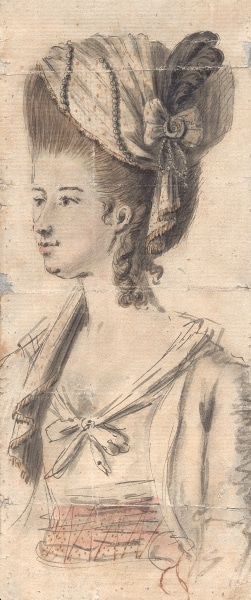
The Meschianza
In late April 1778, General Howe learned he had been relieved of command, and by early May, reports confirmed that the British army would withdraw to New York in response to France’s entry into the war. Many Pennslvanians had initially welcomed the British as liberators, but this retreat signaled a stinging defeat–diminishing any hope of winning hearts and minds. Many who remained in Philadelphia feared the return of the radical government but felt betrayed by the British failure to protect them.
Yet Howe remained popular among his officers and their wealthy loyalist allies. On May 18th, shortly before his departure, they honored him with perhaps the most lavish fete ever seen in colonial America: the Meschianza–Italian for “medley”.
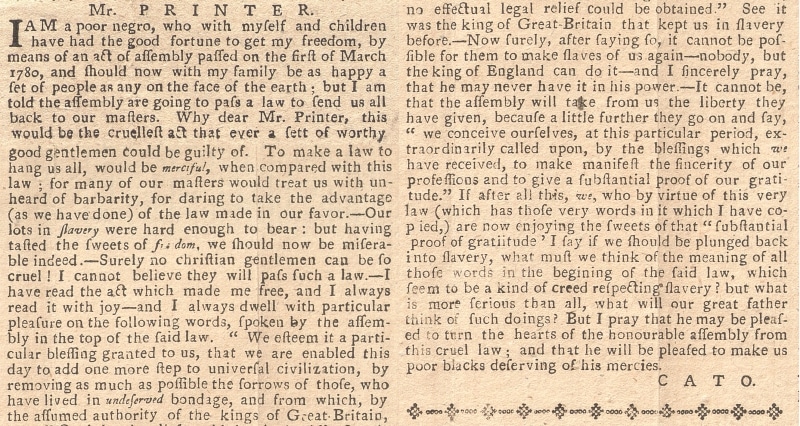
Pennsylvania’s Gradual Abolition Act of 1780: The First Extensive Abolition Legislation Enacted in the Western Hemisphere
Enslaved people had always opposed their enslavement, while some Quakers argued that slavery was incompatible with their religious faith. The Declaration of Independence–with its claim that “all men are created equal”–sparked debate to broader communities. Did “all men” include or exclude African-descended people? The language of the Pennsylvania Constitution went further, declaring that “all men are born equally free and independent.”
Victory, Peace, and the Federal Constitution, 1781-1787
In June, the army departed with an estimated 3,000 loyalists and their families, leaving the city in ruins: some 600 houses destroyed, hundreds more looted, streets choked with refuse, and the air thick with flies.
In the three years after the British evacuation, inflation, shortages, and political turmoil sparked unrest among the militiamen and tradesmen who had driven the Revolution. With victory at Yorktown and peace in sight, moderates gained majority, and John Dickinson became the president of the state. Though radicals remained influential, more conservative men began to assert power.
All the Pennsylvania delegates to the Constitutional Convention of 1787 came from this conservative faction. They believed their state constitution was too democratic and too radical. Using it as a cautionary example, they argued successfully for a strong central government with moderating checks and balances. Many radicals opposed the new federal constitution but asserted meaningful change by successfully pressing for a Bill of Rights–one of the most significant and revered legacies of the Revolution.
Radicals suffered their final defeat in 1790 when conservatives succeeded in replacing the 1776 state constitution with one more like the Federal Constitution.
About Pierre Eugène Du Simitière
Most of the printed materials in this exhibition were acquired by the Library Company in 1785 at the estate auction of Pierre Eugène Du Simitière (1737-1784), the Geneva-born artist, naturalist, and antiquary. In November 1757, having just turned twenty, he sailed to the West Indies, never to return to Europe. For the next sixteen years, he traveled back and forth between the West Indies and the Principal cities of North America, finally coming to rest in 1774 in Philadelphia. In all his travels, collecting materials for a never-to-be-written encyclopedic history of the West Indies and North America was his main occupation.
During the Revolution, he gathered every pamphlet, broadside, and newspaper he could get his hands on that related to the conflict. Many people were aware that history of the most momentous kind was being made, but hardly anyone thought of preserving the ephemeral documents of that history, and no one did so as systematically and energetically.
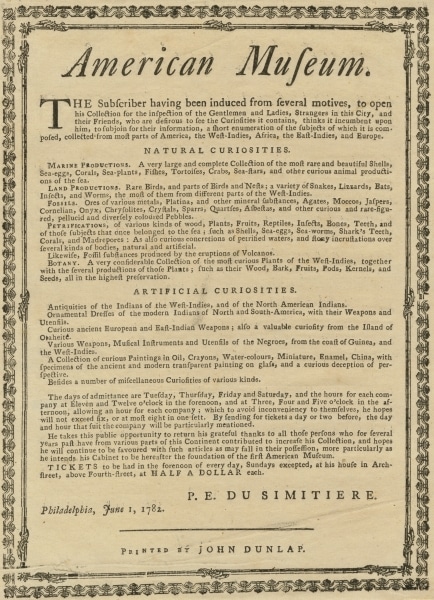
In May 1782, he opened his collection to the public in what he called the American Museum. It was arguably the first such public museum in the nation. At the hefty price of fifty cents a ticket, it did not attract enough visitors to pay for its upkeep. Crushed by debts and depressed by a nearly universal disregard for his labors, he died in October 1784, aged forty-seven, having lived to witness the American victory but not its culmination in the Federal Constitution.
We gratefully acknowledge the financial support for the exhibition and related programming provided by the Philadelphia Funder Collaborative for the Semiquincentennial and the Embassy of Switzerland in the United States of America. Operational funding has been provided by a grant from the Pennsylvania Historical and Museum Commission’s Cultural and Historical Support Program, a program funded by the Commonwealth of Pennsylvania.

