• Link to Facebook
  • Link to Instagram
  • Link to Youtube
  • Link to Mail
  • Link to Rss this site
  • Shopping Cart Shopping Cart
    0Shopping Cart
The Library Company of Philadelphia
  • Home
  • Search Collections
    • Search Library Catalog
    • Search Manuscripts
    • Search Digital Collections
    • How to Search the Collections
      • Subject Guides
      • Access Terms used in our Catalogs
    • Potentially Harmful Materials and Descriptions Statement
  • Academic Programs
    • Overview
    • Fellowships
    • Awards
      • LCP First Book Award
      • Innovation Award
    • Program in African American History
    • Program in Early American Economy & Society
    • The Davida Tenenbaum Deutsch Program in Women’s History
    • Visual Culture Program
  • Research
    • Overview
    • Subject Guides
    • Finding Aids
    • Online Exhibitions
    • Online Resources
  • Using the Library
    • Overview
    • Hours, Access, & Location
    • Appointments
    • Rights & Reproductions
  • Events
    • Upcoming Events
    • Fireside Chats
    • LCP News
    • LCP Press Resources
  • Projects
    • Beyond Glass Cases
    • Library Company Papers Project
  • Support the Library
    • Overview
    • Donate Online!
    • Join & Renew Membership Online!
    • Support: Shareholding
    • Annual Dinner 2026
    • Lecture in Honor of John C. Van Horne
    • The Junto
    • Gifts in Kind
    • Membership Benefits
    • Planned Giving
  • About LCP
    • Annual Reports
    • Staff
    • Academic Program Directors
    • Board of Trustees
    • Library Company Ambassadors
    • Employment
    • Affiliations
    • LCP Blog
    • Press Resources
    • LCP Privacy Policy
    • Overview & History
    • LCP FAQ Sheet
  • Click to open the search input field Click to open the search input field Search
  • Menu Menu

The History of the Bicycle

My bicycle, side view in front of box bush, (Miss Annes) [graphic].

Marriott Canby Morris. My Bicycle, Side View in Front of Box Bush. (Miss Annes), 1887. Glass negative. Marriott C. Morris Collection.

[Bicycle party. Herbert Morris, Horace Eugene Smith, Jedediah H. Adams & myself] [graphic].

Marriott Canby Morris. Bicycle party. Herbert Morris, H[orace] E[ugene] Smith, J[edidiah] H. Adams & Myself. Taken Before Starting on Ride to Doylestown, Norristown & W. Chester, 1884. Glass negative. Marriott C. Morris Collection.

Bicycle group in Public Garden, St. George's. A. H. Bull, S. Harry Sargeant, E. Eugene Sargeant & Dr. Buddington. [Bermuda] [graphic].

Marriott Canby Morris. Bicycle group in Public Garden, St. George’s. A.H. Bull, S. Harry Sargeant, E. Eugene Sargeant & Dr. Buddington. [Bermuda], 1889. Glass negative. Marriott C. Morris Collection.

Veteran Wheelman Asso[ciation] at the Penn Hotel [graphic].

Marriott Canby Morris. Veteran Wheelman Asso[ciation] at the Penn Hotel, 1921. Gelatin silver print. Marriott C. Morris Collection. 

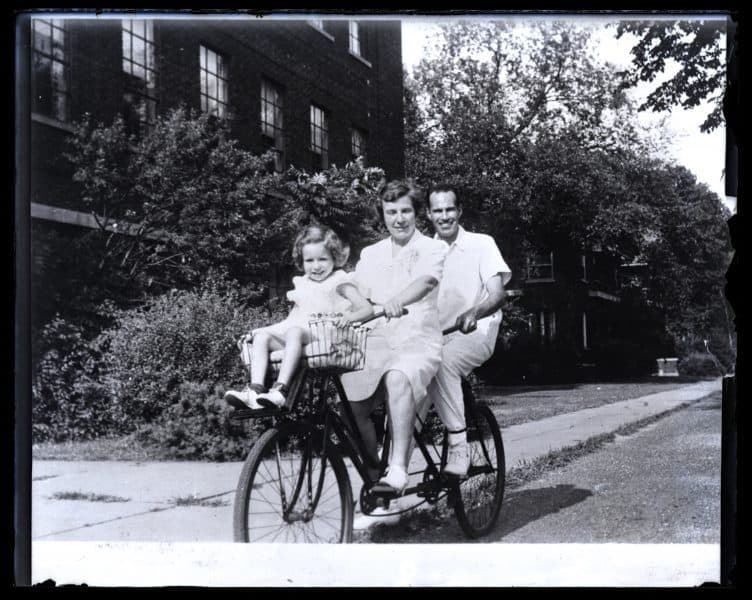
Marriott Canby Morris. M[arriott] C[anby , Jr.], Libby & Ruth on Tandem Bicycle. Madison, Wisconsin, ca. 1942. Glass negative. Marriott C. Morris Collection.

Among his many interests, Marriott C. Morris was a fan of bicycling. Whether playing with his children or taking extended trips, Morris had joined in on a craze that swept America and Europe in the late Victorian period. Interested in the many images of bicycles and bicycling parties within the Marriott C. Morris Collection, I decided to write up a quick history of the bicycle.

The first recognizable bicycle, with pedals and all, was invented around 1869 (bicycles sans-pedals, called Draisines or velocipedes, were invented as early as 1818). These original bikes were limited in how fast the wheels could rotate and were unaffectionately known as boneshakers, taken from the fact that their rigid frames and iron-banded or wooden wheels led to harsh, shaky rides. Understandably, they were not that popular. The first big innovation was the invention of the high-wheel bicycle, later known as the ordinary or the penny-farthing. The eponymous high wheel did not come in one standard size, but ranged from about forty to sixty inches. The wheel was fit to the rider’s leg length or their overall height. For example, one contemporary guide book recommended a forty-two inch wheel for a thirty inch leg or a man of five feet one inch. The wheel diameter increased by two inches for every one inch of leg height or every one and a half inch of overall height. Having a properly sized wheel was essential to mounting and correctly balancing the high-wheel.

These new bicycles had a few advantages. The lighter frames and big front wheel allowed for higher speeds and smoother rides. This was also helped by the addition of solid rubber tires, providing more cushion over bumpy roads. The downside to these machines came from how dangerous they were to ride. It was very easy to be sent over the front wheel from a hole in the road or a sudden stop, and the height made falls more deadly. This led to bicycling being the domain of young men.

Thankfully, however, not everyone was left out. Tricycles existed as early as the 1780s, popularized around the same time as bicycles, and were “designed for ladies and also for gentlemen who on account of age, timidity, or excessive weight, cannot ride a bicycle” (Pope Manufacturing Company. Catalogue and Price List of the Columbia Bicycle and Sundries. [Boston, 1879]). While they were safer, tricycles were much heavier and did not travel at the same speeds. A typical configuration can be seen here, with two large wheels on the side, and a smaller wheel either in back or front for steering. Other models had one large wheel on the side for pedaling and two smaller wheels opposite for steering. Tricycles could be operated by hand levers and pedals and came with wicker seats.

Miss Schenkl on a tricycle, back of Hamilton H[otel], [Bermuda] [graphic].

Marriott Canby Morris. Miss Schenkl on a Tricycle, Back of Hamiton H. [Bermuda], 1886. Glass negative. Marriott C. Morris Collection.

Bicycle designs further improved with the invention of the safety bicycle in the 1880s. These are more recognizable to the bikes we have today and were a drastic improvement on the boneshakers due to their pneumatic tires. These new tires made for a smoother ride without the danger inherent to the high-wheels. They were also easier to turn as the pedals were not attached to the wheel responsible for steering. Furthermore, the lower crossbars of safety bicycles made them more appropriate for women, who no longer had to split their skirts to sit down. This increased mobility fostered a movement of suffragists and feminists using and promoting bicycles. By the 1890s, safety bicycles had all but replaced the high-wheels.

As part of this bicycle craze, cycling clubs began to pop up around the world. According to guide books of the time, these clubs were beneficial for “good-fellowship, companionship for spins, and social standing in the bicycling community, special stimulus to interest, and incentives to excellence in riding” (Charles E. Pratt, The American Bicycler. Boston: Houghton, Osgood and Company, 1879.). One of the biggest clubs was the League of American Wheelmen, today known as the League of American Bicyclists. Morris himself was a member of the Veteran Wheelmen’s Association, a Philadelphia based group formed in 1908.

Around the 1920s bicycles began to lose their fad status and were regarded as a toy for children instead. I wonder how happy Morris and his friends would be to see the resurgence in bicycle riding today! These images are a captivating way to link the fads of the past with the crazes of the present.

Em Ricciardi
Curatorial and Reading Room Assistant

Share this entry

  • Share on Facebook
  • Share on X
  • Share on WhatsApp
  • Share on Pinterest
  • Share on LinkedIn
  • Share on Tumblr
  • Share by Mail

Search

Search Search

Categories

  • All News (778)
  • Announcements (4)
  • Artist at LCP (13)
  • Beyond Glass Cases (4)
  • Beyond the Reading Room (324)
  • Bookbinding Research (16)
  • Curator's Favorites (29)
  • Current Exhibition (5)
  • Featured Collections (33)
  • Graphic Art Department News (87)
  • Imperfect History (24)
  • LCP in the Press (24)
  • LCP News (506)
  • Library Company Papers Project (47)
  • Marriott C. Morris Collection (14)
  • Mellon Scholars Program (46)
  • PAAH (40)
  • Pandemic Reading (8)
  • Podcasts (97)
  • Popular Medicine (1)
  • Program in Women's History (22)
  • Receipts from “The Larder Invaded” (43)
  • Redrawing History (17)
  • Seminars (4)
  • Shareholder Spotlight (56)
  • Talking in the Library Podcast (69)
  • The Living Book (3)
  • Uncategorized (8)
  • VCP News (44)

Archives

© Copyright 2024 - The Library Company of Philadelphia, 1314 Locust Street, Philadelphia, PA 19107. TEL (215) 546-3181
  • Link to Facebook
  • Link to Instagram
  • Link to Youtube
  • Link to Mail
  • Link to Rss this site
Link to: “Book Talk” podcast (from WMKV radio in Ohio) Link to: “Book Talk” podcast (from WMKV radio in Ohio) “Book Talk” podcast (from WMKV radio in Ohio) Wilson Biscuit Co., Manufacturers of Faultless Biscuit, Cakes, and Crackers, 210, 212, 214 N. Front Street, Philadelphia (Philadelphia, ca. 1890). Bly rides a bicycle on a ring around Saturn. Link to: Exploits of Nellie Bly Advertised On Trade Cards Link to: Exploits of Nellie Bly Advertised On Trade Cards J. W. Brown & Co., High Grade Canned Goods, No. 103 Arch Street, Phila. (Philadelphia, ca. 1890). Nellie Bly is shown walking away from Phileas Fogg, the main character of Jules Vernes’ Around the World in Eighty Days.Exploits of Nellie Bly Advertised On Trade Cards
Scroll to top Scroll to top Scroll to top

This site uses cookies. By continuing to browse the site, you are agreeing to our use of cookies.

OKLearn more

Cookie and Privacy Settings


How we use cookies

We may request cookies to be set on your device. We use cookies to let us know when you visit our websites, how you interact with us, to enrich your user experience, and to customize your relationship with our website.

Click on the different category headings to find out more. You can also change some of your preferences. Note that blocking some types of cookies may impact your experience on our websites and the services we are able to offer.

Essential Website Cookies

These cookies are strictly necessary to provide you with services available through our website and to use some of its features.

Because these cookies are strictly necessary to deliver the website, refusing them will have impact how our site functions. You always can block or delete cookies by changing your browser settings and force blocking all cookies on this website. But this will always prompt you to accept/refuse cookies when revisiting our site.

We fully respect if you want to refuse cookies but to avoid asking you again and again kindly allow us to store a cookie for that. You are free to opt out any time or opt in for other cookies to get a better experience. If you refuse cookies we will remove all set cookies in our domain.

We provide you with a list of stored cookies on your computer in our domain so you can check what we stored. Due to security reasons we are not able to show or modify cookies from other domains. You can check these in your browser security settings.

Google Analytics Cookies

These cookies collect information that is used either in aggregate form to help us understand how our website is being used or how effective our marketing campaigns are, or to help us customize our website and application for you in order to enhance your experience.

If you do not want that we track your visit to our site you can disable tracking in your browser here:

Other external services

We also use different external services like Google Webfonts, Google Maps, and external Video providers. Since these providers may collect personal data like your IP address we allow you to block them here. Please be aware that this might heavily reduce the functionality and appearance of our site. Changes will take effect once you reload the page.

Google Webfont Settings:

Google Map Settings:

Google reCaptcha Settings:

Vimeo and Youtube video embeds:

Other cookies

The following cookies are also needed - You can choose if you want to allow them:

Accept settingsHide notification only
X