
• Link to Facebook
  • Link to Instagram
  • Link to Youtube
  • Link to Mail
  • Link to Rss this site
  • Shopping Cart Shopping Cart
    0Shopping Cart
The Library Company of Philadelphia
  • Home
  • Search Collections
    • Search Library Catalog
    • Search Manuscripts
    • Search Digital Collections
    • How to Search the Collections
      • Subject Guides
      • Access Terms used in our Catalogs
    • Potentially Harmful Materials and Descriptions Statement
  • Academic Programs
    • Overview
    • Fellowships
    • Awards
      • LCP First Book Award
      • Innovation Award
    • Program in African American History
    • Program in Early American Economy & Society
    • The Davida Tenenbaum Deutsch Program in Women’s History
    • Visual Culture Program
  • Research
    • Overview
    • Subject Guides
    • Finding Aids
    • Online Exhibitions
    • Online Resources
  • Using the Library
    • Overview
    • Hours, Access, & Location
    • Appointments
    • Rights & Reproductions
  • Events
    • Upcoming Events
    • Fireside Chats
    • LCP News
    • LCP Press Resources
  • Projects
    • Beyond Glass Cases
    • Library Company Papers Project
  • Join & Support
    • Overview
    • Donate Online!
    • Join & Renew Membership Online!
    • Support: Shareholding
    • Annual Dinner 2026
    • Lecture in Honor of John C. Van Horne
    • The Junto
    • Gifts in Kind
    • Membership Benefits
    • Planned Giving
  • About LCP
    • Annual Reports
    • Staff
    • Academic Program Directors
    • Board of Trustees
    • Library Company Ambassadors
    • Employment
    • Affiliations
    • LCP Blog
    • Press Resources
    • LCP Privacy Policy
    • Overview & History
    • LCP FAQ Sheet
  • Click to open the search input field Click to open the search input field Search
  • Menu Menu

Exploits of Nellie Bly Advertised On Trade Cards

J. W. Brown & Co., High Grade Canned Goods, No. 103 Arch Street, Phila. (Philadelphia, ca. 1890). Nellie Bly is shown walking away from Phileas Fogg, the main character of Jules Vernes’ Around the World in Eighty Days.

J. W. Brown & Co., High Grade Canned Goods, No. 103 Arch Street, Phila. (Philadelphia, ca. 1890). Nellie Bly is shown walking away from Phileas Fogg, the main character of Jules Vernes’ Around the World in Eighty Days.

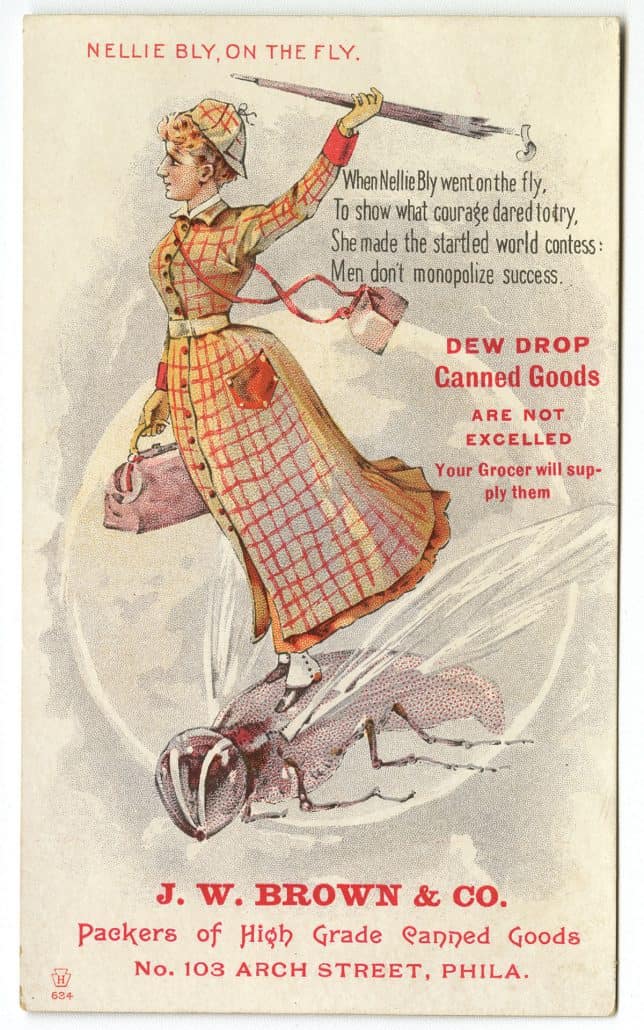
While working with the Richard and Rosalind Berman Collection of Philadelphia Trade Cards, I discovered three cards that promote journalist Elizabeth Cochran, better known by her journalism pseudonym Nellie Bly, and her expedition across the globe. Despite advertising two different businesses, the cards are a single series. Their printer mass produced these cards, and individual companies bought them and later stamped or printed their own business information on them. Two of these cards advertise the canned goods manufacturer J. W. Brown & Company, while the other advertises the Wilson Biscuit Company. Bly is shown walking away from Phileas Fogg, the protagonist of Jules Verne’s Around the World in Eighty Days and inspiration for Bly. She also uses an oversized fly as a means for transport and rides a bicycle on the ring of Saturn. These trade cards reveal that Americans identified Nellie Bly primarily with her gender, but also as an adventurer and an American whose reporting provided entertainment as well as information.

In 1890, Bly set off to travel around the world. Bly had already established herself as a journalist by reporting under cover on the conditions of an insane asylum where she had been committed after faking psychosis. This style of reporting made Bly a pioneer in the genre of “stunt girl” journalism. Towards the latter half of the nineteenth century, newspapers as a mode of media began to evolve. The publications focused on tabloid-like gossip about social elites and balls and interviews became more invasive (Tuchner 50-51). Adventure journalism that detailed excursions around the world and appealed to Americans’ support of Manifest Destiny became popular (Cronin 24). Somewhere along the way, the trade produced stunt girls, female journalists who would place themselves in bizarre, dangerous, or otherwise sensational situations about which to report. Bly became the best known of these stunt girls (Lutes 218).
bly-p-2015-56-410

W. Brown & Co., High Grade Canned Goods, No. 103 Arch Street, Phila. (Philadelphia, ca. 1890). Bly is portrayed riding a fly, along with her travel bags and umbrella.
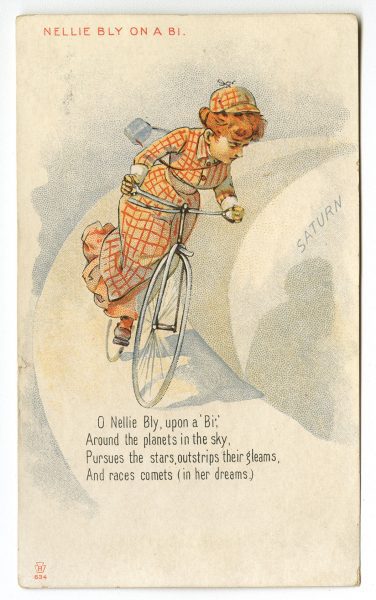
 Wilson Biscuit Co., Manufacturers of Faultless Biscuit, Cakes, and Crackers, 210, 212, 214 N. Front Street, Philadelphia (Philadelphia, ca. 1890). Bly rides a bicycle on a ring around Saturn.

The absurd illustrations and rhyming captions on the cards portray Bly and her adventure as whimsical. All three cards rhyme “Bly” with the last word of the title, and all contain a poem comprised of a pair of couplets. The jaunty rhyming scheme and comedic portrayal of her create an image of Bly that is entertaining, novel, friendly, and silly. The surreal images of her traversing the rings of Saturn by bicycle and traveling via insect create the idea that her work is entertainment as much as it is reporting. Her informal and witty writing style in Around the World in Seventy-Two Days also cultivates this image. She often humorously recounts events on her travels, such as becoming sea sick on her first boat trip during her excursion.

The advertisements depict the multiple identities of Bly with woman as the most primary of them. As a stunt girl, Bly depended on her femininity to attract readers. Her feats were inherently interesting, but her stories about them were more interesting to read.  Both the audience and Bly were aware that her vulnerability as a woman in a world dominated by men gripped the reader (Lutes 218). This is noted by Bly in her opening chapter of Around the World in Seventy-Two Days, when her editor at first denies her request to go on the trip, saying that “they had thought of this same idea before and the intention was to send a man” and that she was “a woman and would need a protector.” The poem on the trade card titled “Nellie Bly Bids Fogg Good-Bye” reads: “‘O Fogg, good bye,’ said Nellie Bly, ‘It takes a maiden to be spry, to span the space ‘twixt thought and act, And turn a fiction to a fact.’” “Nellie Bly, On The Fly” reads “When Nellie Bly went on the fly, To show what courage dared to try, She made the startle world confess: Men don’t monopolize success.” Both of these poems acknowledge that Bly was doing something extraordinary, but their themes capitalize on her prescribed role as a woman. However, the illustrations on all three cards also portray her as an adventurer, going to new lands in strange ways. Additionally, her identity as an American is present as she waves a flag towards Fogg.

The Nellie Bly promoted as intrepid reporter and American traveler is illustrated in this series of trade cards. The eccentric illustrations and jovial poems on each one creates an image of Bly that is entertaining and endearing. This portrayal of her provides a window onto how she and her journalism were perceived by the American public.

Juliana Benitez, Haverford College ‘20

Hurford Center Summer Intern 2017

Works Cited

Bly, Nellie. Nellie Bly’s Book: Around the World in Seventy-Two Days. London: Bretano’s; New
York: Pictorial Weeklies, 1890. A Celebration of Women Writers.

Cronin, M. M. (2016). An Almost Undiscovered Country. Journalism History, 42(1), 24-32.
Lutes, Jean Marie. “Into the Madhouse with Nellie Bly: Girl Stunt Reporting in Late Nineteenth-Century America.” American Quarterly, vol. 54, no. 2, 2002, pp. 217–253.

Tucher, A. (2001). In search of Jenkins: Taste, Style, and Credibility in Gilded-Age Journalism.
Journalism History, 27(2), 50-55.

Share this entry

  • Share on Facebook
  • Share on X
  • Share on WhatsApp
  • Share on Pinterest
  • Share on LinkedIn
  • Share on Tumblr
  • Share by Mail

Search

Search Search

Categories

  • All News (780)
  • Announcements (4)
  • Artist at LCP (13)
  • Beyond Glass Cases (4)
  • Beyond the Reading Room (325)
  • Bookbinding Research (16)
  • Curator's Favorites (29)
  • Current Exhibition (5)
  • Featured Collections (33)
  • Graphic Art Department News (87)
  • Imperfect History (24)
  • LCP in the Press (24)
  • LCP News (507)
  • Library Company Papers Project (47)
  • Marriott C. Morris Collection (14)
  • Mellon Scholars Program (46)
  • PAAH (40)
  • Pandemic Reading (8)
  • Podcasts (97)
  • Popular Medicine (1)
  • Program in Women's History (22)
  • Receipts from “The Larder Invaded” (43)
  • Redrawing History (17)
  • Seminars (4)
  • Shareholder Spotlight (57)
  • Talking in the Library Podcast (69)
  • The Living Book (3)
  • Uncategorized (8)
  • VCP News (44)

Archives

© Copyright 2024 - The Library Company of Philadelphia, 1314 Locust Street, Philadelphia, PA 19107. TEL (215) 546-3181
  • Link to Facebook
  • Link to Instagram
  • Link to Youtube
  • Link to Mail
  • Link to Rss this site
Link to: The History of the Bicycle Link to: The History of the Bicycle The History of the BicycleVeteran Wheelman Asso[ciation] at the Penn Hotel [graphic]. Link to: The Library Company of Philadelphia Announces New Website Link to: The Library Company of Philadelphia Announces New Website Visitors in the Louis Lux-Sions and Harry Sions Gallery at the Library Company of Philadelphia.The Library Company of Philadelphia Announces New Website
Scroll to top Scroll to top Scroll to top

This site uses cookies. By continuing to browse the site, you are agreeing to our use of cookies.

OKLearn more

Cookie and Privacy Settings


How we use cookies

We may request cookies to be set on your device. We use cookies to let us know when you visit our websites, how you interact with us, to enrich your user experience, and to customize your relationship with our website.

Click on the different category headings to find out more. You can also change some of your preferences. Note that blocking some types of cookies may impact your experience on our websites and the services we are able to offer.

Essential Website Cookies

These cookies are strictly necessary to provide you with services available through our website and to use some of its features.

Because these cookies are strictly necessary to deliver the website, refusing them will have impact how our site functions. You always can block or delete cookies by changing your browser settings and force blocking all cookies on this website. But this will always prompt you to accept/refuse cookies when revisiting our site.

We fully respect if you want to refuse cookies but to avoid asking you again and again kindly allow us to store a cookie for that. You are free to opt out any time or opt in for other cookies to get a better experience. If you refuse cookies we will remove all set cookies in our domain.

We provide you with a list of stored cookies on your computer in our domain so you can check what we stored. Due to security reasons we are not able to show or modify cookies from other domains. You can check these in your browser security settings.

Google Analytics Cookies

These cookies collect information that is used either in aggregate form to help us understand how our website is being used or how effective our marketing campaigns are, or to help us customize our website and application for you in order to enhance your experience.

If you do not want that we track your visit to our site you can disable tracking in your browser here:

Other external services

We also use different external services like Google Webfonts, Google Maps, and external Video providers. Since these providers may collect personal data like your IP address we allow you to block them here. Please be aware that this might heavily reduce the functionality and appearance of our site. Changes will take effect once you reload the page.

Google Webfont Settings:

Google Map Settings:

Google reCaptcha Settings:

Vimeo and Youtube video embeds:

Other cookies

The following cookies are also needed - You can choose if you want to allow them:

Accept settingsHide notification only
X